Our registered ergonomists are ready to help. Call us at (613) 730-1074 or book a consultation today.
How Small Workflow Changes Reduce Strain
Jul 23
Introduction
Ergonomic problems don’t always need a new chair. They often also need different habits.
That’s the part that often gets missed. A worker dealing with persistent forearm tension isn’t necessarily using the wrong equipment. They might be gripping harder than the task requires. Reaching slightly further than they need to. Holding a position for thirty seconds longer than makes sense. Small things. Done two hundred times a day, five days a week, they add up to something the body can’t absorb without consequence.
Ergonomic training exists to surface these patterns. Not to hand workers a posture checklist and send them back to their desks, but to help them see what their work is actually asking of their body and where the unnecessary demand is hiding.
Are Small Workflow Changes Actually Enough to Make a Difference?
Yes. In many cases, they’re more effective than equipment changes, because they address what the worker is doing rather than what they’re sitting on.
Equipment matters. A poorly adjusted chair, a screen at the wrong height, a keyboard too far from the body- these create conditions that make strain more likely. But the same worker in a perfectly configured workstation can still accumulate significant physical load through habits that equipment can’t fix. How often they change position. Whether they reach for things or move toward them. How much force they use on tasks that don’t require it. Whether they hold their breath during demanding tasks, which increases muscular tension across the whole upper body in ways most people never connect to the ache they feel at 3 pm.
Ergonomic principles applied at the workflow level address the behaviour inside the environment, not just the environment itself.
What Workflow Habits Drive the Most Unnecessary Strain?
Reaching Instead of Moving
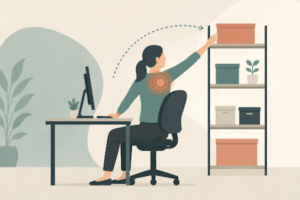
This is probably the single most common source of avoidable upper limb and shoulder strain in both office and industrial settings. The item is slightly too far. The worker reaches rather than repositioning. The shoulder elevates, the trunk rotates, the reach happens, and nothing dramatic occurs. Then it happens again. And again.
A worker retrieving items from a shelf positioned just outside comfortable reach does this dozens or hundreds of times per shift. The cumulative rotator cuff load from that pattern across a working week is significant. The fix isn’t complicated. Move the shelf. Or move closer before reaching. Neither requires equipment.
Gripping Harder Than Necessary
Most people apply more grip force than tasks actually require. It’s partly habit, partly the body’s response to uncertainty about whether the grip is secure. In tool use, keyboard work, and manual handling, excess grip force loads the forearm flexors continuously. Those muscles fatigue. The tendons they attach to get irritated. What follows is the kind of forearm and wrist complaint that gets attributed to overuse when it’s actually a force management problem.
Ergonomic training that includes grip awareness, specifically helping workers feel the difference between sufficient grip and excessive grip, reduces forearm load without changing a single piece of equipment.
Static Positions Held Slightly Too Long
The problem with static posture isn’t the posture. It’s the duration. A neutral seated position held for four uninterrupted hours loads the lumbar discs, fatigues the postural muscles, and produces the kind of lower back stiffness that workers assume is inevitable. It isn’t.
The research on this is consistent. Brief postural changes every twenty to thirty minutes reduce cumulative spinal loading more effectively than occasional longer breaks. Standing for two minutes, shifting weight, reaching overhead briefly, walking to a colleague rather than sending a message. None of these are significant interruptions to the work. Together they change what the spine is managing across a shift.
Twisting Under Load
In industrial and physical roles, twisting through the trunk while carrying or lifting is one of the more reliable injury mechanisms in any workplace. It’s also one of the most habitual. The load is there, the destination is at an angle, and the body rotates to bridge the gap rather than the feet repositioning to face the direction of travel.
Pivoting feet instead of twisting trunk is a workflow change, not an equipment change. It requires no budget approval. It requires awareness and repetition until the pattern replaces the old one.
How Does Ergonomic Training Help Workers Actually Change These Habits?
Telling someone to stop twisting under load doesn’t change the behaviour. The twist happens automatically, below the level of conscious attention, which is exactly why it keeps happening after every safety briefing that mentions it.
Effective ergonomic training works differently. It creates enough body awareness that the worker starts noticing the habit in real time rather than in retrospect. That noticing is the gap where change becomes possible.
Practically, this means training that includes:
Actual task observation rather than classroom instruction only. Workers need to see their own patterns, not a generic example of someone else’s.
Specific feedback on the tasks generating the highest load, not general guidance about posture.
Simple replacement behaviours that are easier to perform than the old habit, not harder. If the correction requires more effort than the original pattern, it won’t stick.
Follow-up. A single training session changes behaviour for about two weeks. Periodic reinforcement is what produces lasting shift.
The ergonomics principle underneath all of this is straightforward. Physical load is cumulative. Reducing it doesn’t require dramatic intervention. It requires consistent small reductions across the tasks that generate the most exposure.
What Workflow Changes Make the Biggest Difference in Office Settings?
A few that consistently come up in assessments across Ottawa, Toronto, and Gatineau workplaces:
Moving the mouse closer. Most office workers have their mouse positioned slightly too far from their body. The shoulder stays marginally elevated throughout the working day to maintain reach. Bringing the mouse to where the elbow naturally rests drops that elevation entirely.
Typing with less force. Keyboards respond to light touch. Most people type like they’re trying to push the letters through the desk. Reducing keystroke force by half doesn’t affect typing speed and cuts forearm flexor load significantly across a day.
Looking away from the screen. Not for rest, for focus distance variation. The ciliary muscles controlling lens shape fatigue under sustained near-focus demand. Every twenty minutes, looking at something across the room for twenty seconds resets that muscular demand. Eye fatigue in the afternoon is often driving the forward lean and neck tension that gets attributed to posture.
Placing frequently used items within the primary reach zone. The primary reach zone is the arc the forearm traces without the upper arm moving from the side of the body. Anything used more than a few times per hour belongs in that zone. Everything outside it costs shoulder and trunk movement every time it’s accessed.
When Does Workflow Change Need to Be Supported by a Formal Assessment?
When the habits are leading to symptoms that aren’t resolving, or when a number of workers in the same role are reporting that same pattern, the changes to be done in the workflow need to be identified with the help of a proper assessment.
An ergonomic risk assessment identifies which specific tasks are generating the highest physical load and what changes, behavioural or environmental, would reduce it most effectively. Injury Prevention Plus conducts assessments across office, industrial, vehicle, and remote environments throughout Ottawa, Gatineau, Toronto, and surrounding regions, carried out by registered healthcare professionals with over 33 years of experience.
For organisations that would like to build these habits in their entire teams, ergonomic training sessions provide a proper way that turns awareness into lasting behaviour change.
Book an assessment to identify exactly where the unnecessary load is sitting in your team’s work, and what it would take to reduce it.
Frequently Asked Questions
Can workflow changes alone reduce ergonomic strain without new equipment?
Yes, and in many cases they produce more significant results than equipment changes. Grip force, reach patterns, posture duration, and movement habits all drive physical load independently of the equipment being used. Ergonomic training that targets these behaviours directly can reduce strain significantly without any capital expenditure.
What is the most common workflow habit driving upper limb strain in office workers?
Reaching for the mouse rather than positioning it within the natural resting arc of the forearm. This keeps the shoulder in a marginally elevated position throughout the working day. Multiplied across thousands of mouse movements per shift, the cumulative rotator cuff load is significant. Moving the mouse closer is the single highest-impact low-cost change in most office ergonomic assessments.
How long does it take for new ergonomic habits to replace old ones?
Research on habit formation suggests consistent repetition over four to eight weeks is typically required for a new movement pattern to become automatic. Ergonomic training that includes follow-up reinforcement at two and four weeks after the initial session produces significantly better long-term behaviour change than a single session alone.
How does ergonomic training differ from a standard workplace safety briefing?
A safety briefing covers rules and hazard awareness. Ergonomic training develops physical awareness of how specific tasks load the body and provides replacement behaviours grounded in that understanding. It’s the difference between telling someone not to twist under load and helping them feel why the twist happens, what it costs, and what a different movement pattern feels like in the context of their actual work.
When should an organisation invest in ergonomic training for a team rather than individual assessments?
When the same strain patterns are appearing across multiple workers in the same role, ergonomic training addresses the shared behavioural and environmental factors more efficiently than individual assessments alone. It’s also appropriate when new employees are onboarded into physically demanding roles, when equipment or processes change, and as part of an annual health and safety program for teams with sustained physical demand.
Need help improving ergonomics in your workplace?
Recent post
 Managing Heat and Comfort in the Workplace 12 Aug 2026