Ergonomic Risk Assessment
Identify hazards, prevent injuries, and optimize performance with precision-driven ergonomic risk assessments for workplaces across Ontario and Québec.
Ergonomists On-Site
WSIB Documentation
NMSO Listed
Provider
OPS Security
Clearance
English & French Services
OHSA
Legislature

Precision-Driven Evaluations for Safer Workspaces
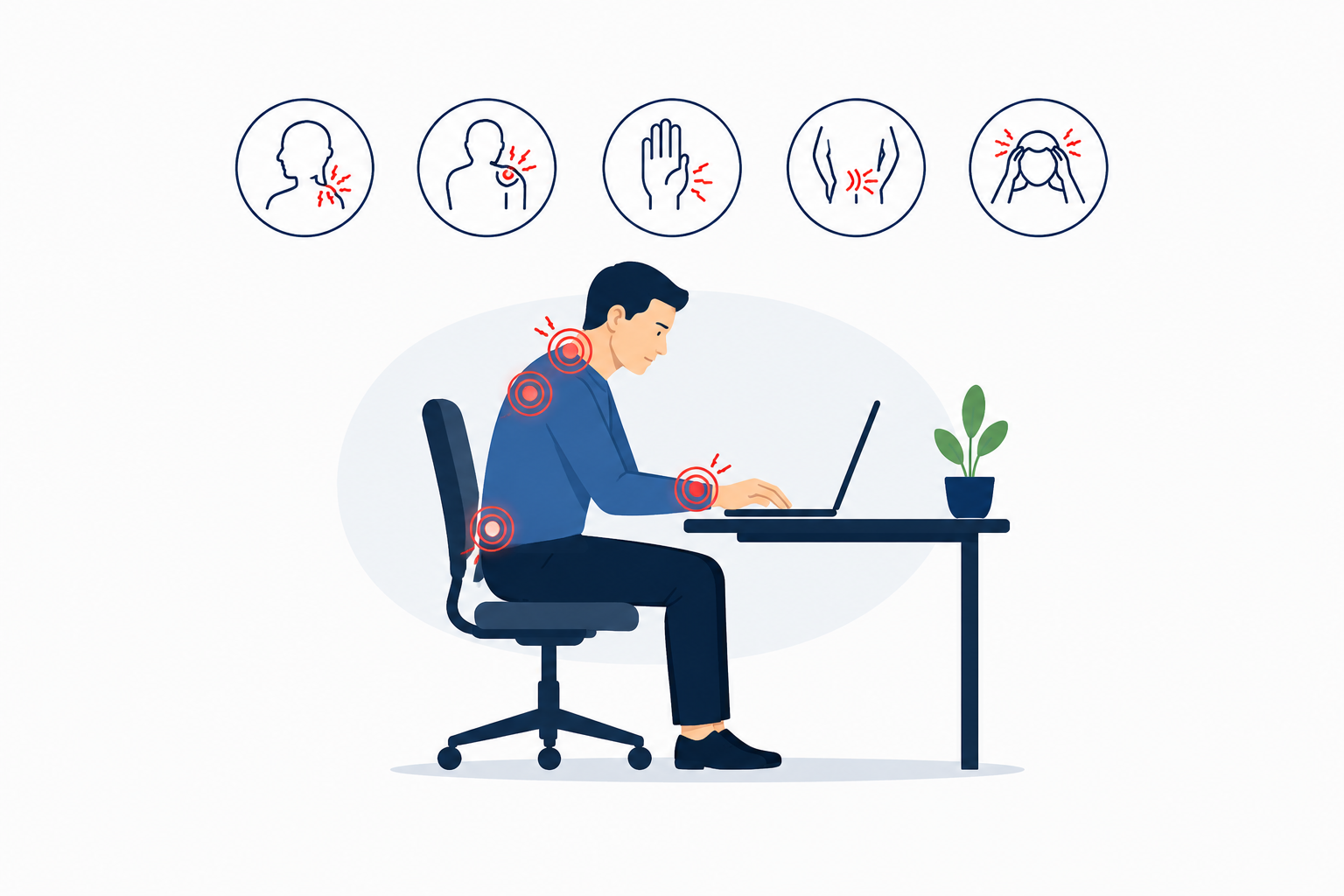
At Injury Prevention Plus, our ergonomic risk assessments are designed to uncover and address the physical stressors that contribute to musculoskeletal disorders (MSDs) in the workplace. Whether you’re managing a manufacturing floor, warehouse, healthcare facility, or office environment, our certified ergonomists deliver on-site, evidence-based evaluations using validated tools and methodologies, helping your organization reduce injury risk, improve productivity, and stay compliant with Ontario’s Occupational Health and Safety Act (OHSA).
Musculoskeletal injuries are one of the leading causes of lost time and workers’ compensation claims in Ontario. A proactive ergonomic risk assessment identifies the hazards driving those injuries before they happen, giving your team the insight and documentation needed to act.
Why ergonomic risk assessments matter
Musculoskeletal disorders (MSDs) are one of the leading causes of lost time and compensation claims in Ontario. Without proactive assessment, organizations face:Preventable lost-time injuries and escalating WSIB costsReduced productivity from worker discomfort and fatigueHigher absenteeism and employee turnoverLegal exposure under Ontario’s Occupational Health and Safety Act (OHSA)Delayed return-to-work without documented ergonomic baselines
What an ergonomic risk assessment evaluates
Each assessment is tailored to your specific environment, workforce, and job demands. Our certified ergonomists evaluate your unique operational workflows and equipment setups to provide practical, high-impact changes. This customized approach ensures we pinpoint the exact root causes of physical strain rather than relying on generic checklists.
Repetitive motion & forceful exertions
Frequency, duration, and force requirements of repetitive tasks that contribute to cumulative strain injuries.
Awkward & sustained postures
Upper and lower body posture analysis during static and dynamic work tasks using validated assessment tools.
Manual material handling
Lifting, pushing, pulling, and carrying demands quantified against accepted safe limits and guidelines.
Workstation layout & reach zones
Physical dimensions and reach envelopes assessed for compatibility with the worker population using the workstation.
Environmental risk factors
Lighting, temperature, vibration, and contact stress evaluated for their contribution to physical fatigue and injury risk.
Tools, equipment & PPE
Ergonomic suitability of hand tools, equipment handles, and personal protective equipment for the tasks being performed.
Validated tools and methodologies we use
We apply industry-recognized ergonomic assessment tools to ensure our findings are thorough, quantified, and defensible.
Our ergonomic risk assessments draw on:
- RULA
Rapid Upper Limb Assessment – evaluates posture risk in upper body and office tasks. - NIOSH & RNLE Lifting Equation
Determines safe lifting limits and assesses manual handling risk, including complex multi-task scenarios.
- Snook Tables
Evaluates acceptable limits for pushing, pulling, carrying, and lifting based on population data.
- Liberty Mutual MMH Equations
Calculates acceptable weight limits for manual material handling tasks..
- Dempsey Liberty Mutual Metabolic Equations
Estimates energy expenditure and task fatigue levels to inform work-rest scheduling.
- HandPak
Analyzes hand-intensive tasks and grip force requirements for upper limb injury prevention.
- LiFFT
Lifting Fatigue Failure Tool – assesses cumulative spinal loading and fatigue risk over time.
- Arm Force Field & Bloswick BCF Model
Evaluates upper limb exertion thresholds and biomechanical compression force in lifting tasks.
These tools allow us to quantify risk, prioritize interventions, and support compliance with Ontario’s Occupational Health and Safety Act (OHSA).
What you receive
Each ergonomic risk assessment produces actionable, immediately applicable deliverables:
Detailed risk assessment report
A comprehensive written report outlining all ergonomic risk factors identified, their severity, and prioritized recommendations for improvement.
High-resolution photos & annotated diagrams
Visual documentation of risk factors and task observations to support internal training, management review, and WSIB submissions.
Practical, low-cost recommendations
Prioritized improvement recommendations ranging from immediate low-cost adjustments to longer-term engineering or process changes.
On-the-spot coaching
Real-time guidance on posture, lifting technique, and workstation setup delivered during the assessment session.
OHSA & WSIB Legislature support
Documentation suitable for WSIB claim management, modified duty planning, and demonstrating OHSA due diligence.
Optional follow-up support
Implementation support, progress reviews, and accommodation planning available as an optional add-on following the assessment.
How ergonomic risk assessments support your organization
Proactive risk assessments help:
Injury prevention
Prevent musculoskeletal injuries before they occur
Workforce Retention
Reduce absenteeism and improve employee retention
Reintegration Planning
Support return-to-work and modified duty planning
Regulatory Compliance
Demonstrate OHSA Legislature and due diligence
Performance Optimization
Boost workforce morale, comfort, and productivity
What makes our approach different:
Quantifiable Methodologies
Validated, quantified methodologies, not just observation
Customized Industry Solutions
Tailored to your specific industry, tasks, and workforce
Dual Environment Expertise
Delivered by certified ergonomists with industrial and office expertise
Stakeholder Ready Reporting
Reports formatted for HR, WSIB, legal, and management use
Bilingual Regional Coverage
Available in English and French across Ontario and Québec
OHSA Legislature and ergonomic risk in Ontario
Under Ontario’s Occupational Health and Safety Act (OHSA), employers have a statutory duty to take every precaution reasonable to protect the health and safety of workers, including addressing hidden ergonomic hazards.An ergonomic risk assessment conducted by a certified ergonomist provides the documented, objective evidence that an employer has actively identified, evaluated, and mitigated risk factors in the workplace. In the event of a Ministry of Labour inspection or a workplace injury dispute, these professional reports serve as a critical element of demonstrating legal due diligence. By proactively intervening before injuries occur, organizations robustly shield themselves from regulatory penalties, costly inspector orders, and long-term financial liability.
Industries we serve

Employers reducing injury claims
Health & safety coordinators
HR & return-to-work teams

Union representatives
WSIB & insurance case managers

Workers in high-risk roles
Ergonomic risk assessment service areas
We proudly deliver ergonomic risk assessments across Ontario and Québec, with on-site expertise available at your facility. Our certified ergonomists serve:
Ottawa
Serving government agencies, healthcare facilities, and hybrid workplaces across the capital region.
Toronto
Supporting logistics, healthcare, corporate, and manufacturing teams throughout the GTA.
Oakville
Helping growing businesses, logistics hubs, and regional employers optimize workplace safety in the Halton and Peel regions.
Hamilton
Partnering with industrial, transportation, and municipal employers to reduce injury risk on the shop floor and beyond.
Mississauga
Helping growing businesses, logistics hubs, and regional employers optimize workplace safety in the Halton and Peel regions.
Gatineau
Providing fully bilingual ergonomic risk assessment services for federal agencies and private sector clients across the Outaouais region.
Frequently Asked Questions
What is an ergonomic risk assessment?
An ergonomic risk assessment is a systematic, on-site evaluation conducted by an ergonomist to identify physical workplace hazards, such as repetitive motion, awkward postures, manual material handling, and contact stress, that contribute to musculoskeletal disorders (MSDs).
What is the difference between an ergonomic risk assessment and an ergonomic assessment?
An ergonomic risk assessment focuses on identifying and quantifying hazards across a job, task, or work area, typically used to evaluate groups of workers or specific high-risk tasks. An ergonomic assessment is a one-on-one evaluation of an individual worker’s setup, posture, and discomfort.
Which industries benefit most from ergonomic risk assessments?
Ergonomic risk assessments are particularly valuable in manufacturing, warehousing, logistics, healthcare, construction, and municipal services. Office and hybrid environments also benefit, especially during workstation redesign or workforce expansion.
What tools do you use to conduct an ergonomic risk assessment?
Injury Prevention Plus uses validated ergonomic assessment tools, including RULA, the NIOSH and Revised NIOSH Lifting Equations, Snook Tables, Liberty Mutual MMH Equations, HandPak, LiFFT, the Arm Force Field Worksheet, and the Bloswick BCF Model.
Is an ergonomic risk assessment required under Ontario's OHSA?
OHSA requires employers to take every reasonable precaution to protect workers’ health and safety, including identifying and addressing ergonomic hazards. Conducting an ergonomic risk assessment is the best practice for demonstrating OHSA due diligence, and is important when workers have reported MSDs, or there are high-risk tasks.
How does an ergonomic risk assessment support WSIB claims and return-to-work planning?
An ergonomic risk assessment produces objective, documented evidence of the physical demands and hazards present in a job or work area. This documentation is used by WSIB adjudicators, case managers, and healthcare providers to inform claim decisions, modified duty planning, and accommodation strategies.
Can ergonomic risk assessments be conducted across multiple sites or departments?
Yes. Injury Prevention Plus can conduct ergonomic risk assessments across multiple facilities, departments, or job classifications. Multi-site programs can be scheduled and may include consolidated reporting with cross-site risk comparisons and intervention recommendations
Are ergonomic risk assessments available in French?
Yes. Injury Prevention Plus provides fully bilingual ergonomic risk assessment services in English and French, with particular strength serving francophone organizations in Gatineau, Québec, and across the National Capital Region.
Ready to book an ergonomic risk assessment?
Let’s create a safer, more productive workplace — one assessment at a time.
Serving Toronto, Ottawa, Hamilton, Mississauga, Oakville, Gatineau & beyond