Our registered ergonomists are ready to help. Call us at (613) 730-1074 or book a consultation today.
How Ergonomic Risk Assessment Helps Reduce Musculoskeletal Risk in Education Settings
Aug 13
Introduction
Teaching kindergarten to grade three doesn’t look physically demanding from the outside. There’s no heavy equipment, no loading dock, no obvious industrial hazard. What there is, is a working day spent almost entirely in positions the adult body wasn’t built to sustain for six hours straight.
Getting down to a five-year-old’s level to read with them. Crouching beside a desk to help a child with their pencil grip. Sitting on a chair that was sized for a seven-year-old. Kneeling on a hard floor during carpet time. Reaching across a low table to point at a worksheet. Lifting a child who has fallen, or who needs repositioning, or who simply needs to be carried from one spot to another because they’re tired and three years old.
None of these look like injury mechanisms. Over a school year, repeated across every working day, they produce exactly that. The lower back that gets progressively harder to ignore by Friday. The knee that’s fine in summer and swollen by November. The hip that started aching sometime in October and hasn’t really stopped.
Ergonomic risk assessment in K-3 education settings identifies these conditions before they reach that point. That identification matters more than most school administrators realise until the absence data starts telling a story.
Why Do K-3 Educators Have Such High Rates of Musculoskeletal Injury?
Because the entire physical environment is built for someone roughly a third of their height, and they spend the day working inside it.
Everything in a kindergarten or primary classroom is scaled to children. The tables are low. The chairs are small. The storage is at floor level. The carpet area where group instruction happens puts the teacher either on their knees, cross-legged on the floor, or crouching in a way that loads the hips and lumbar spine for however long the session runs.
A grade one teacher might spend two to three hours of their day in floor-based or low-level positions. That’s not an estimate. That’s what structured observation during an ergonomic risk assessment consistently surfaces in early primary classrooms. Two to three hours of sustained posture at a height the body can manage briefly but not repeatedly across a thirty-week school year without consequence.
Add to that the student handling component. K-3 educators lift children. Not occasionally, routinely. A child who is upset and needs to be moved. A student with developmental delays who needs physical repositioning. A kindergartener who has fallen asleep on the carpet. These lifts happen in awkward positions, in confined spaces, without mechanical assist, and without the formal manual handling training that healthcare workers performing equivalent tasks would receive.
The cumulative physical load on a K-3 educator across a full school year is significant. It rarely gets assessed as such.

What Does Ergonomic Risk Assessment Look at in a K-3 Classroom?
The assessment looks at what the teacher is actually doing, not what the timetable says they’re doing.
Floor-level and low-level posture exposure. How much time is spent kneeling, crouching, or sitting at child height. Which specific activities require these positions. Whether the floor surface, the duration, and the frequency of transitions in and out of these positions fall within safe limits or exceed them.
Student interaction postures. How the teacher bends to assist students at desks and tables. Whether repeated forward flexion from standing height is the default pattern for most desk interactions. What that pattern is doing to the lumbar spine across a five-day week of continuous exposure.
Student handling demands. What lifting and repositioning tasks occur, how frequently, at what heights, and in what postures. Whether any mechanical assists are available, and whether the physical demands of the handling tasks exceed what the teacher’s body can absorb safely across a full term.
Classroom layout and furniture. Whether storage is positioned to require repeated floor-level reaching. Whether the teacher’s own workstation, where one exists, is configured for an adult rather than a child. Whether the carpet area, the reading corner, and the small-group instruction zones are arranged in ways that reduce or compound the postural demands on the educator working in them.
Standing exposure. How long the teacher stands during instruction, on what surface, and in what footwear. Hard classroom floors without anti-fatigue matting are a consistent finding in Healthcare Ergonomics Toronto and Healthcare Ergonomics Ottawa assessment work in early education, and the lower limb and lumbar fatigue they produce across a standing-heavy teaching day is entirely preventable.
What Does the Physical Layout of a K-3 Classroom Do to the Teacher's Body?
The physical layout helps a lot more than most people consider when they’re designing or furnishing a learning space.
Display boards put at child eye level need the teacher to crouch or bend to interact with them during instruction. Storage at floor level means bending forward every time materials are retrieved, which in an active K-3 classroom happens repeatedly across a day. Small-group instruction tables that work perfectly for six-year-olds put the adult supervising them either perched on a child’s chair or leaning forward from standing for the duration of the session.
The teacher’s body adapts to the space because the space doesn’t adapt to the teacher. That adaptation is the injury mechanism. Not a single dramatic event, but the accumulated physical cost of a working environment that was designed entirely around someone else’s dimensions.
An ergonomic risk assessment in a K-3 classroom looks at this layout directly. Moving a storage unit from floor level to waist height. Providing a height-adjustable chair for small-group instruction. Repositioning the carpet area so the teacher can lead floor-based sessions from a low stool rather than kneeling. These are environmental changes that reduce physical demand more significantly than any individual habit adjustment could.
What Practical Changes Actually Help K-3 Educators?
The changes that help are the ones that fit into how a primary classroom actually runs. A teacher managing twenty-five five-year-olds cannot stop mid-lesson to worry about posture. The changes need to be built into the environment and the equipment.
A height-adjustable chair or stool for small-group and carpet instruction. A low stool that allows the teacher to sit at child level without kneeling or crouching changes the postural demand of floor-based and small-group work. It’s inexpensive, and it’s not present in most K-3 classrooms.
Kneeling pads positioned where the floor work happens. Not in a storage cupboard. On the carpet, at the reading corner, wherever the teacher is regularly on their knees. Available and in place before the session starts.
Anti-fatigue matting at the teacher’s primary standing position. Most K-3 teachers have a spot they return to repeatedly during whole-class instruction. A mat at that position reduces lower limb and lumbar fatigue across a standing-heavy day without requiring any change in how the lesson is delivered.
Storage repositioned to waist height where possible. Reducing the number of floor-level reaches required to access frequently used materials across a day reduces cumulative lumbar loading in a way that’s simple, immediate, and costs nothing beyond some reorganisation.
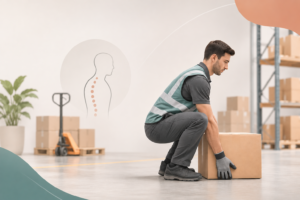
Manual handling guidance specific to child lifts. K-3 educators lift children in ways that healthcare workers would receive formal training for. To prevent musculoskeletal injuries from these tasks, the same principles that Healthcare Ergonomics Toronto and Healthcare Ergonomics Ottawa assessments apply to patient handling need to reach primary classrooms. Lift height, body positioning, frequency limits, and when to ask for help rather than managing alone.
When Should Schools Commission an Ergonomic Risk Assessment for K-3 Staff?
Before the absence data makes it obvious that something is wrong.
Schools that engage with ergonomic risk assessment reactively, after injury patterns are already visible in leave records or formal claims, are addressing conditions that have been present for months or years. The teachers most affected have typically been managing discomfort without reporting it because discomfort in early education tends to get normalised as part of the job.
It isn’t part of the job. It’s a product of conditions that an assessment identifies and addresses.
The most effective starting point is a baseline assessment of K-3 classrooms and the specific roles within them, before the school year builds momentum and the pattern of demand becomes entrenched for another term. To prevent musculoskeletal injuries from accumulating across a full school year, the assessment needs to happen before the year is already underway.
Injury Prevention Plus conducts ergonomic risk assessments across education, healthcare, office, industrial, and field environments throughout Ottawa, Gatineau, Toronto, and surrounding regions. Every assessment is carried out by registered healthcare professionals with over 33 years of applied experience.
Book an assessment to identify what your K-3 classrooms are physically asking of your educators, and what it would take to make that sustainable across a full school year.
Frequently Asked Questions
Why are K-3 educators at higher musculoskeletal injury risk than teachers in other grades?
K-3 educators spend a significantly higher proportion of their working day in floor-based and low-level positions than teachers in higher grades. The physical environment is scaled entirely to children, which means the adult working in it spends the day adapting their body to surfaces, furniture, and storage that were never designed for someone their size. Combined with routine child lifting tasks that lack the mechanical assist access and formal training provided in healthcare settings, the cumulative physical demand on a K-3 educator across a school year is considerably higher than it appears.
What specific postures drive the most musculoskeletal risk in K-3 teaching?
Repeated forward bending from standing height to assist students at desks and tables, sustained kneeling and crouching during carpet and floor-based activities, and asymmetrical child lifts in confined or awkward positions are the three posture patterns that consistently generate the highest cumulative load in K-3 ergonomic risk assessment findings. Duration and frequency of exposure matter as much as the posture itself.
How does ergonomic risk assessment for K-3 educators differ from a standard office assessment?
A standard office assessment evaluates a fixed workstation. A K-3 classroom assessment evaluates a constantly changing physical environment where the educator moves between standing instruction, floor-level activity, small-group work, and student handling tasks across the day. The assessment tools and the risk factors being evaluated are substantially different, drawing more from healthcare ergonomics methodology than standard office assessment practice.
Can simple classroom changes prevent musculoskeletal injuries without a full ergonomic overhaul?
Yes, and this is one of the more consistent findings in education ergonomic assessment work. A height-adjustable stool for floor-based instruction, kneeling pads positioned where they’re actually needed, anti-fatigue matting at primary standing positions, and storage repositioned to waist height collectively reduce physical demand significantly without requiring major capital expenditure or changes to how the classroom runs.
How do Healthcare Ergonomics Toronto and Ottawa assessment approaches apply to K-3 education settings?
The student handling tasks performed by K-3 educators, particularly in classrooms that include children with developmental delays or physical support needs, carry a risk profile comparable to patient handling in healthcare. Healthcare ergonomics assessment methodology, which evaluates transfer and repositioning tasks against established safe load limits and assesses mechanical assist availability and use, applies directly to these tasks in education settings. Injury Prevention Plus draws on this methodology when assessing education support and classroom teacher roles involving regular student handling.