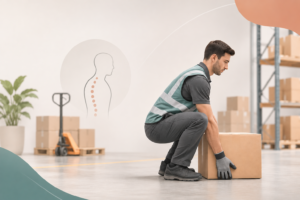
A thorough ergonomic risk assessment evaluates not just workstation configuration but the full pattern of postural exposure across a shift, including how often posture changes, which positions are sustained, and whether the work design allows for adequate recovery between high-load demands. Recommendations address both the physical setup and the task structure, producing changes that reduce cumulative spinal loading rather than simply improving static posture.
Ergonomic Risk Assessment: Why Movement Matters More Than Posture
May 28
Introduction
The advice to sit up straight is not bad advice. It is incomplete advice, and it’s exactly what a proper ergonomic risk assessment is designed to address. Posture matters, but it is not the full problem with prolonged sitting. The problem is static positioning. Holding any position, however correct, for hours at a time is what the body cannot sustain.
The spine is a dynamic structure. It’s built to move, to load and unload, to undergo through positions across a day. It is not made to sustain a single position for hours at a stretch. When movement stops, disc nutrition suffers, and the conditions to develop musculoskeletal injury begin.
Why movement matters starts with understanding what happens inside the spine when it doesn’t get enough of it.
What Is Intradiscal Pressure and Why Does It Matter For Injury Prevention?
Understanding intradiscal pressure is foundational to any ergonomic risk assessment. Intradiscal pressure is the pressure found inside the spinal discs located between each vertebra. These fluid-filled discs absorb impact and support movement. Unlike most tissues, they do not have a direct blood supply and instead depend on movement to circulate nutrients and remove waste.
What Happens When Movement Stops?
When the spine stays in one position for too long, that exchange slows. The consequences are:
- The disc gradually loses hydration and resilience
- Its capacity to absorb load decreases
- Surrounding tissues begin to fatigue under static demand
- The cumulative effect builds across days, weeks, and months before it registers as pain
This is the underlying mechanism behind many chronic spinal complaints in office workers, drivers, and anyone whose work involves sustained static posture. The injury doesn’t come from a single damaging event. It comes from discs that have been under sustained load without adequate recovery.
Ergonomic risk assessment that accounts for movement, not just posture, addresses this at the source.
Sitting vs Standing: What Does Intradiscal Pressure Actually Look Like?
Foundational studies on intradiscal pressure can be traced back to the work of Alf Nachemson, a Swedish orthopaedic surgeon who began measuring lumbar disc pressure in different positions during the 1960s. The findings established something that ergonomists still work from today.
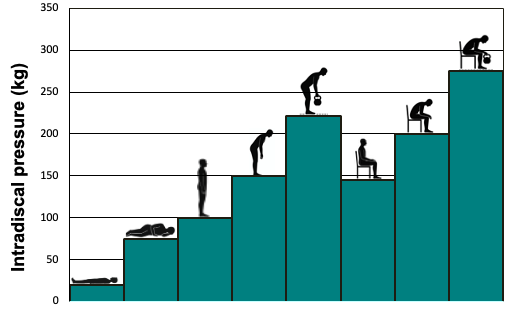
The Pressure Hierarchy by Posture
- Lying down produces the lowest intradiscal pressure
- Standing upright increases it moderately
- Sitting unsupported increases it further, roughly 40% higher than standing
- Forward bending while seated pushes it considerably higher still
- Lifting with a rounded back produces the highest recorded values
What this means practically is that a worker who spends a full day seated, even in a well-configured chair, is sustaining elevated lumbar disc pressure throughout that time. The chair reduces postural stress, but it doesn’t eliminate spinal loading completely.
The Sit-Stand Desk Question
Sit-stand desks work when used right as we know that standing all day is just the opposite static posture to sitting all day. Research points to alternating every 30 minutes as the effective pattern. Standing for a full day is not a solution to sitting for a full day. What the spine needs is variation, not a different static posture.
How Does Forward Bending Increase Intradiscal Pressure?
Spinal flexion, or forward bending, increases intradiscal pressure far more than normal upright sitting or standing positions. Nachemson’s data showed that forward flexion while seated could drive lumbar disc pressure to levels well above standing, particularly when combined with load.
Why This Shows Up So Consistently in Workplaces
Forward bending is not an unusual posture. It’s a routine one for most workers:
- Leaning toward a screen positioned too low
- Reaching across a desk surface that’s too wide
- Looking down at a phone or document for extended periods
- Bending to handle materials at floor level without engaging the hips
In isolation, none of these is a problem. The issue is frequency and duration. A worker accumulating several hours of spinal flexion daily, because their screen is poorly positioned or their task requires repeated forward reach, is loading their lumbar discs in ways that correct chair adjustment alone cannot offset.
What Ergonomic Assessment Does With This Information
This is precisely why an ergonomic risk assessment evaluates task demands and workstation configuration together. Forward bending that is brief, varied, and followed by postural recovery is tolerable. Forward bending held for prolonged periods, or repeated hundreds of times across a shift, is a reliable pathway to lumbar disc injury.
What Does a Disc Pressure Chart Tell Ergonomists?
A disc pressure chart plots the relative intradiscal pressure values associated with different postures and activities. Ergonomists use these as a reference point when evaluating workstation design, task demands, and postural exposure.
How to Read the Chart in a Practical Context
The chart tells a consistent story across the research:
- Postures combining spinal flexion with load produce the highest pressure values
- Postures maintaining the lumbar curve, seated or standing, produce lower values
- The position with the lowest disc pressure remains lying supine
What the chart doesn’t capture on its own is duration and frequency. A posture sitting at a moderate pressure level becomes high-risk when held continuously for several hours or repeated thousands of times across a working week.
Where Assessment Tools Come In
In a formal ergonomic risk assessment, tools like RULA, REBA, and the LiFFT method translate posture and load data into risk ratings that account for both the magnitude of the demand and how often and how long it occurs. The disc pressure chart informs those tools. It doesn’t replace them.
What Role Does Lumbar Spine Pressure Play in Workplace Injury?
Sustained loading of the lower lumbar discs at L4-L5 and L5-S1 sits at the centre of most work-related back injuries. These two levels carry the greatest spinal load in both sitting and standing postures and are the most common sites of disc injury and degeneration in working populations.
The Three Patterns That Drive Lumbar Injury
The lumbar spine handles dynamic loading well when demands are varied and recovery is built in. The problem is work that eliminates variation:
- Repetitive floor-level lifting in warehouse environments, where the same flexion-load pattern repeats across an entire shift
- Sustained vibration in vehicle operation, where lumbar compression builds continuously without postural relief
- Fixed seated posture in office work, where the same spinal position is held from morning through mid-afternoon without meaningful interruption
All three accumulate lumbar spine pressure beyond what the disc can safely absorb without recovery. An ergonomic risk assessment in each environment identifies the specific demand pattern and what changes would reduce cumulative loading to manageable limits.
For workers and employers across Ottawa, Toronto, Gatineau, and surrounding regions, Injury Prevention Plus conducts assessments that look specifically at these loading patterns across office, industrial, vehicle, and remote environments.
How Does Movement Break the Injury Cycle?
Movement does several things simultaneously that static posture cannot. It’s not a wellness recommendation. It’s a biomechanical one.
What Regular Movement Actually Does to the Spine
- Drives fluid exchange in the intervertebral discs, maintaining hydration and nutrient delivery
- Varies load distribution across spinal structures, preventing any single tissue from accumulating stress continuously
- Activates stabilising muscles, reducing passive load on discs and ligaments
- Interrupts postural fatigue, which causes workers to drift into progressively worse positions as a shift progresses
How Much Movement Is Enough?
The movement does not need to be significant. Standing briefly, walking to a printer, shifting posture, or repositioning in a chair all produce enough variation to interrupt static loading.
What matters is frequency. A two-minute walk every 90 minutes produces far less benefit than brief postural changes every 20 to 30 minutes. The disc responds to regular variation, not infrequent large breaks. This is the practical case for movement reminders, activity-permissive workstation design, and task rotation in physically demanding roles.
Ergonomic Risk Assessment in Ottawa, Toronto, and the GTA: How Movement Gets Built Into Recommendations
A well-conducted ergonomic risk assessment doesn’t just evaluate whether a workstation is configured correctly. It looks at how work is actually performed across a shift, which postures are sustained, how often transitions occur, and whether the work design allows for the movement frequency the spine needs.
How This Looks Across Different Work Environments
- Office workers in Ottawa and Toronto may receive sit-stand desk protocols with specific timing guidance rather than a general suggestion to use the desk more
- Industrial workers in manufacturing and distribution environments across the GTA may see task rotation schedules restructured to reduce cumulative lumbar loading on any one worker
- Fleet drivers operating across Gatineau and Eastern Ontario may have scheduled movement breaks built into route planning as a formal operational recommendation
The Role of Physical Demands Analysis
The physical demands analysis component of an assessment captures exactly this kind of exposure data. It documents not just what a role requires physically, but how those demands are distributed across a workday and where loading patterns exceed what the body can absorb without adequate recovery.
Injury Prevention Plus conducts assessments across office, industrial, vehicle, and remote environments for workers and employers in Ottawa, Toronto, Gatineau, and surrounding regions, looking specifically at these loading patterns.
Book an assessment to understand what your workday is asking of your spine, and what it would take to make that sustainable.
Frequently Asked Questions
What is intradiscal pressure and how does it relate to workplace injury?
Intradiscal pressure is the internal pressure within the intervertebral discs of the spine. It varies with posture and movement, increasing with sitting, forward bending, and load, and decreasing with movement and postural change. Sustained elevated intradiscal pressure in the lumbar spine is a key mechanism behind disc degeneration and many common work-related back injuries. Ergonomic assessment uses this understanding to evaluate workstation design and task demands.
Does sitting increase lumbar spine pressure more than standing?
Yes. Unsupported sitting increases lumbar intradiscal pressure by roughly 40% compared to standing, based on Nachemson’s research and subsequent studies. Supported sitting reduces this somewhat but does not eliminate the loading. Alternating between sitting and standing regularly produces lower cumulative spinal loading than either posture sustained for extended periods.
How much does forward bending increase disc pressure?
Forward spinal flexion significantly increases intradiscal pressure beyond both upright sitting and standing. The increase is most pronounced when flexion is combined with load, such as lifting with a rounded back. Repeated or sustained forward bending without postural recovery is one of the more reliable injury mechanisms in both office and industrial work environments. This is one reason ergonomic risk assessment looks specifically at the frequency and duration of forward bending tasks.
How often should workers change posture to protect spinal health?
Research suggests postural variation every 20 to 30 minutes is more effective at reducing cumulative spinal loading than infrequent longer breaks. Brief movement, standing, walking, or deliberate repositioning, interrupts static disc loading and supports the fluid exchange process that keeps discs hydrated and resilient. Frequency matters more than the duration of each movement.