
Our registered ergonomists are ready to help. Call us at (613) 730-1074 or book a consultation today.
The Benefits of Proactive Ergonomic Assessments
Jul 14
Introduction
Organizations that book an ergonomic assessment after someone gets hurt aren’t doing anything wrong. They’re just doing it late.
By the time a formal complaint is filed or an injury gets documented, the physical conditions that caused it have usually been present for months. The workstation that needed adjusting. The task that was loading the lower back several hundred times a shift. The home setup that was meant to be temporary and became permanent. None of it was invisible. It just wasn’t looked at.
That’s what separates proactive ergonomic assessment from reactive. Not the process. The timing. And timing, in this context, determines whether the assessment prevents a problem or responds to one that’s already done its damage.
What Does Getting Ahead of Ergonomic Risk Actually Look Like in Practice?
Proactive ergonomic assessment means evaluating physical demand before the worker reports discomfort, before the injury occurs, and before the organisation is in damage-control mode.
It looks like assessing a new employee’s workstation in their first two weeks rather than six months in. Reviewing a role’s physical demands when the equipment changes rather than after three workers in that role have filed claims. Building ergonomic review into the annual health and safety calendar rather than treating it as something reserved for emergencies.
The assessment itself doesn’t change. What changes is what happens as a result of it. A workstation problem caught in week two is a quick configuration fix. The same problem caught after months of daily exposure is a configuration fix plus a worker already managing established strain. Both get addressed. Only one prevents the injury.
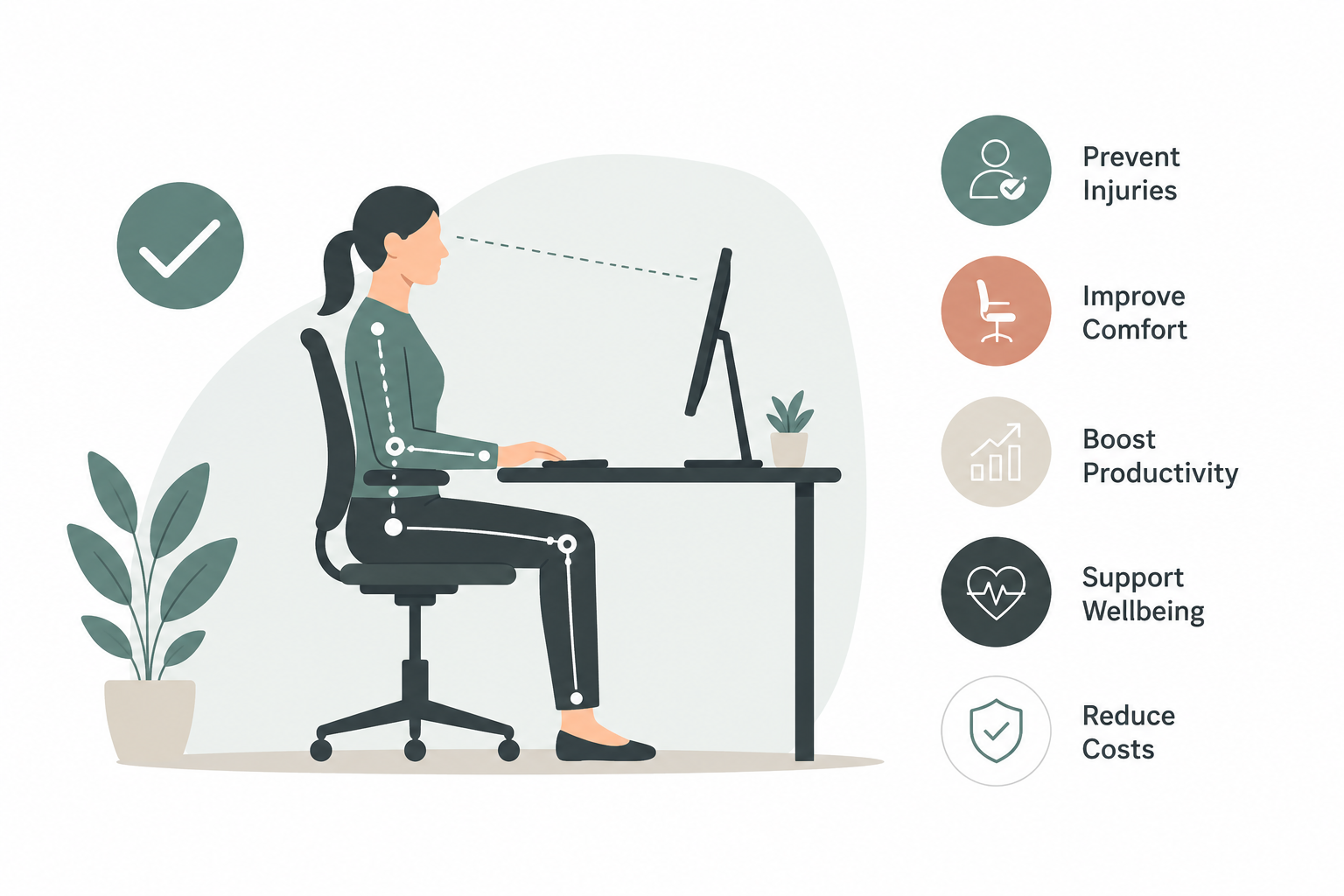
Why Do Early Interventions Produce Better Physical Outcomes for Workers?
Because the body doesn’t wait. Cumulative loading builds across weeks and months whether or not anyone is paying attention to it.
A worker whose monitor has been sitting too low since their first day has been sustaining neck flexion for however long that situation has been allowed to continue. The neck tension they’re experiencing isn’t a new development. It’s the accumulated result of a problem that an early ergonomic assessment would have identified and resolved before it had anything to accumulate.
This is the part that doesn’t get enough attention. Ergonomic injuries are not events. They are processes. Slow, quiet processes that produce a formal outcome at the end of them. Proactive assessment interrupts the process. Reactive assessment responds to the outcome.
For workers, the difference is tangible:
- Sustained comfort across a full workday rather than managing increasing discomfort through the afternoon
- Better concentration because physical distraction is removed rather than tolerated
- Less time spent in modified duty or physiotherapy because the injury that would have required it didn’t happen
- A working environment that actually fits the person in it, which affects how people feel about their work in ways that are hard to measure but very easy to notice
What Does Proactive Ergonomic Assessment Cost Compared to What It Prevents?
This is where the numbers get straightforward. A single lost-time musculoskeletal injury generates costs across several categories at once. The workers’ compensation claim. The productivity gap while the role is covered or left partially unfilled. Modified duty arrangements if the worker returns before full capacity is restored. Potential accommodation costs if the injury produces lasting limitation. And the less visible cost of a team absorbing additional load while one of its members is out.
None of those costs appear when a proactive ergonomic assessment identifies and fixes the workstation problem before the injury occurs. The assessment has a cost. It is a fraction of what any one of those downstream costs amounts to.
For organisations managing teams across Ottawa, Toronto, Gatineau, and surrounding regions, a structured proactive program produces measurable return within the first year. It shows up in claims data, in absenteeism trends, and in the quieter metric of how many workers are still in the same role two years after joining because the physical demands of the job didn’t drive them out.
When Should a Proactive Ergonomic Assessment Be Built Into the Calendar?
Certain moments are significantly higher value than others for proactive ergonomic assessment. Getting these right is most of what a structured program involves.
When someone new joins. Before compensatory posture habits have had time to form around a poorly configured setup. This is the cleanest intervention point because nothing needs to be undone yet.
When equipment or workstations change: A new chair, a monitor upgrade, a keyboard tray, a software change that shifts how the mouse is used. Equipment changes that look like improvements can introduce new ergonomic problems. Assessment at the point of change catches them immediately.
When work becomes hybrid or remote: Home setups carry ergonomic risks that go unexamined indefinitely without a deliberate process for reviewing them. A virtual ergonomic assessment brings the same standard of evaluation to a worker’s home environment that a workplace assessment would apply in the office.
When roles change: A worker moving into a position with different physical demands is adjusting to a new risk profile. Assessment at that transition catches the mismatch before it becomes a complaint.
As part of an annual review: Work demands rarely stay the same. Tasks change, equipment wears out, and people naturally develop different working habits over time. A yearly ergonomic assessment helps identify these changes before they start affecting worker health.
An experienced ergonomic consultant can identify the roles and work environments that carry the greatest ergonomic risk, helping organisations focus their efforts where they will have the biggest impact.
How Does a Proactive Approach Support Return to Work When Injuries Do Occur?
Proactive ergonomic risk assessment produces something reactive programs almost never generate: documented baseline data about the physical demands of specific roles before anyone is injured.
When a worker does get hurt and needs to return, that documentation becomes directly useful. A physical demands analysis conducted as part of a proactive program gives treating practitioners and return-to-work coordinators an objective record of what the role actually requires. Without it, return-to-work planning relies on estimates. With it, the process is grounded in evidence, which reduces friction and produces better outcomes for the worker.
For Ontario employers, this documentation supports Workplace Safety and Insurance Act requirements while creating a clear record of the organisation’s ergonomic assessments and any changes made to reduce workplace risk.
What Does Proactive Ergonomics Look Like Across Different Work Environments?
Proactive ergonomic assessment delivers value in every workplace, but the focus changes as per the work being performed.
In office settings across Ottawa and Toronto, the assessment helps to identify workstation problems early. Addressing issues such as poor monitor height, chair setup, or keyboard positioning can prevent the neck, shoulder, and lower back discomfort that many desk based workers gradually come to accept.
In industrial and warehouse settings across the GTA, early ergonomic risk assessment identifies the manual handling tasks generating cumulative lumbar loading before that loading produces a lost-time claim.
In healthcare and community care settings, proactive assessment addresses patient handling demands and the postural risks of care work in environments that were rarely designed with the care worker’s body in mind.
In vehicle and field-based roles across Gatineau and Eastern Ontario, a vehicle ergonomic assessment conducted before complaints emerge identifies the seat fit, vibration exposure, and entry and exit mechanics that accumulate into injury across months of daily exposure.
Injury Prevention Plus conducts ergonomic assessments across all of these environments throughout Ottawa, Gatineau, Toronto, and surrounding regions, carried out by registered healthcare professionals with over 33 years of applied experience.
Book an assessment before the next injury makes it urgent.
Frequently Asked Questions
What is the difference between a proactive and a reactive ergonomic assessment?
The process is identical. What differs is the timing. A proactive ergonomic assessment is conducted before discomfort or injury occurs, which means it prevents the clinical outcome rather than responding to it. A reactive assessment addresses a problem that has already produced strain or injury. Both add value, but proactive assessment costs considerably less when the downstream costs of the injury it prevents are factored in.
How often should proactive ergonomic assessments be conducted?
At minimum, when new employees join physically demanding roles, when workstations or equipment change, and once annually as part of a standard health and safety review. Higher risk environments benefit from more frequent review. An ergonomic consultant can advise on appropriate frequency based on the specific demands and injury history of the organisation.
Can proactive ergonomic assessment be conducted virtually for remote workers?
Yes. A virtual ergonomic assessment evaluates the home workstation through a structured video session to the same standard as an in-person office assessment. For organisations managing hybrid or fully remote teams, virtual assessment is the most consistent way to extend proactive review across all workers regardless of location.
Does a proactive ergonomic assessment program reduce workers' compensation costs?
Yes, and the reduction is measurable. Organisations with structured proactive programs consistently report lower musculoskeletal injury rates, fewer lost-time claims, and reduced modified duty requirements. In most cases the cost of the program is recovered through reduced claims and absenteeism within the first year of implementation.
Where should an organisation start if it wants to build a proactive ergonomic assessment program?
Start with a baseline ergonomic risk assessment across the roles and environments carrying the highest physical demand. That assessment identifies where the most significant risks currently sit, which determines how the proactive program should be structured and where early intervention would have the greatest impact.