A follow-up assessment is appropriate when complaints persist or return after recommendations have been implemented. Persistent symptoms sometimes indicate that the implemented changes need refinement, that a different contributing factor wasn’t identified in the first assessment, or that the worker’s physical condition has changed in a way that requires a revised setup. Injury Prevention Plus conducts follow-up assessments and works with treating practitioners where the situation requires a coordinated approach.
Inside an Ergonomic Assessment: What to Expect
Jul 3
Introduction
Most people book an ergonomic assessment not knowing what they’re actually walking into. They expect someone to look at the chair, suggest a few adjustments, and leave within twenty minutes. What actually happens is considerably more involved than that, and considerably more useful.
The process is built around one question: what is this specific person’s work environment asking of their body, and is that demand within safe limits? Everything in the assessment flows from that question. The chair is part of it. So is the monitor, the keyboard, the task pattern, the posture the worker defaults to after three hours, and the physical complaints they may have stopped mentioning because they assumed nothing could be done.
If you’ve never had one, or you’re organising assessments for a team and want to know what to expect, here is how it actually works.
Who Conducts an Ergonomic Assessment and What Qualifies Them?
A registered healthcare professional conducts this assessment. The professional has hands-on training specifically in workspace Ergonomics and a complete understanding of how continuous physical demand affects the body. This person is someone whose entire professional focus is the relationship between work and physical health.
Knowing ergonomic principles is one thing. Applying them in a real workplace is another. Clinically trained professionals can recognise how physical demands build over time and recommend changes based on evidence, not assumptions.
At Injury Prevention Plus, every assessment is conducted by a registered healthcare professional with applied experience across office, industrial, vehicle, and remote work environments.
What Happens When the Assessment Starts?
At the beginning of every ergonomic assessment, the assessor gathers context. This is not a formality. The intake conversation shapes what the assessor pays attention to during the observation itself.
The assessor typically asks about:
The worker’s role and the primary tasks that fill their day
Any current physical complaints, where they are, when they appear, and whether they follow a workday pattern
How long the worker has been in this role and this specific workstation
Any previous injuries or physical conditions that affect how they work
Whether the worker has made any self-directed adjustments to their setup already
That last point is particularly telling. A worker who has already raised their monitor, added a lumbar cushion, or started taking more frequent breaks is showing the assessor exactly where the discomfort has been concentrating. Those adaptations are data.
What Tools Does an Ergonomic Analysis Use to Measure Risk?
An ergonomic analysis doesn’t rely on observation alone. It uses validated measurement tools that translate what’s being observed into quantified risk data.
The tools vary depending on the environment and the type of demand being evaluated:
- RULA and REBA assess posture across the upper and lower body, scoring the risk level of specific positions based on joint angles, load, and duration of exposure.
- The LiFFT method calculates cumulative lumbar compression across a shift, identifying whether manual handling tasks are generating spinal loading that exceeds safe thresholds over time rather than in a single lift.
- Liberty Mutual equations evaluate the acceptable limits for pushing, pulling, lifting, lowering, and carrying tasks based on the specific parameters of how the task is performed.
- The Arm Force Field assesses shoulder and upper limb force demands during overhead and extended-reach tasks.
The combination of tools used depends on the work. An office-based ergonomic assessment draws primarily on postural tools. An industrial assessment draws on the force and load-focused methods. The assessor selects the tools that are appropriate for what the worker is actually doing.
What Comes Out of an Ergonomic Assessment at the End?
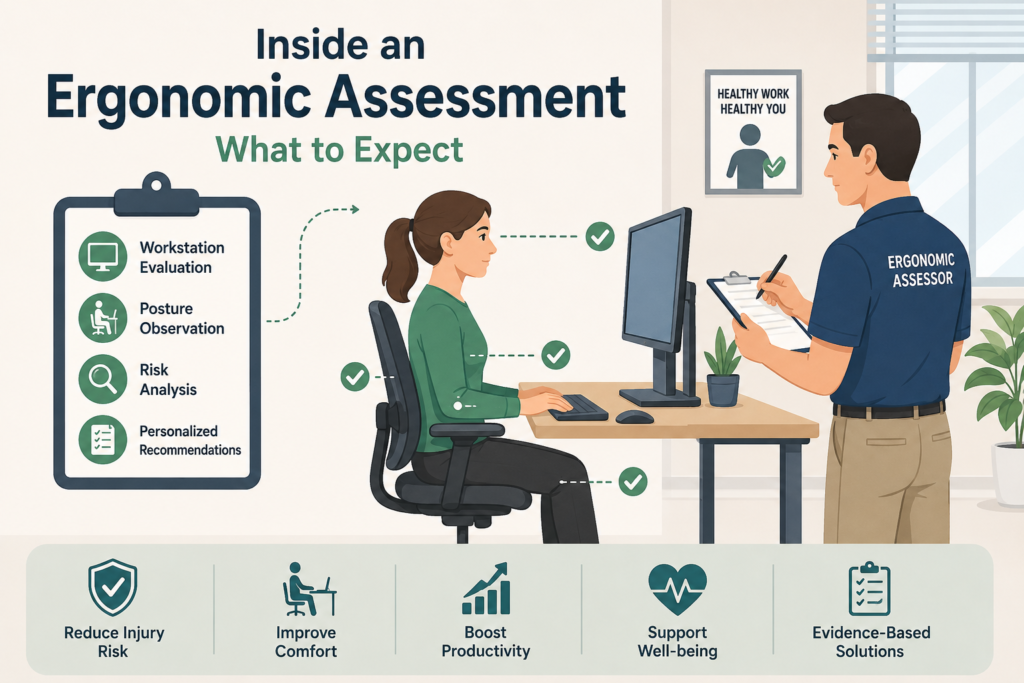
The assessment produces a written report. Not a checklist. A document that explains what was found, why it matters, and what specifically needs to change.
A good report from a qualified ergonomic consultant includes:
- A summary of the worker’s current setup and task demands
- Specific findings identified during the observation and ergonomic analysis
- The risk level associated with each finding, based on the validated tools used
- Concrete recommendations, prioritised by urgency and impact
- Equipment suggestions where relevant, with enough specificity to act on
- Follow-up guidance for situations where reassessment would be appropriate
Every recommendation is based on what the health professional observes during the evaluation. The report explains exactly what needs to change, for example, raising the monitor by 4 cm or moving it closer to improve posture during reading tasks. This helps to remove all the guesswork.
For organisations managing employees across Ottawa, Toronto, Gatineau, and surrounding regions, reports can be made to support return-to-work plans, accommodation requests, HR processes, and WSIB documentation when required.
How Long Does an Ergonomic Assessment Take
The assessment usually runs around 60 minutes, including the intake conversation, observation period, and initial discussion of findings. The written report is shared separately.
Industrial assessments covering multiple tasks or roles take longer, sometimes half or a full day, depending on the scope. Virtual assessments for remote workers are generally comparable in duration to in-person office assessments and follow the same structured process.
Injury Prevention Plus tailors the assessment scope to the specific environment and workforce. Whether the need is a single workstation in a home office or a structured review across a manufacturing floor in the GTA, the process is grounded in what the work actually requires rather than a fixed template applied uniformly.
Book an assessment to get a clear picture of what your setup is currently asking of your body and what a targeted intervention would look like.
Frequently Asked Questions
What should I do to prepare for an ergonomic assessment?
Not much, and that’s deliberate. The assessor wants to see how you actually work, not a prepared version of it. Show up and work as you normally would. If you have specific physical complaints, note where they are and when they tend to appear during the day. That information helps the assessor focus on the right areas during observation.
Will the ergonomic assessment involve any physical testing or measurements?
It depends on the environment and the scope of the assessment. Office assessments primarily involve observation and workstation measurement. Industrial assessments may include task timing, load measurement, and postural analysis using validated tools. A functional capacity evaluation, which assesses an individual worker’s physical capacity against the demands of a role, is a separate and more involved process conducted in specific circumstances, such as return to work following injury.
Can an ergonomic assessment be conducted for an entire team rather than one worker?
Yes. Group or department-level assessments are common in office environments where multiple workers share similar setups, and in industrial settings where several workers perform the same role. The assessor evaluates a representative sample of workstations or tasks and produces findings and recommendations that apply across the group, with individual variation noted where relevant.
How are the recommendations from an ergonomic assessment prioritised?
Recommendations are typically prioritised by the risk level of the finding and the ease of implementation. High-risk findings with straightforward solutions, such as repositioning a monitor or adjusting chair height, are addressed first. Equipment changes or task redesign recommendations that require more coordination are flagged clearly with enough detail to move forward without ambiguity.