Our registered ergonomists are ready to help. Call us at (613) 730-1074 or book a consultation today.
5 Common Non-Office Ergonomic Issues—and How to Fix Them
Apr 18
Introduction
Ergonomics gets a lot of attention in office settings for monitor height, chair support, and keyboard position. But a significant portion of the workforce never sits at a desk. Drivers, warehouse workers, healthcare workers, tradespeople, lab technicians and field staff face a different category of physical demands entirely, and the non-office ergonomic issues they deal with are just as serious, often more so.
The body responds the same way whether strain comes from a poorly adjusted chair or from lifting at an awkward angle for eight hours. Musculoskeletal injuries develop either way. What changes is the environment and the solution.
Here are five of the most common non-office ergonomic issues, why they happen, and what can actually be done about them.

What Makes Non-Office Ergonomic Issues Different from Desk-Based Risks?
Non-office environments introduce physical variables that a controlled office setting doesn’t. Surfaces change. Tasks vary in force and range. Workers may spend hours in vehicles, on their feet, or in confined spaces. The risks are less predictable and often harder to standardize, which is exactly why they need structured attention.
1. What Happens to the Body When Vehicle Seating Isn’t Adjusted Properly?
Professional drivers, whether operating delivery vans, heavy trucks, or fleet vehicles, spend long hours in a fixed seated posture while also managing vibration, awkward reach, and limited movement. This combination is one of the most persistent non-office ergonomic issues in Canadian workplaces.
Drivers may feel symptoms in their back due to the driving position. Whole-body vibration, common in commercial vehicles, can also contribute to whole body vibration symptoms over time. Add a seat that isn’t or can’t be adjusted to the driver, and the problem compounds quickly.
What helps:
Adjust seat height so thighs are roughly parallel to the floor and feet rest flat
Position the steering wheel to allow a slight bend in the elbows, not a full extension
Use lumbar support, either built-in or added, to maintain the natural curve of the lower spine, ensuring the upper back still has contact with the vehicle’s seat. Ie. if an additional lumbar support is too large is will push the user forward and they will no longer have any contact with the seat’s backrest.
If available, use the vehicle’s air ride feature
Take standing breaks every 60–90 minutes where the route and schedule allow
A formal vehicle ergonomic assessment goes beyond seat positioning. It looks at mirror placement, control reach, entry and exit mechanics, and overall driver posture under real working conditions.
2. Why Do Industrial Workers Develop Back Injuries Even When They’re “Lifting Correctly”?
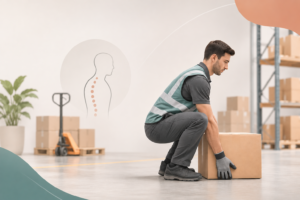
Teaching workers to bend their knees is the standard advice. It’s not wrong, but it’s incomplete. Many industrial back injuries develop not from a single “bad lift” but from repeated exposure to loads that are too heavy, too frequent, or handled at heights that place the spine in a compromised position, regardless of technique.
This is one of the most misunderstood non-office ergonomic issues: the belief that training alone is sufficient protection. Technique matters, but task design matters more.
Cumulative lumbar compression is the cumulative loading of spinal structures over a shift, which is what drives many warehouse and manufacturing injuries. The LiFFT method and Liberty Mutual equations, used during a professional ergonomic risk assessment, can quantify exactly how much compression a task generates and whether it exceeds safe thresholds.
What helps:
Redesign tasks so lifts occur between knee and shoulder height wherever possible
Reduce load weights or introduce mechanical assists (carts, hoists, conveyors)
Rotate workers across tasks to reduce cumulative exposure on any one muscle group
Conduct a physical demands analysis to match job requirements to worker capacity
3. What Are the Ergonomic Risks in Healthcare and Caregiving Work?
Patient handling is consistently ranked among the highest-risk occupations for musculoskeletal injury. Nurses, personal support workers, and home care aides regularly assist with transfers, repositioning, and mobility support, often in spaces not designed for it.
The physical demands are intense: sustained awkward postures, asymmetrical loading, and forceful exertions with minimal mechanical assistance. These non-office ergonomic issues are compounded by time pressure and unpredictable patient conditions.
Prolonged forward bending during patient care, combined with lateral reaching, places significant strain on spinal structures, rotator cuff muscles, amongst other structures in the body.
What helps:
Use mechanical lifts, transfer belts, and slide sheets consistently, not just when available
Adjust bed heights before tasks, not mid-task
Identify high-risk patient handling tasks through an individual industrial ergonomic assessment and implement targeted controls
Make sure training reflects actual working conditions, not idealized scenarios
4. How Do Overhead and Awkward-Posture Tasks Cause Injury in Trades Work?
Electricians, plumbers, HVAC technicians, dry wallers and construction workers frequently work in overhead, crouched, or confined-space positions. Sustained overhead reaching a common non-office ergonomic issues. The shoulder joint operates far outside its strongest range, and fatigue accumulates faster than most workers realize.
Neck strain follows a similar pattern. When the head is tilted back or the chin is pushed forward for extended periods, the cervical spine carries a load it isn’t built to sustain for long.
Tools also contribute. Heavy power tools held at shoulder height or above generate joint torque that, repeated across a shift, leads to rotator cuff stress and elbow strain.
What helps:
Use extension tools and positioning aids to reduce the duration of overhead work
Adjust workstation as much as possible to work in a neutral position
Rotate tasks to give the shoulder and neck time to recover within the same shift
Apply the Arm Force Field (AFF) method during ergonomic evaluations to identify which postures generate the highest force demands and redesign accordingly
Keep tool weight to a minimum; battery-operated tools should be assessed for weight relative to usage frequency
5. What Ergonomic Issues Affect Workers Who Are Constantly on Their Feet?
Retail staff, restaurant workers, assembly line workers, healthcare workers, and tradespeople often spend full shifts standing on hard surfaces. Standing work is frequently treated as inherently safe compared to sedentary desk work. It isn’t prolonged static standing that is its own category of non-office ergonomic issues.
Lower limb fatigue, plantar fasciitis, varicose veins, and lower back discomfort are all associated with extended standing. The problem isn’t standing itself; it’s standing without variation, on hard floors, often in footwear that provides insufficient support.
What helps:
Introduce anti-fatigue matting at fixed standing workstations
Create opportunities for postural change, brief seated tasks, and movement between stations
Where tasks are fixed and repetitive, evaluate whether the workstation height is appropriate for the worker’s build. A surface that’s too low creates forward bending; too high creates shoulder elevation
When Is a Professional Assessment the Right Step?
For any of these non-office ergonomic issues, self-directed fixes can reduce discomfort. But when injuries are recurring, when multiple workers report similar problems, or when task demands are difficult to assess without measurement tools, a professional evaluation provides something informal adjustments can’t: data.
Injury Prevention Plus works across industrial, vehicle, field, and healthcare environments. Assessments are tailored to the actual conditions workers face and not generic checklists. Whether the concern is a fleet of vehicles, a production line, or a physically demanding care environment, the approach stays grounded in evidence and practical application.
Book an assessment with Injury Prevention Plus to identify what is creating strain in the work of your team before it becomes an injury.
.
Conclusion
The freedom to work from anywhere is nice, but the discomfort can creep in if your setup isn’t right. Bad posture and long days tend to cause the same kinds of tension wherever you work.
A virtual ergonomic assessment is a simple way to get ahead of that. It helps you spot what’s not working and gives you practical ideas you can actually use and ideas for a better set-up when needed. Even where in-person support is available, many still prefer the simplicity and convenience of a virtual ergonomic assessment.
Injury Prevention Plus keeps things practical and straightforward. Their goal is to help you build a setup that feels good to work in every day.
Frequently Asked Questions
What are non-office ergonomic issues?
Non-office ergonomic issues refer to musculoskeletal risks and physical strain that arise outside traditional desk-based work environments. They include hazards in industrial, vehicle, healthcare, trades, and retail settings, such as manual handling, vibration exposure, overhead postures, prolonged standing, and etc.
Are non-office ergonomic issues covered under workplace safety regulations in Canada?
Yes. Canadian occupational health and safety legislation, including federal Hazard Prevention Program Regulations, requires employers to identify and address ergonomic hazards regardless of industry. Non-office environments are not exempt, and employers have a duty to assess and control physical demands that could lead to musculoskeletal injuries.
How is an ergonomic assessment different for non-office workers?
Non-office ergonomic assessments focus on task demands, posture variability, force, and environment rather than workstation configuration. Tools like the Liberty Mutual equations, LiFFT method, and Arm Force Field analysis are used to measure physical load and identify risk in manual and industrial work contexts.
Can ergonomic improvements reduce injury claims in industrial or field-based workplaces?
Yes. Addressing non-office ergonomic issues through task redesign, mechanical assists, and targeted training consistently reduces musculoskeletal injury rates. Lower injury frequency translates directly to reduced absenteeism, fewer accommodation costs, and improved worker retention.
What kind of issues can it identify?
Recurring musculoskeletal complaints, high injury rates in specific roles, physically demanding tasks involving lifting, driving, overhead work, or prolonged standing, and upcoming changes to job tasks or equipment are all indicators. A professional ergonomist can review current conditions and identify where intervention would have the greatest impact.