Our registered ergonomists are ready to help. Call us at (613) 730-1074 or book a consultation today.
How Ergonomic Risk Assessment Supports Productivity, Not Just Comfort
Apr 24
Introduction
Ergonomics tends to get filed under comfort. Better chair, lower monitor, less neck pain. It’s not a wrong framing, just an incomplete one.
The real case for ergonomic risk assessment is a business case. When people aren’t fighting their workstation to get through the day, the quality of their work shifts. Not dramatically, not overnight, but it does shift. Fewer mistakes. More consistent output. Less sick leave. These aren’t side effects of good ergonomics; they are the point.
Why Does Ergonomic Risk Assessment Affect Both Output and Physical Comfort?
Chronic discomfort does not stay in the background. A worker managing lower back or shoulder pain through a shift is running two processes at once: the job, and the constant low-level effort of managing how their body feels. That second process doesn’t register on any output report, but it is quietly consuming attention.
An ergonomic risk assessment removes or reduces those physical stressors. What follows isn’t just relief from discomfort. Concentration steadies. Decision-making improves. The kind of fatigue that builds across a full shift and starts showing up in errors by mid-afternoon eases off.
Error rates drop. Tasks get completed faster. Staff stop filing informal complaints about how their neck feels at 3 pm. The environment stops working against the people in it.
How Does Poor Ergonomics Directly Reduce Workplace Productivity?
Poor ergonomics doesn’t always announce itself.
Frequent forward reaching positions held there for prolonged periods over weeks becomes neck and shoulder strain. The worker starts taking more breaks, not by choice, but because staying in a forward-reaching position has stopped being comfortable. Their output slows. Errors creep in toward the end of shifts. They call in sick with increasing frequency. Eventually, what started as mild stiffness becomes a soft tissue injury with formal documentation, time off, and accommodation requirements.
Multiply that across a team and you have a pattern that is difficult to attribute directly to ergonomics, but that is being driven by it nonetheless. Reduced output, higher absenteeism, rising turnover in physically demanding roles, and growing claims costs are all downstream of workstation problems that could have been caught earlier.
Ergonomic risk assessment catches the chain before it runs its course.
What Productivity Gains Can Employers Actually Expect from Ergonomic Risk Assessment?
What employers gain depends on a few variables such as the extent of existing issues, the type of work, and whether recommendations are properly followed through. But the pattern across sectors is consistent enough to say something definite.
Structured ergonomic programs show up in operational numbers. A 2023 Ottawa Police Service report noted that following ergonomic risk assessment and training, proactive interventions increased by 22%, with both injury frequency and severity declining. That’s not a soft finding.
For employers, the return runs through several channels:
Fewer injury-related absences and the replacement or overtime costs that come with them
Reduced workers’ compensation claims and modified duty requirements
Lower staff turnover in roles where physical discomfort drives people out
More consistent output across full shifts, rather than performance that deteriorates as fatigue sets in
For workers, it is more direct. Less pain. Better concentration. Getting to the end of the day without feeling physically depleted.
Does Ergonomic Risk Assessment Help Remote and Hybrid Workers Perform Better Too?
Yes, though it doesn’t always get the attention it should.
In many cases, remote setups are improvised, built around whatever happens to be available rather than what is appropriate. A kitchen chair that was never designed for eight hours of sitting. A laptop on a surface that puts the screen too low. A mouse positioned just far enough to cause a slow, steady strain across the shoulder. These setups get normalised quickly because there is no one flagging them.
A virtual ergonomic assessment looks at the actual conditions someone is working in, posture, screen placement, chair support, reach patterns, and identifies what needs to change. The productivity link is the same as it is in an office: a worker who isn’t managing discomfort has more to give to the work itself.
For organisations running distributed teams, virtual ergonomic risk assessment also provides consistency. Every employee, regardless of where they are sitting, gets evaluated to the same standard. That matters for performance. It also matters for duty-of-care obligations under Canadian occupational health and safety legislation.
How Does Ergonomic Risk Assessment Support Productivity in Industrial and Physical Work Environments?
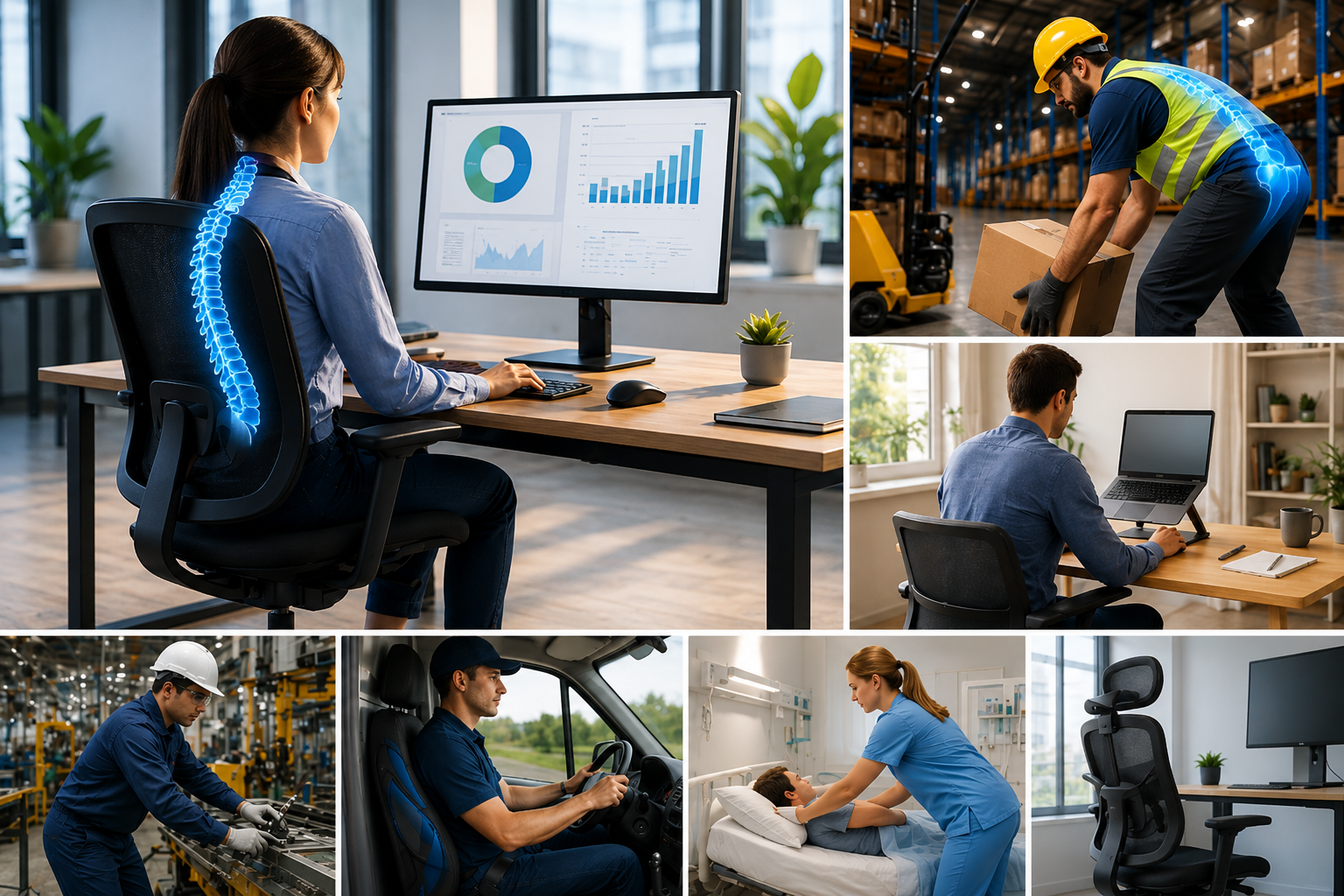
In physically demanding environments such as warehouses, manufacturing floors, trades, ergonomic risk assessment focuses on task design, force demands, posture under load, and work-rest cycles. The risk is rarely a single moment. Workers repeatedly handling loads at floor level accumulate lumbar compression across the entire shift. The body compensates. Movement slows. Rest periods lengthen. The compensations that reduce injury risk also reduce efficiency, and both are happening for the same underlying reason.
Adjusting lift heights, introducing mechanical assists, and rotating workers across stations addresses both problems simultaneously. The change that cuts injury risk also removes the physical bottleneck slowing the work.
Physical demands analyses and industrial ergonomic risk assessment provide the data to make those changes with accuracy rather than approximation.
When Is the Right Time to Book an Ergonomic Assessment?
Earlier than most organisations do. Ergonomic risk assessment most often gets booked after something has already gone wrong: a complaint, an injury, a pattern of absence that has become hard to ignore. At that point an assessment still adds value, but some of the cost has already been paid.
There are specific moments where an ergonomic risk assessment makes particular sense:
New staff coming into physically demanding roles
Changes to workstations, tools, or processes
When a worker returns from injury or a period of modified duty
When discomfort is reported before it becomes a formal injury
As part of an annual health and safety review
Injury Prevention Plus conducts ergonomic risk assessment across office, virtual, industrial, and vehicle environments. Assessments are carried out by registered healthcare professionals with over 33 years of experience, with a focus on what can realistically be changed in actual working conditions.
Book an assessment to understand what is affecting your team’s performance and what can be done about it.
Frequently Asked Questions
What is an ergonomic assessment?
An ergonomic assessment is a structured evaluation of a worker’s environment, tasks, and physical demands, conducted by a qualified ergonomist. It identifies risk factors, such as poor posture, awkward reach, or excessive force, and provides specific recommendations to reduce strain, prevent injury, and improve how work is performed.
How do Ergonomic risk assessment improve productivity?
By reducing physical discomfort and eliminating stressors that draw on cognitive focus, Ergonomic risk assessment allows workers to sustain performance across a full shift rather than fatiguing early. The result is fewer errors, more consistent output, reduced absenteeism, and lower injury-related costs for employers.
Are Ergonomic risk assessment only relevant for office workers?
No. Ergonomic risk assessment applies across all work environments, including offices, warehouses, manufacturing floors, vehicles, healthcare settings, and field-based roles. The tools and methods used vary by environment, but the goal is the same: match the demands of the job to the physical capacity of the worker.
How often should Ergonomic risk assessment be conducted?
There is no fixed interval that suits every workplace. Assessments are recommended when new employees join, when tasks or equipment change, when a worker returns from injury, or when musculoskeletal complaints arise. Many organizations also include ergonomic reviews as part of their annual health and safety process.
Can a single ergonomic assessment make a measurable difference?
Yes, particularly when recommendations are implemented promptly. Many workers notice comfort improvements after a single session, and organizations often see a reduction in reported discomfort and improved task performance within weeks of implementing the suggested changes. For systemic issues, follow-up assessments help track progress and refine the approach.