
Injury Prevention Plus provides on-site and virtual ergonomic assessments across Ottawa, Toronto, Hamilton, Mississauga, Oakville, Gatineau, and surrounding regions in Ontario and Québec. Assessments are conducted by registered healthcare professionals with over 33 years of experience in occupational health ergonomics. Call (613) 730-1074 or email info@ipp-ergo.com to book.
Early Warning Signs of Ergonomic-Related Injuries
May 15
Table of Contents
- Introduction
- What Are the First Signs That Ergonomic Stress Is Building?
- Why Do Workers in Ontario Often Ignore These Early Signals?
- Which Body Areas Are Mostly Affected by Ergonomic Stress at Work?
- When Should a Worker or Employer in Ontario Act on These Warning Signs?
- What Happens If Early Warning Signs Are Left Unaddressed?
- Frequently Asked Questions
Introduction
Most injuries related to work develop over time rather than through a single moment. It may begin with neck stiffness during the week, soreness through the shoulder, or discomfort in the wrist that slowly becomes routine. The warning is there. It just doesn’t look like an injury yet.
That gap between “something feels off” and a formal diagnosis is where occupational health ergonomics operates. It’s also where most of the opportunity is. Catching these signals early, i.e., before compensation patterns set in, before soft tissue becomes persistently inflamed is far less costly and far more effective than treating injuries after the fact.
What Are the First Signs That Ergonomic Stress Is Building?
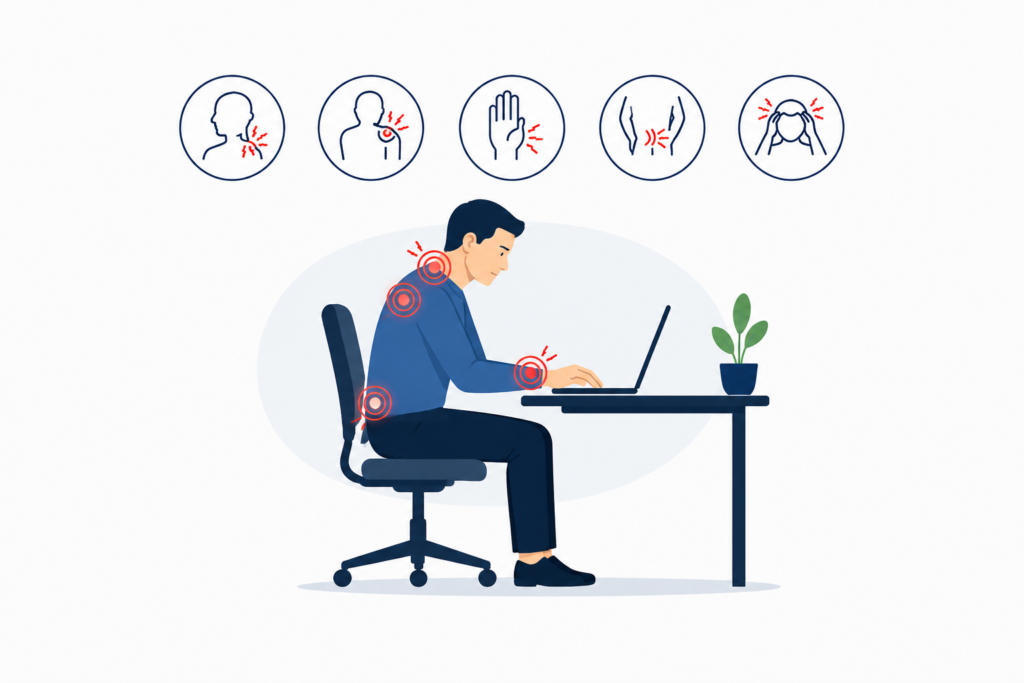
Early ergonomic stress usually presents gradually: mild discomfort during work, stiffness that improves when resting, and localised muscle fatigue that becomes increasingly familiar. They are easy to dismiss and easy to miss entirely.
A worker who notices their forearm aching after repetitive tasks, or their lower back tightening after long periods of sitting, is experiencing the body’s early attempt to flag a problem. At this stage, the tissue isn’t damaged, it’s fatigued. The difference matters because fatigue is reversible; injury often isn’t, or at least not without time and intervention.
Other early indicators include:
- Tingling sensations in the hands or fingers after repetitive keyboard or gripping activity
- Neck stiffness that appears consistently after prolonged work periods
- Low-level shoulder discomfort that feels tight or fatigued rather than sharp
- Wrist irritation when turning or extending the joint repeatedly
- Visual fatigue, headaches, or tension around the jaw from sustained screen use
None of these feels serious in isolation. Repeated day after day, in a workspace that hasn’t been evaluated, they represent a clear occupational health ergonomics concern.
Why Do Workers in Ontario Often Ignore These Early Signals?
Because the discomfort is manageable and the connection to work isn’t obvious. Workers normalise what they experience daily. When the discomfort finally becomes disruptive, the pattern behind it is usually well established.
In office environments across Ottawa and Toronto, the problem is often invisible to everyone except the person experiencing it. There’s no visible incident, no moment of injury to report. The worker stretches, takes an extra break, adjusts how they sit, and carries on. The discomfort becomes background noise.
In industrial settings such as warehousing in Mississauga, manufacturing in Hamilton, the physical demands are more obvious, but the tolerance for discomfort is often higher. Workers expect to feel the job. That expectation doesn’t make the cumulative loading less damaging; it just makes it less likely to be flagged early.
This is precisely why occupational health ergonomics matters as a proactive discipline rather than a reactive one. The cost of waiting for a formal complaint or WSIB claim is that the organisation ends up absorbing exactly what it was trying to avoid in the first place.
Which Body Areas Are Mostly Affected by Ergonomic Stress at Work?
Most work-related ergonomic complaints are concentrated in the lower back, neck, shoulders, and upper limbs. The distribution of symptoms tends to follow the specific tasks workers perform repeatedly.
Office and hybrid workers in roles requiring sustained computer use typically develop symptoms in the neck, upper trapezius, and forearms. The pattern is driven by static loading: holding the same position for hours at a time with minimal variation in muscle activation.
Industrial and manual handling roles produce a different distribution. The most common presentations in these roles are lower back strain from floor-level lifting, shoulder injuries from overhead or extended-reach tasks, and knee discomfort from prolonged kneeling or squatting. They also tend to develop faster than office-related injuries because the forces the body is absorbing are significantly higher.
A proper ergonomic assessment ties these patterns directly to the demands of the job. Not as a broad observation but as a task level analysis that pinpoints which movements, loads, and postures are driving the most cumulative exposure.
When Should a Worker or Employer in Ontario Act on These Warning Signs?
As soon as the pattern becomes consistent. Discomfort that returns predictably after specific tasks or at the end of a shift is not incidental. It reflects an exposure that is repeating. That’s the point at which occupational health ergonomics intervention has the most impact.
Under Ontario’s Occupational Health and Safety Act, employers have a duty to identify and address known hazards. Discomfort that keeps coming back in a pattern tied to specific work tasks is not incidental. An ergonomic assessment at this stage puts the risk on record, offers practical recommendations for reducing it, and demonstrates that the employer did not ignore it.
For workers based in Ottawa, Toronto, Hamilton, Mississauga, Oakville, or Gatineau, Injury Prevention Plus conducts both on-site and virtual ergonomic assessments. Virtual options are particularly useful for hybrid workers whose home setup may be contributing to the problem as much as their office environment. Either way the process starts the same way, by looking at the actual conditions someone is working in rather than running through a generic checklist. Injury Prevention Plus can walk you through what an ergonomic assessment would look like for your workplace. Call them at (613) 730-1074 or write to info@ipp-ergo.com.
What Happens If Early Warning Signs Are Left Unaddressed?
Intermittent discomfort can slowly change into continuous pain. Fatigue-related symptoms progress to structural soft tissue injury. What was addressable through workstation adjustment or task redesign becomes a medical issue requiring treatment, time off, and formal accommodation.
The progression isn’t inevitable, but it is common. Rotator cuff injuries, carpal tunnel syndrome, chronic lower back conditions, and lateral epicondylitis are all well-documented endpoints of ergonomic exposures that were present long before the diagnosis. Each one is associated with significant lost time, WSIB claims, and in many cases permanent functional limitation.
Occupational health ergonomics doesn’t claim to prevent all musculoskeletal injury. What it does is interrupt the exposure patterns that drive most of it, early enough that the intervention is minor and the outcome is preserved capacity rather than managed disability.
Frequently Asked Questions
What are the most common early warning signs of ergonomic-related injury?
The most common early signs are intermittent discomfort during or after work, stiffness that eases with rest but returns with activity, tingling or numbness in the hands or forearms, and localised muscle fatigue in the neck, shoulders, or lower back. These symptoms are easy to dismiss but consistently signal that an occupational health ergonomics review is warranted.
How is an ergonomic-related injury different from a regular workplace injury?
A regular workplace injury typically has a single identifiable cause a slip, a fall, an acute strain. Ergonomic-related injuries develop through cumulative exposure: repeated postures, sustained static loading, or high-frequency tasks that individually seem manageable but accumulate over time. This is why early warning signs appear long before a formal injury is recorded.
Can an ergonomic assessment detect injury risk before symptoms become serious?
Yes. An ergonomic assessment evaluates the physical demands of a job and the conditions under which work is performed, identifying risk factors before they produce injury. In occupational health ergonomics practice, assessment at the early-symptom stage is more effective than post-injury intervention because the exposure patterns can be addressed before structural damage occurs.
Are early ergonomic warning signs covered under WSIB in Ontario?
WSIB covers musculoskeletal injuries that arise out of and in the course of employment, including those that develop gradually through repetitive work. Early warning signs are not claims in themselves, but they are relevant to WSIB injury prevention obligations. Ontario employers are required under the Occupational Health and Safety Act to address known ergonomic hazards proactively.
Where can I get an ergonomic assessment for early warning signs near me in Ottawa, Toronto, or Hamilton?
Need help improving ergonomics in your workplace?
Our registered ergonomists are ready to help. Call us at (613) 730-1074 or book a consultation today.