Yes, consistently. Organisations that implement structured ergonomic programs tailored to their industry see measurable reductions in musculoskeletal injury rates, lost-time claims, and modified duty requirements over time. The reduction compounds as workstation and task changes take effect and workers are no longer absorbing physical demands that exceed safe limits.
Ergonomics Across Industries: One Size Doesn't Fit All
May 8
Table of Contents
Why Can’t a Single Ergonomic Approach Work Across All Industries?
How Does Ergonomic Risk Assessment Apply in Office and Professional Environments?
What Makes Industrial and Warehouse Ergonomics a Different Category Entirely?
How Does Ergonomics Apply to Healthcare and Caregiving Roles?
What Ergonomic Risks Do Vehicle Operators Face That Other Workers Don’t?
Why Do Location and Work Environment Affect Ergonomic Recommendations?
When Does an Organisation Need Industry-Specific Ergonomic Support?
Introduction
There’s a version of ergonomics that gets applied like a template. Adjust the chair. Raise the monitor. Take breaks. And for a certain kind of worker, in a certain kind of setting, that’s probably enough. But most workplaces aren’t that setting, and most workers aren’t that worker.
A nurse repositioning a patient in a long-term care facility in Ottawa has nothing in common with a warehouse picker in a Mississauga distribution centre, who has nothing in common with a municipal fleet driver covering routes across Gatineau. The physical demands are different. The injury risks are different. The interventions that actually reduce those risks are different. An ergonomic risk assessment done properly accounts for all of that. What follows is a look at how ergonomics actually applies across different industries, and why the one-size approach leaves too many workers unprotected.
Why Can't a Single Ergonomic Approach Work Across All Industries?
Because the body responds to what it’s actually asked to do, not to a generalised category of work.
Static postures held for hours at a desk produce a different injury pattern than repetitive overhead reaching on a production line. Whole-body vibration from operating heavy equipment has nothing in common with the fine motor strain of extended keyboard use. Treating these as variations of the same problem produces interventions that are too vague to change anything.
The physical demands of a role determine which tissues get loaded, how heavily, how often, and with how much recovery time. A proper ergonomic risk assessment maps those demands specifically. The assessment for a dental hygienist in a Toronto clinic looks nothing like the one conducted for a construction worker in the Ottawa Valley, and it shouldn’t.
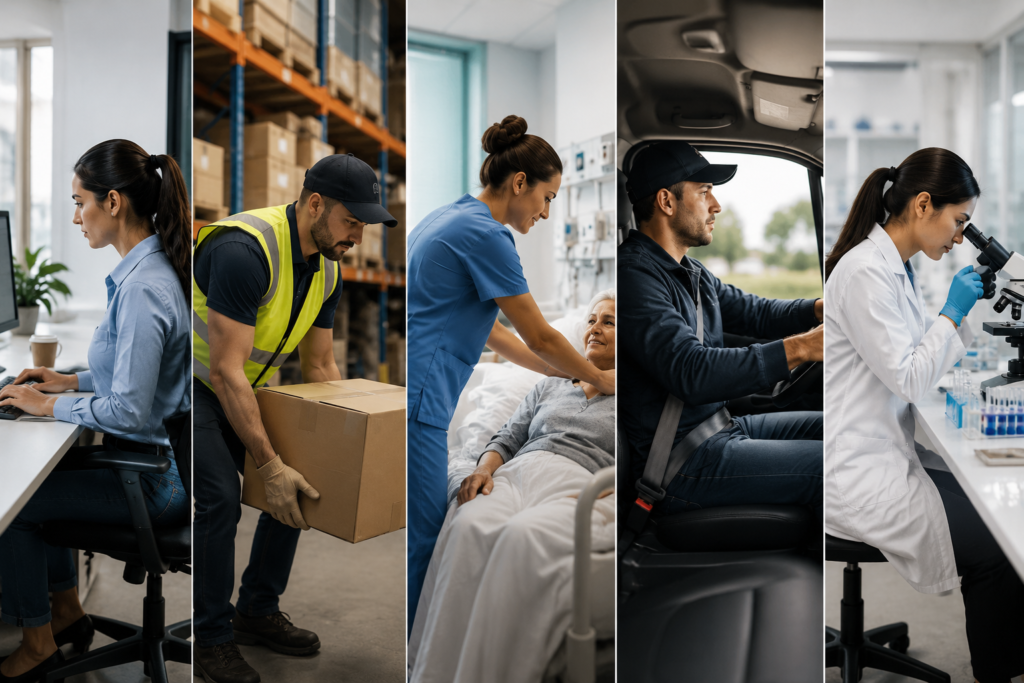
How Does Ergonomic Risk Assessment Apply in Office and Professional Environments?
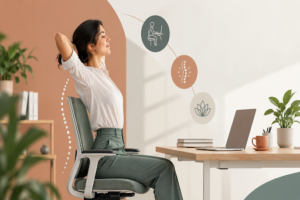
Office-based work is where ergonomics gets the most attention, and still gets underestimated. Sustained static posture, the kind that comes from sitting in a fixed position for the better part of a workday, loads the spine, shoulders, and neck in ways that accumulate steadily and quietly.
In Ottawa’s federal government sector, Toronto’s financial and tech districts, and Gatineau’s public service offices, large proportions of the workforce spend most of their working hours at a desk. The injury risk isn’t dramatic. It builds across months and years of screens positioned too low, chairs adjusted for someone else’s proportions, and keyboards placed just far enough forward to keep the shoulders slightly elevated all day.
An office ergonomic assessment addresses these specifics rather than offering general guidance. Monitor height relative to eye level, chair adjustments relative to the individual worker’s build, reach distances, lighting, and how the full setup interacts with the tasks actually being performed. For organisations running hybrid or fully remote teams across the Ottawa-Gatineau region and beyond, a virtual ergonomic assessment applies the same standard to home office setups that rarely get evaluated otherwise.
What Makes Industrial and Warehouse Ergonomics a Different Category Entirely?
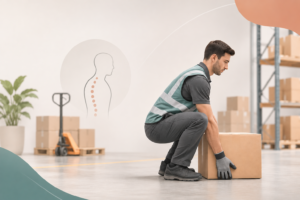
The demands are higher, the results of getting it wrong arrive faster, and the solutions need a different toolkit. Manual handling, repetitive lifting, regular awkward postures, whole-body vibration, and forceful exertions are all common in warehouse, manufacturing, and trades environments. In the Greater Toronto Area alone, the concentration of logistics, distribution, and light manufacturing work means a large portion of the regional workforce is exposed to these demands daily.
An ergonomic risk assessment in industrial settings uses tools like the Liberty Mutual equations and LiFFT method to measure cumulative lumbar compression and identify where task demands exceed safe limits. The findings drive concrete changes: lift heights get adjusted, mechanical assists get introduced, task rotation schedules get restructured.
A physical demands analysis often runs alongside the assessment, documenting the full physical requirements of a role. In Ontario, this documentation carries practical value beyond injury prevention. It supports return-to-work planning, accommodation decisions, and hiring processes where matching the capacity of the candidate to the demand of the role matters a lot.
How Does Ergonomics Apply to Healthcare and Caregiving Roles?
Patient handling is one of the most physically demanding categories of work in any sector. Nurses, personal support workers, and home care aides in Ottawa, Toronto, and surrounding communities regularly help with transfers, repositioning, and mobility support. This usually takes place in rooms and hallways that are not designed with those tasks in mind.
The injury pattern is predictable. Lower back strain from repeated forward bending under load. Shoulder injuries from asymmetrical reaching during patient transfers. Cumulative fatigue from sustained physical exertion with minimal mechanical assistance across a full shift.
An ergonomic risk assessment in healthcare settings looks at the specific tasks generating the highest physical demand, the equipment available, and the environmental constraints limiting how those tasks can be performed. An individual industrial ergonomic assessment in a care environment produces findings specific enough to act on, not general reminders to use proper technique.
What Ergonomic Risks Do Vehicle Operators Face That Other Workers Don't?
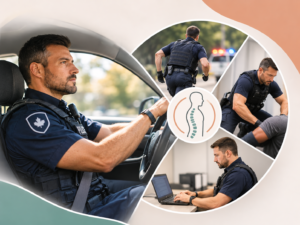
Prolonged sitting combined with whole-body vibration is a specific injury mechanism that office-based ergonomics doesn’t address and industrial ergonomics only partially covers. Fleet drivers, delivery operators, and heavy equipment operators in the Ottawa, Gatineau, and Toronto regions spend large portions of their working hours in a vehicle seat, absorbing vibration and maintaining a fixed posture with very less space to move.
The lumbar spine bears most of the load. Add a seat that hasn’t been adjusted to the driver’s build, controls positioned outside comfortable reach, and the cumulative physical demands of entry and exit across a full shift, and the injury risk compounds considerably.
A vehicle ergonomic assessment looks at all of it. Seat height and lumbar support, steering wheel and control placement, mirror configuration, and how the driver’s posture holds under actual operating conditions rather than in a parked vehicle. For municipal fleet operators, logistics companies, and government transport services in the region, this is a category of ergonomic risk assessment that directly affects both driver health and operational reliability.
Why Do Location and Work Environment Affect Ergonomic Recommendations?
Two workers in the same job title can face meaningfully different ergonomic conditions depending on where and how they work. A government office worker in a purpose-built federal building in Ottawa’s downtown core is working in a different physical environment than a colleague operating from a converted spare room in Kanata or a shared coworking space in Gatineau. The job is the same. The ergonomic conditions are not.
The same principle applies across industries. A trades worker on a structured commercial site in Toronto’s downtown corridor is working differently than one servicing properties across rural Eastern Ontario. Environment shapes exposure, and exposure shapes risk.
This is why an ergonomic risk assessment conducted by professionals who understand regional work patterns and industry-specific demands produces better outcomes than standardised programs applied uniformly. Injury Prevention Plus works across Ottawa, Gatineau, Toronto, and surrounding areas with exactly that in mind. Assessments reflect the actual conditions workers are in, not an averaged-out approximation of what those conditions might look like.
When Does an Organisation Need Industry-Specific Ergonomic Support?
When the work involves physical demands that don’t fit the standard office framework, which is most industries.
Healthcare organisations managing high rates of musculoskeletal injury among care staff. Logistics and distribution companies in the GTA dealing with recurring lower back claims. Municipal fleet operators in Ottawa and Gatineau whose drivers are logging consistent complaints about back and neck pain. Manufacturing operations where the same tasks have been generating the same injuries for years without a clear intervention.
All of these situations call for an ergonomic risk assessment grounded in the specific demands of the industry and the specific conditions of the workplace.
Injury Prevention Plus delivers assessments across all of these environments, conducted by registered healthcare professionals with over 33 years of experience across Ottawa, Toronto, Gatineau, and the broader regions they serve. The focus is always on what can be changed in the actual conditions your people are working in.
Book an assessment to get an evaluation built around your industry, your environment, and your team.
Frequently Asked Questions
Why does ergonomic assessment need to be industry-specific?
Different industries place different physical demands on workers. The posture, force, repetition, and duration profiles of a warehouse role are fundamentally different from those of an office role or a patient care role. An assessment that doesn’t account for those differences produces recommendations too general to be useful. Industry-specific ergonomic assessment identifies the actual risks present in a specific work environment and addresses them directly.
Does Injury Prevention Plus serve workplaces outside Ottawa and Toronto?
Yes. Injury Prevention Plus serves Ottawa, Toronto, Gatineau, and surrounding regions, including communities across Eastern Ontario and the broader Greater Toronto Area. Virtual ergonomic assessments extend that reach further, making it possible to evaluate remote and hybrid workers regardless of where they are located.
What industries does Injury Prevention Plus work with most frequently?
Injury Prevention Plus works across office and professional environments, healthcare and long-term care, warehousing and distribution, manufacturing, municipal and government operations, and transportation and fleet services. Assessments are tailored to the specific demands of each environment rather than adapted from a standard template.
How does a physical demands analysis support industry-specific ergonomics in Ontario?
A physical demands analysis documents the full range of physical requirements associated with a specific role, including lifting demands, postural requirements, force levels, and duration. In Ontario, this documentation supports return-to-work planning, workplace accommodation processes, and role-matching decisions. It is particularly valuable in industrial and healthcare settings where physical demands are high and the consequences of a mismatch between role requirements and worker capacity are significant.
Can ergonomic assessment reduce industry-specific injury rates over time?
Need help improving ergonomics in your workplace?
Our registered ergonomists are ready to help. Call us at (613) 730-1074 or book a consultation today.