

Ergonomics Tips for Mobile and Field-Based Work
Most ergonomic guidance assumes a fixed workstation. A desk, a chair, a screen, a predictable environment. Field-based and mobile workers have none of that.
They operate out of vehicles, work in client spaces where nothing is configured for their physical comfort, carry equipment across uneven ground, and then sit back behind the wheel and do it again. The physical demands stack across multiple environments in a single shift, and the standard ergonomic advice, the kind designed for offices, rarely reaches this group at all.
A vehicle ergonomic assessment is usually where the conversation needs to start. For many mobile workers, the vehicle is the one consistent environment across the workday. Getting that right first makes practical sense.
What Makes Field-Based Work Harder on the Body Than Office Work?
Field work compounds physical demands in ways that a single environment never does. A utility technician might spend ninety minutes driving, two hours crouching in a service area, and another forty minutes doing documentation on a laptop balanced on a passenger seat. Each environment loads the body differently. None of them has ergonomic controls in place.
Office ergonomics addresses a relatively contained problem. Field work does not. The injury risk isn't concentrated in one posture or one task. It accumulates across the whole day, across every environment the worker moves through.
Risk Profile Across Common Field Roles
| Role | Primary Risk Factors | Body Areas Most Affected |
|---|---|---|
| Field technician | Confined space work, carrying tools, kneeling | Knees, shoulders, lower back |
| Delivery driver | Prolonged sitting, repeated exit and entry, lifting | Lumbar spine, hips, wrists |
| Construction inspector | Uneven terrain, prolonged standing, vehicle travel | Ankles, lower back, neck |
| Home care worker | Client transfers, driving, bending in client homes | Shoulders, lower back, neck |
| Sales representative | Extended driving, laptop use in vehicle, phone use | Cervical spine, lower back, wrists |
How Should a Vehicle Be Set Up Before a Long Field Day?
A complete vehicle ergonomic assessment evaluates seat position, lumbar support, mirror alignment, and reach to controls. It takes just 5 minutes to make these adjustments within your vehicle if it is done correctly. The difference across a four hour driving shift is significant.
Most workers set the seat once when they first get the vehicle and never touch it again. When the height, backrest angle, and distance to pedals don't match the driver's build, every minute behind the wheel loads the lumbar spine and hip flexors in ways that compound steadily. In roles involving two to four hours of daily driving, that accumulation moves quickly toward clinical territory.
Vehicle Setup Reference
| Setting | Target Position | Why It Matters |
|---|---|---|
| Seat height | Hips at or slightly above knee level | Reduces hip flexor tension and lumbar compression |
| Seat distance | Slight bend in knee at full pedal depression | Prevents overreaching and knee strain |
| Backrest angle | Upright or a slight recline | Maintains natural lumbar curve during extended drives |
| Lumbar support | Positioned at the small of the back | Supports spinal curve and reduces disc pressure |
| Headrest | Top level with the crown of the head | Reduces cervical strain and whiplash risk |
| Steering grip | Both hands at 9 and 4 position | Lowers shoulder and neck fatigue over distance |
A formal vehicle ergonomic assessment makes fit issues visible before they become injury reports. Many of the adjustments workers need have been available the entire time. Nobody ever showed them what to do with them.
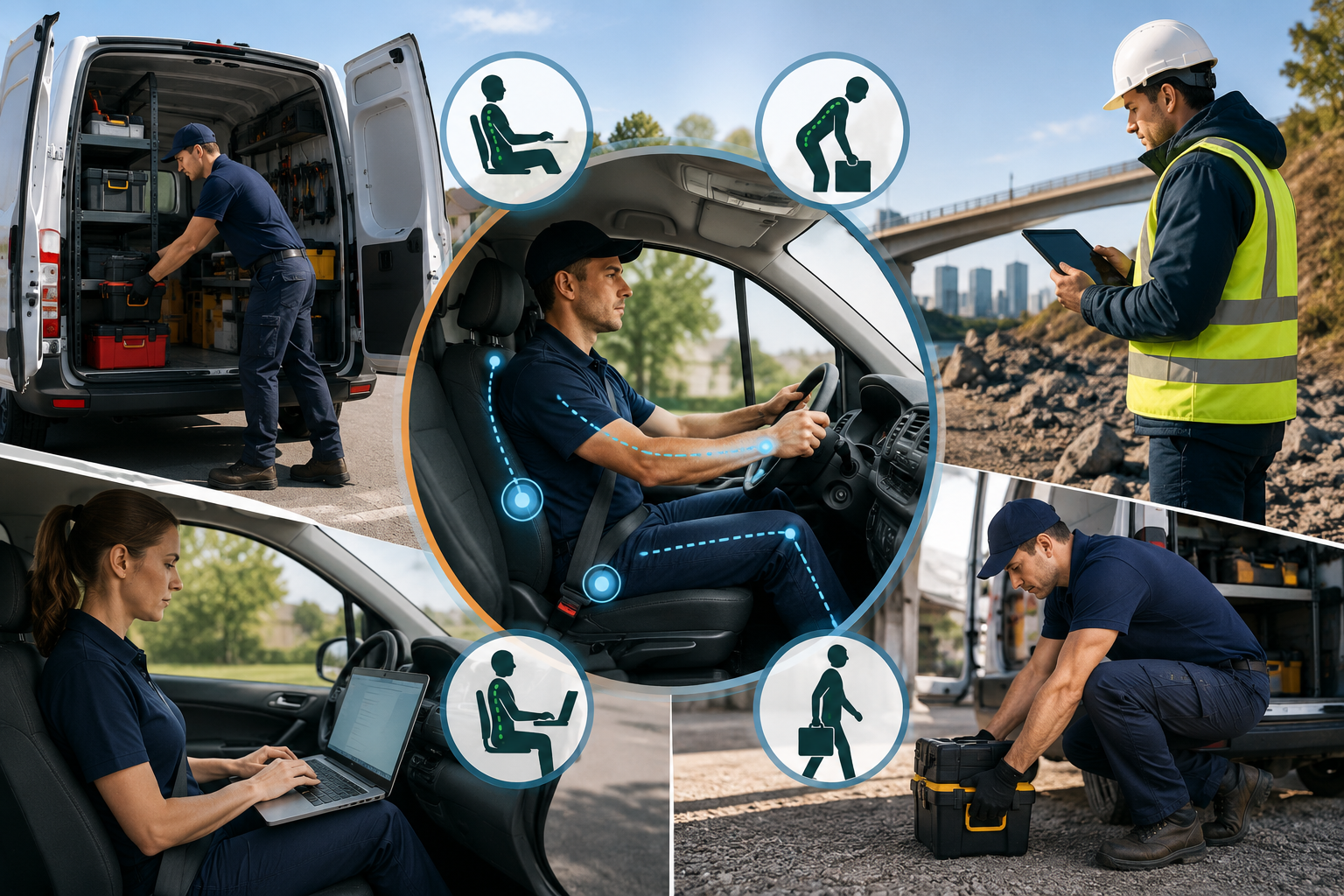
What Ergonomic Risks Come From Working Out of a Vehicle?
A vehicle ergonomic assessment that only looks at driving posture captures roughly half the picture for most field workers. The other half is what happens when the vehicle becomes a base of operations.
Retrieving tools from a van floor after a long drive. Twisting from the driver seat to reach equipment in the back. Hoisting cargo out of a high-clearance vehicle onto hard ground, repeatedly, across a full shift. These are distinct injury risks that standard office-based ergonomic risk assessment tools aren't designed to detect.
Practical habits that reduce vehicle-related strain outside of driving:
Step down, don't jump. The impact force from dropping onto hard ground is equivalent to a short fall. Repeated dozens of times per shift it adds up fast through the knees, hips, and lumbar spine.
Turn your whole body when reaching into cargo or accessing from side or rear exit. Twisting through the trunk from the driver seat to reach the back is one of the more reliable ways to load the lumbar spine under awkward conditions.
Keep frequently used tools at waist height. Anything retrieved more than ten times per shift should not be living on the cargo floor.
Pivot out of the seat rather than half-turning. Put both the feet on the ground before standing, every time.
Many mobile workers use their laptops in their vehicles between appointments, but working from the steering wheel or passenger seat for too long can create poor posture. Repeating these positions every day can gradually contribute to neck and wrist pain.
How Does a Physical Demands Analysis Protect Mobile Workers?
A physical demands analysis documents the actual strength, posture, and repetition requirements of a field role. It gives employers, return-to-work coordinators, and treating healthcare providers an objective reference point that injury reports alone can't provide.
Where an ergonomic risk assessment focuses on the individual and their environment, a physical demands analysis focuses on the job itself. For field roles this distinction matters considerably. A role might require carrying twenty kilograms of equipment across uneven ground, working overhead in a crawl space for thirty minute stretches, and driving two to three hours per day. Without documenting those requirements it becomes difficult to determine whether a worker recovering from injury can return safely to full duties or needs a modified work plan.
For Ontario employers, a physical demands analysis also supports return-to-work obligations under the Workplace Safety and Insurance Act. Having an accurate, role-specific document on file reduces friction between employers, workers, and healthcare providers when that process begins.
What a Physical Demands Analysis Documents for Field Roles
| Component | What Gets Recorded | How It Gets Used |
|---|---|---|
| Travel demands | Daily drive time, postures, vibration exposure | Vehicle ergonomic assessment baseline |
| Load handling | Weights lifted, carry distances, frequency | Injury risk rating and job matching |
| Postural demands | Bending, reaching, kneeling duration per shift | Return-to-work planning |
| Environmental factors | Heat, cold, outdoor surfaces, confined spaces | Risk controls and PPE requirements |
| Cognitive demands | Documentation tasks, route planning, client interaction | Fatigue and mental load assessment |
What Daily Habits Make the Biggest Difference for Field Workers?
Small habits built over months matter more than any single equipment change. The goal is to decrease the cumulative exposure to awkward postures, static loading, and vibration rather than completely eliminating physical demand from the role. Managing the accumulation is the realistic goal.
A vehicle ergonomic assessment sets up the framework. Daily decisions determine how much of that benefit actually carries through the working week.
| Situation | Practical Habit | What It Reduces |
|---|---|---|
| Before each drive | Reset seat and lumbar support every time | Cumulative lumbar and cervical strain |
| Every 90 minutes of driving | Five minute walk and light movement break, or slight angle change to the backrest | Hip flexor tightness and disc pressure |
| Phone use in vehicle | Mount at eye level using a holder | Neck flexion and cervical loading |
| Lifting from cargo | Slide load to vehicle edge before lifting | Lower back and shoulder injury risk |
| End of field day | Brief movement before the drive home | Fatigue-driven injury risk on the return trip |
When Should Employers Arrange a Vehicle Ergonomic Assessment for a Field Team?
Any role that involves more than two hours of daily driving, regular cargo handling, or a lot of vehicle entry and exit calls for a vehicle ergonomic assessment. Waiting for complaints to surface before acting means the first wave of injuries has already happened.
Organisations typically request an ergonomic risk assessment reactively. After complaints, after an incident, after the pattern is already established. It works, but it misses the window to prevent the first injury. A vehicle ergonomic assessment conducted when a new fleet is deployed, when job demands change significantly, or when field roles are flagged through an ergonomic risk assessment delivers considerably more return.
It is also appropriate when a worker returns from a musculoskeletal injury. Their tolerance for sustained driving posture may have changed, and the setup that worked before may no longer suit their current condition.
The working demands for mobile and field-based workers are varied because the environment shifts continuously. An assessment that includes a physical demands analysis and role-specific ergonomic support is the right starting point.
Injury Prevention Plus conducts vehicle ergonomic assessments across Ottawa, Gatineau, Toronto, and surrounding regions, carried out by registered healthcare professionals with over 33 years of applied experience in occupational health ergonomics.
Book an assessment to get a clear picture of where the risk sits in your mobile workforce and what it would take to reduce it.
Frequently Asked Questions
1. What does a vehicle ergonomic assessment cover for field-based workers?
A vehicle ergonomic assessment evaluates driving posture, seat configuration, lumbar support, mirror and control placement, headrest position, and steering grip. For field workers it also covers vehicle entry and exit mechanics, cargo retrieval postures, and any in-vehicle documentation tasks. The assessment identifies where the vehicle fit is creating cumulative strain and produces specific adjustments the worker can implement immediately.
2. How often should a vehicle ergonomic assessment be conducted?
A vehicle ergonomic assessment is warranted when a worker first takes on a driving-intensive role, when the fleet vehicle changes, when a worker returns from a musculoskeletal injury, and when driving hours or task demands increase materially. For organisations managing large field teams, periodic assessment built into the health and safety calendar is more effective than waiting for complaints to trigger a review.
3. What is a physical demands analysis and why does it matter for field roles in Ontario?
A physical demands analysis documents the full physical requirements of a field role including load weights, carry distances, postural demands, driving time, and environmental conditions. In Ontario it supports return-to-work planning under the Workplace Safety and Insurance Act and provides the objective baseline that employers, treating practitioners, and return-to-work coordinators need when determining whether a worker can safely resume full or modified duties.
4. Can a vehicle ergonomic assessment reduce workers' compensation claims for mobile teams?
Yes. Many musculoskeletal claims in mobile and field-based roles trace back to vehicle fit issues, cargo handling mechanics, and entry and exit strain that a vehicle ergonomic assessment would have identified and addressed. Organisations that conduct assessments proactively, particularly when deploying new fleets or onboarding drivers into high-demand roles, consistently see lower injury rates and reduced claims costs over time.
5. What is the difference between a vehicle ergonomic assessment and a standard ergonomic risk assessment for field workers?
A standard ergonomic risk assessment evaluates the physical demands placed on a worker in their primary work environment, identifying posture, force, repetition, and recovery patterns that generate injury risk. A vehicle ergonomic assessment is a specialised assessment focused specifically on the vehicle as a work environment, covering driving posture, vehicle fit, vibration exposure, and vehicle-related manual handling. For field workers, both are typically needed because the vehicle and the work site carry different and compounding risk profiles.
