

How Fatigue Signals Potential Ergonomic Risk
Everyone gets tired at work. That is just part of the job. But there is a particular kind of fatigue that is worth paying closer attention to. The kind that shows up in the same spot, doing the same task, on the same day of the week, consistently. That is not tiredness from a long day. That is the body pointing at something specific.
In workplace ergonomics, that pattern is treated as information. Fatigue that localises, that follows a predictable schedule, that gets worse across the week rather than clearing with a night's sleep, tends to surface well before a formal injury does. An ergonomic risk assessment is one of the most direct ways to understand what that fatigue is actually pointing at.
Is All Workplace Fatigue an Ergonomic Signal?
No, and that distinction matters. General tiredness goes away. It comes from a heavy week, disrupted sleep, a demanding project, or just the accumulated weight of everything on someone's plate. It tends to spread across the whole body and resolves reasonably well with rest.
Ergonomic fatigue concentrates. A worker whose forearms are consistently aching by early afternoon on keyboard-heavy days isn't just overworked. Something about the physical setup of that work is loading those muscles beyond what they can sustain across a shift. The worker whose lower back is significantly worse by Thursday than it was on Monday, doing the same tasks each day, is demonstrating that the physical demand is outpacing overnight recovery.
That second type is where ergonomic risk assessment becomes directly relevant. The fatigue pattern contains specific information about where the physical overload is happening and what is likely causing it.
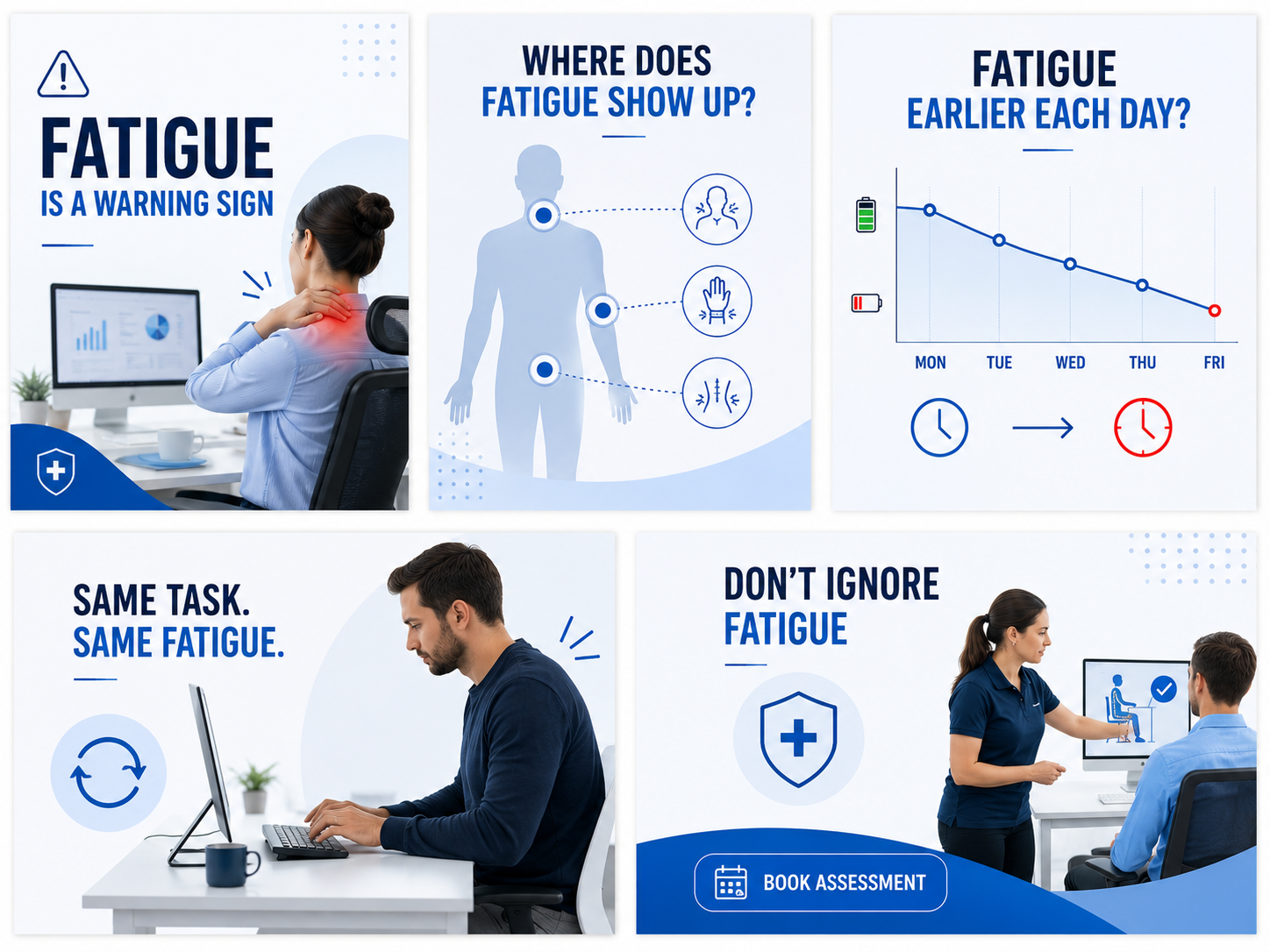
What Fatigue Patterns Should Trigger an Ergonomic Risk Assessment?
Fatigue That Gets Earlier Each Day
A worker managing fine until 3 pm on Monday, who is noticeably fatigued by 1 pm on Thursday, is showing cumulative loading. The tissue isn't fully recovering between shifts. That deficit compounds across the week, and without intervention, it continues until something gives.
Localised Fatigue During Specific Tasks
This is one of the cleaner signals in ergonomic risk assessment work. When fatigue consistently concentrates in one region during one category of task, the task is generating the overload.
Forearm and wrist — Mostly from typing or tool use for long stretches. Grip force, wrist position, and how often the motion repeats are the main things to check.
Neck and upper back — Screen work and overhead reaching are usually the culprits. Monitor height and how long the arms stay elevated matter more than most people realise.
Lower back — Sitting too long, lifting, or driving. Lumbar support, lift height, and vibration all feed into this one.
Shoulder — Overhead tasks, heavy mouse use, carrying. The arm angle and how long it stays there tell most of the story.
Knees and hips — Kneeling and crouching on hard surfaces. Surface type and recovery time between positions are what the assessment focuses on.
Movement Quality That Deteriorates Across the Shift
A worker lifting correctly at 8am who is rounding their lower back by 2pm isn't always getting careless. Their stabilising muscles are fatigued and the body has shifted load onto passive structures. That compensation is where a significant proportion of injuries actually happen, in the second half of the shift, when accumulated fatigue has quietly removed the physical buffer that was protecting the worker earlier in the day.
Occupational health ergonomics pays close attention to this kind of degradation because it indicates that the demand level is exceeding sustainable capacity, not just at the moment of injury, but consistently across the working day.
Recovery Time That Stretches Longer Each Week
If a worker arrives on Monday noticeably more tired than they were the previous Monday, and that pattern is consistent, cumulative damage is outpacing repair. That trajectory doesn't self-correct. It continues in one direction until a formal injury interrupts it.
How Does Fatigue Present Differently Across Work Settings?
Office and Desk-Based Workers
In office environments, ergonomic fatigue often shows up as postural drift rather than pain. The worker sitting reasonably upright at 9am is significantly forward by 11am, not from inattention, but because the muscles holding that posture have fatigued and the body has offloaded onto ligaments and discs instead.
Neck tension building through the afternoon, wrist discomfort during intensive keyboard periods, eye fatigue correlating with sustained screen work. These are all fatigue signals with specific physical causes. An office ergonomic assessment reviews the workstation conditions producing these patterns in workers who have attributed them to stress or screen time for months without making that connection.
Industrial and Physical Roles
In warehouse, manufacturing, and trades environments, fatigue signals include reduced grip strength toward the end of a shift, increasing tendency to shortcut correct lifting mechanics when the stabilising muscles are tired, and movement compensations that introduce new load patterns the body wasn't prepared for.
A formal ergonomic risk assessment in these environments uses tools like the LiFFT method and Liberty Mutual equations to quantify cumulative lumbar loading and identify where fatigue-driven risk is climbing beyond manageable limits. A physical demands analysis documents the full physical profile of the role, which is essential context for interpreting what those fatigue patterns are actually communicating.
Field and Vehicle-Based Workers
Mobile workers accumulate fatigue across multiple environments in a single day. Driving load, physical task load, and postural fatigue from confined space work all compound on top of each other. The worker arriving at the last job of the day is carrying accumulated physical load from everything before it. Their injury risk in that final hour is meaningfully higher than it was at the start of the day, even though by that point they've been doing the work for hours.
A vehicle ergonomic assessment addresses the driving component specifically. For field workers across Ottawa, Gatineau, Toronto, and surrounding regions, that is often where the cumulative load begins, before the first physical task of the day has even started.
When Multiple Workers Report the Same Fatigue Pattern, What Does That Mean?
It means the role is the problem, not the individuals in it. This is a distinction that changes how the response needs to be structured. Directing wellness advice or individual coaching at workers experiencing role-specific fatigue treats the symptom while leaving the source intact. The conditions keep producing the same fatigue for whoever fills the role next, and the one after that.
A structured ergonomic risk assessment of the role itself identifies the physical demand conditions generating the pattern. That is where occupational health ergonomics adds something that general wellness programs cannot. It doesn't ask workers to manage strain more effectively. It finds what is creating the strain and changes it.
Practically, when fatigue patterns surface across a team:
Record them formally before they become injuries. Consistent fatigue reports in a specific body region during specific tasks are early warning data, not minor complaints.
Look at the role level, not just the individual. When the pattern is shared across multiple workers in the same position, the assessment needs to reflect that scope.
Evaluate recovery between demanding tasks, not just the tasks themselves. Insufficient recovery time is as significant a risk factor as the demand level.
Check task rotation schedules. Cumulative loading that is being concentrated in one worker rather than distributed across a team accelerates the injury timeline considerably.
Conclusion
Fatigue that is localised, recurring, and tied to specific physical tasks isn't a management problem. It is a physical environment problem with a physical solution. An ergonomic risk assessment identifies what that solution is.
Injury Prevention Plus conducts ergonomic risk assessments across office, industrial, vehicle, and remote environments throughout Ottawa, Gatineau, Toronto, and surrounding regions. Every assessment is carried out by a registered healthcare professional with over 33 years of experience in occupational health ergonomics.
Book an assessment to find out what the fatigue patterns in your workplace are actually pointing toward.
Frequently Asked Questions
1. How is work-related fatigue different from general tiredness?
Work-related ergonomic fatigue is localised, task-specific, and follows a consistent pattern tied to particular physical demands. It concentrates in specific muscle groups during specific tasks and tends to worsen progressively across the working week. General tiredness is diffuse and resolves with rest. When fatigue is localised, recurring, and correlates with specific tasks or postures, it is a signal that an ergonomic risk assessment is warranted.
2. Can fatigue cause workplace injuries without a specific incident occurring?
Yes, and this accounts for the majority of musculoskeletal injuries in physically demanding roles. Fatigue reduces movement quality, degrades technique under load, and shifts physical stress from active muscle support to passive structures like ligaments and intervertebral discs. The injury doesn't come from one moment. It comes from the cumulative effect of fatigued tissue being asked to keep performing beyond what it can sustain.
3. What does occupational health ergonomics look for when assessing fatigue-related risk?
Occupational health ergonomics evaluates the relationship between specific physical demands and the fatigue patterns they produce. This includes posture, force, repetition, duration, and recovery time, assessed using validated tools that quantify exposure levels and identify where they exceed safe thresholds. The goal is to identify the specific task or workstation condition generating the overload rather than addressing fatigue as a general symptom.
4. How does an ergonomic risk assessment differ from a general fatigue management program?
A fatigue management program addresses workload, shift patterns, and rest behaviours. An ergonomic risk assessment focuses on the physical demands of work and how they generate musculoskeletal loading. Where a fatigue program recommends rest breaks, an ergonomic risk assessment identifies which specific task or workstation condition is producing the fatigue and modifies it at the source. Both have value, but only one addresses the cause.
5. When should an employer commission an ergonomic risk assessment in response to fatigue reports?
When multiple workers in the same role report similar fatigue patterns, when fatigue correlates consistently with specific tasks, when technique degradation is observed later in shifts, or when weekly recovery time is increasing. These patterns indicate that the physical demands of the role are exceeding sustainable capacity, which is an ergonomic problem with an ergonomic solution.
