Duration depends on the environment and scope. A single workstation assessment typically takes 60 to 90 minutes. Industrial assessments covering multiple tasks or roles take longer. Virtual assessments for remote workers can be completed efficiently without requiring an on-site visit. Injury Prevention Plus tailors the scope to the organization’s specific needs and workforce size.
Why Ergonomics Is a Key Part of Workplace Injury Prevention
Apr 30
Table of Contents
- Introduction
- What Does Ergonomics Actually Have to Do With Injury Prevention?
- Why Is Musculoskeletal Injury Worth Prioritising Over Other Safety Risks?
- How Does Ergonomic Risk Assessment Spot Risk Before It Becomes an Injury?
- Does Ergonomic Risk Assessment Work Across Different Types of Workplaces?
- What Does It Actually Cost When Ergonomic Risk Assessment Gets Left Out?
- When Is the Right Time to Bring in an Ergonomic Consultant?
- Frequently Asked Questions
Introduction
Workplace injuries don’t usually announce themselves. You cannot look at a single moment and say, that’s where it went wrong. What actually happens is more silent. A posture that gets held a little too long. A reach that gets repeated several hundred times a day. A seat that forces the lower back into a position it was never built to sustain for eight hours. By the time the injury shows up formally, the conditions producing it have often been there for months, sometimes longer.
Ergonomics exists to catch those conditions. An ergonomic risk assessment is what makes that process structured rather than a matter of waiting until someone gets hurt.
What Does Ergonomics Actually Have to Do With Injury Prevention?
Most workplace safety programs are set up to respond. Incident report is filed, first aid is given, and at the end return-to-work protocols get activated. These are important, but they all begin after the incident happens.
Ergonomics works differently. It addresses the physical environment before strain becomes injury. Musculoskeletal disorders, which cover damage to muscles, tendons, nerves, and joints, account for a substantial portion of lost-time claims in Canadian workplaces every year. They are not freak accidents. They are the predictable result of physical demands that exceed what the body could absorb, repeated often enough and for long enough to cause real damage.
Ergonomic risk assessment identifies those demands early. It creates a basis for reducing them before the injury occurs rather than after. That distinction matters more than it might seem.
Why Is Musculoskeletal Injury Worth Prioritising Over Other Safety Risks?
Slips, falls, and equipment incidents dominate safety conversations for an obvious reason. They are visible. The cause is clear, the documentation is straightforward, and nobody slips on a wet floor every day for three months before getting hurt. The event and the injury are connected by a short, traceable line.
Musculoskeletal injuries don’t work that way. A lower back injury doesn’t happen at a specific identifiable moment. It accumulates. The worker reaches a threshold after weeks or months of loading that never quite triggered a formal complaint because it never quite crossed the line into unbearable. Until one day it does.
That pattern makes these injuries easy to undercount and easy to attribute to things outside work entirely. But the data is consistent. The data on musculoskeletal disorders in Canada points in one direction. Leading cause of workplace disability. A significant share of cases tracing back to task design, workstation setup, and physical demand levels that were never formally examined. An ergonomic risk assessment examines them.
If you want to reduce the category of injury that causes the most sustained disruption to workers and to operations, ergonomics is where that work happens.
How Does Ergonomic Risk Assessment Spot Risk Before It Becomes an Injury?
It doesn’t wait for someone to raise a complaint. A formal ergonomic risk assessment starts with what the worker is actually doing. Postures held, forces exerted, how often certain motions repeat, how long certain positions are sustained, how much recovery exists between demands. Each variable gets examined, not estimated.
Validated assessment tools like the Liberty Mutual equations, the LiFFT method, RULA, and REBA translate those observations into measurable exposure levels. The output is specific. Not “consider improving posture” but rather this task generates excessive lumbar compression at this stage of the workflow, and this is what needs to change.
That specificity is what makes an ergonomic risk assessment useful rather than decorative. Vague recommendations don’t change working conditions. Precise findings do.
Does Ergonomic Risk Assessment Work Across Different Types of Workplaces?
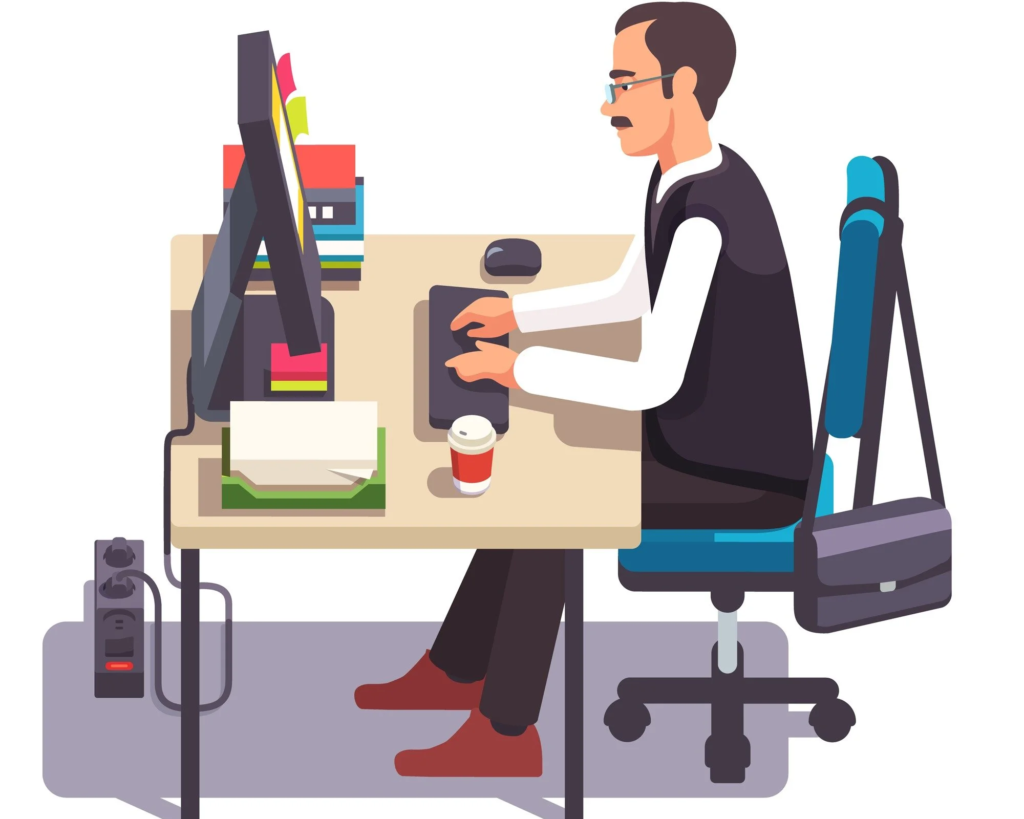
The principles hold across every environment. What changes is what they are applied to. In an office, the physical demands are quieter with static postures, poorly positioned screens, chairs that do not suit the person sitting in them. An office ergonomic assessment checks for monitor height, chair configuration, keyboard and mouse placement, and how all of it works for the individual, not the theoretical average user.
Warehouse and industrial workers are dealing with manual handling loads, whole-body vibration, overhead reaching, and confined work positions. The ergonomic risk assessment in these environments does not look at chair height. It looks at task redesign, lift heights, mechanical assists, and work-rest cycles. A physical demands analysis often runs alongside to document exactly what a role physically requires.
Vehicle operators spend extended periods seated with vibration running through the body, often combined with awkward entry and exit mechanics and controls that don’t suit their reach. A vehicle ergonomic assessment covers seat position, mirror placement, control reach, and how the driver’s posture holds up under actual operating conditions.
Remote and hybrid workers frequently fall outside injury prevention planning altogether, which is a significant gap. A virtual ergonomic assessment applies the same standard of evaluation to home office setups that would otherwise go unexamined indefinitely.
The environment changes. The core question stays the same: are the physical demands of this work within safe limits for the person doing it?
What Does It Actually Cost When Ergonomic Risk Assessment Gets Left Out?
The costs don’t show up cleanly. That’s part of why they persist.
Preventable injuries accumulate. Modified duty arrangements multiply. Workers’ compensation claims increase. People who are good at their jobs leave roles they find physically unsustainable, and the organisation absorbs the cost of finding and training someone else. The workers still showing up and managing chronic discomfort are not operating at full capacity. That gap is real and measurable. It just never appears in an incident report, so it rarely gets traced back to ergonomics.
An ergonomic risk assessment program won’t eliminate every musculoskeletal injury. What it does is systematically reduce the conditions that produce them. Over time, as workstations get adjusted and tasks get redesigned, the cumulative physical load workers carry decreases. The reduction compounds. The numbers eventually show it, in claims costs, in attendance patterns, in how long people stay in physically demanding roles.
When Is the Right Time to Bring in an Ergonomic Consultant?
Most organisations come to ergonomic risk assessment through a problem. An injury occurs, complaints pile up to a point they can no longer be set aside, or an accommodation request arrives and forces the conversation. These are reasonable triggers. They’re also late ones.
The more effective approach runs ahead of the problem. New employees entering physically demanding roles benefit from an assessment before strain has a chance to develop. Workstation reviews make sense whenever processes or equipment change. Returning workers should be evaluated before resuming full duties. And a periodic ergonomic review built into annual health and safety planning catches drift that accumulates gradually and would otherwise go unnoticed.
Injury Prevention Plus delivers ergonomic risk assessments across office, industrial, vehicle, and remote environments. Every assessment is conducted by a registered healthcare professional with more than three decades of applied experience, focused on what can realistically be changed in the conditions your team is actually working in.
Book an assessment to identify what your workplace is currently asking of its people and what it would take to bring that within safer limits.
Frequently Asked Questions
What is an ergonomic risk assessment, and how does it support injury prevention?
An ergonomic risk assessment is a structured evaluation of workplace physical demands, posture, force, repetition, duration, and recovery conducted by a qualified ergonomist. It identifies conditions that exceed safe thresholds and generates specific recommendations to reduce them, addressing the root causes of musculoskeletal injury before they produce a claim.
Which industries benefit most from ergonomic risk assessment?
All industries with physical work demands benefit, but the impact is most significant in healthcare, warehousing, manufacturing, transportation, construction, and office-based settings with high-volume computer work. Each environment carries its own pattern of musculoskeletal risk, and ergonomic risk assessment is designed to identify and address the specific conditions present.
How is ergonomic risk assessment different from a general workplace safety audit?
A general safety audit covers a broad range of hazards such as chemical, electrical, and procedural. Ergonomic risk assessment focuses specifically on the physical demands of work and their relationship to musculoskeletal injury risk. It uses validated measurement tools to quantify exposure levels and produces findings specific enough to act on.
Can ergonomic risk assessment reduce workers' compensation costs?
Yes. Organizations with structured ergonomic programs consistently report reductions in musculoskeletal injury rates, lost-time claims, and modified duty requirements. The cost of an assessment is typically recovered through reductions in claims and absenteeism within the first year of implementation.
How long does an ergonomic risk assessment take?
Need help improving ergonomics in your workplace?
Our registered ergonomists are ready to help. Call us at (613) 730-1074 or book a consultation today.