Our registered ergonomists are ready to help. Call us at (613) 730-1074 or book a consultation today.

- Home
- About
- Services
- Office Ergonomic Assessment
- Virtual Ergonomic Assessment
- Webinars, Seminars and Training
- Physical Demands Analysis
- Vehicle Assessments
- Individual industrial Assessments
- Return to work-assessments
- Ergonomic risk assessments
- Corporate Opportunities
- Functional capacity evaluations
- Healthcare Ergonomics Assessments
- Manufacturing Ergonomic Assessment
- Warehouse Ergonomic Assessment
- Construction Ergonomic Assessment
- Ergonomics for Police, Military and Public Safety
- Blog
- Contact
- FAQs

Ergonomics for Employees on the Go
July 31
Introduction
The ergonomics conversation often is referencing a fixed or single workstation. Almost everything written about it assumes a desk, a chair, a monitor, a consistent environment. Most of the guidance is genuinely useful for that context. For workers who don’t have that context, it lands somewhere between irrelevant and misleading.
Sales representatives driving between client sites across the GTA. Community health workers carrying equipment through client homes in Ottawa and Gatineau. Field technicians working out of vans, in equipment rooms, on rooftops. Hybrid professionals moving between a home setup, a downtown Toronto office, and a coworking space in the same week. These workers are mobile. Their physical environment changes constantly. And the ergonomic risk they carry changes with it.
Ergonomic assessments Toronto professionals and mobile workers across Ottawa and Gatineau need is fundamentally different from what an office worker needs. Not because the body works differently, but because the environment does.
Why Do Mobile Workers Accumulate More Physical Strain Than Office Workers?
Because the demands stack across multiple environments in a single day, and there’s rarely any infrastructure in place to identify or reduce them.
An office worker accumulates strain through one set of conditions. A poorly adjusted chair, a screen at the wrong height, a keyboard too far from the body. Consistent conditions that build a consistent pattern. A mobile worker accumulates strain through several sets of conditions, often in the same day or shift. Driving posture for ninety minutes. Carrying equipment across uneven ground. Working in a confined space in a position the body wasn’t designed to hold. Doing documentation on a laptop balanced on a passenger seat before driving back.
Each environment loads a different set of structures. None of them has ergonomic controls in place. And the fatigue from one environment carries into the next.
Occupational health ergonomics for mobile workers treats this stacking as the central risk, not the individual demands in isolation.
What Physical Risks Do Mobile Workers Face That Often Get Overlooked?
The Drive Itself:
Most mobile workers don’t count driving as a physical demand, but it is. Sustained sitting combined with whole-body vibration loads the lumbar spine continuously. A seat not adjusted to the driver’s build concentrates that load on specific spinal structures rather than distributing it. Entry and exit from a vehicle, done dozens of times across a shift, adds hip and lower back demand that compounds on top of the driving load.
A vehicle ergonomic assessment addresses this specifically. Seat height, lumbar support positioning, control reach, headrest placement, and entry and exit mechanics as well as positioned to work on their laptop/ tablet. For workers driving more than ninety minutes daily across Ottawa, Gatineau, Toronto, and surrounding regions, this is where the cumulative load often starts before the first physical task of the day has even begun.
Carrying Loads Between Locations:
Field workers and community health workers carry equipment between sites regularly. The ergonomic risk isn’t just the weight. It’s how the weight is distributed, how far it’s carried, what surface it’s carried across, and whether the same shoulder is absorbing the load every time.
A bag carried consistently on one side creates asymmetrical loading through the shoulder, neck, and lumbar spine that builds across a working week. Nobody flags it because nothing dramatic happens. It just gradually becomes the shoulder complaint that physiotherapy eventually has to address.
Working in Environments That Weren’t Designed for Work:
A client’s home. A ceiling cavity. A server room. A vehicle used as a temporary office. None of these spaces were designed for the work being carried out. Workers have to adjust to the environment, often adopting awkward postures, overreaching, or working on unsuitable surfaces that increase physical strain.
How Should Mobile Workers Manage Ergonomic Risk Across Variable Environments?
The fixed workstation approach doesn’t transfer. What does transfer is a set of physical principles that the worker can apply regardless of where they end up.
Set the vehicle up before every drive. Not once when the vehicle is first assigned. Every time. Seat position changes when different people use the vehicle. Lumbar support shifts. The two minutes spent resetting before a long drive changes what the lumbar spine absorbs across the next hour.
Split loads symmetrically where the work allows it. Two lighter bags rather than one heavy one. Backpack-style carriers rather than single-shoulder bags for equipment transported over distance. When asymmetrical loading is unavoidable, switching sides deliberately rather than defaulting to the dominant shoulder every time.
Stage tools and equipment close to the work area. Carrying everything to every location is a habit, not a requirement. Tools needed for the specific task at hand, positioned within reach of where the task is performed, reduce the carrying demand and the reach demand simultaneously.
Take brief movement breaks between sites. Five minutes of walking before getting back into the vehicle after a physically demanding task interrupts the cumulative loading pattern and reduces the stiffness that builds into the next environment.
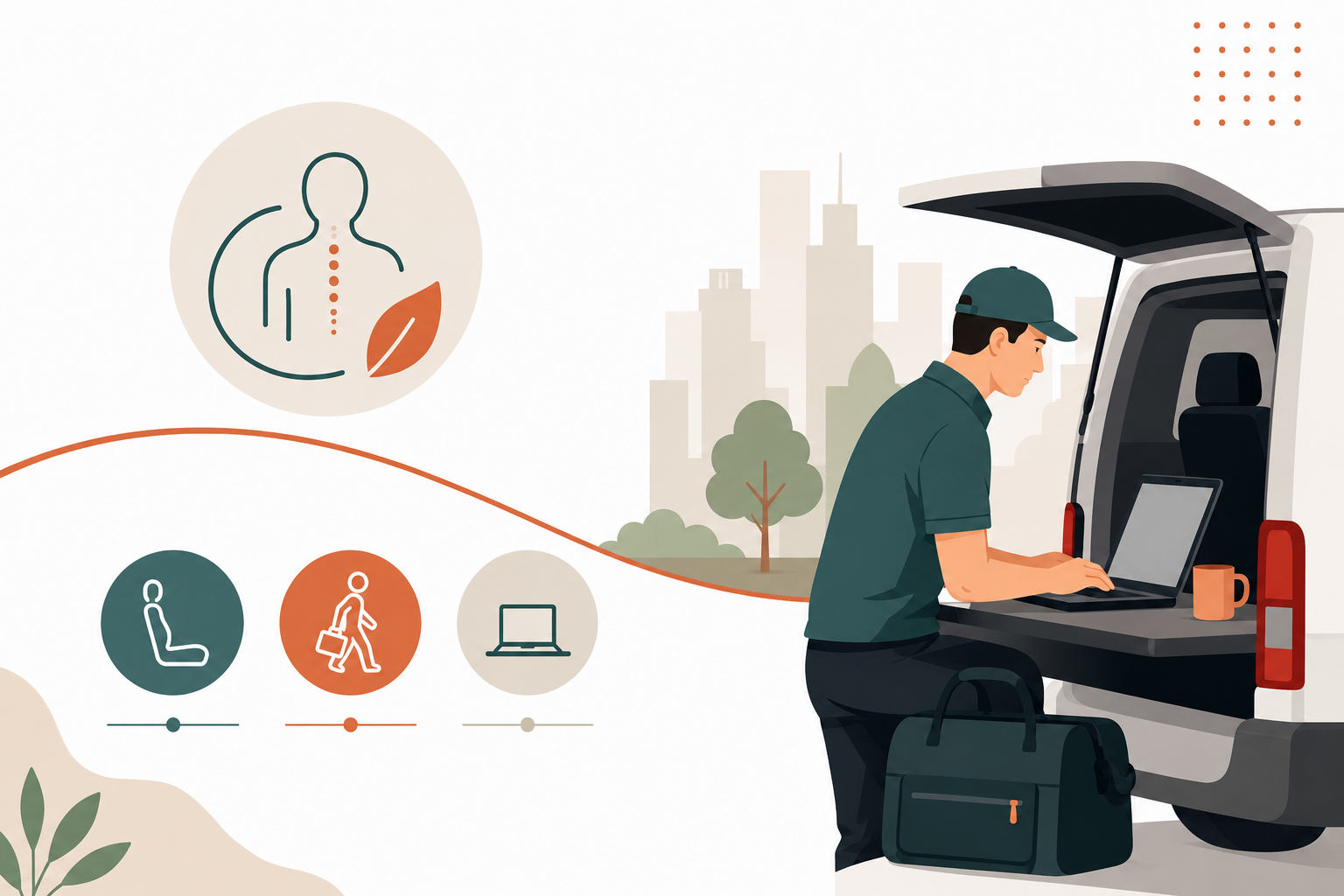
Avoid in-vehicle documentation beyond a few minutes. A laptop on a steering wheel or passenger seat puts the neck into sustained flexion with no support. For workers who document between sites regularly, a dashboard mount or a brief stop at a location with a proper surface is worth the time.
What Does Ergonomic Assessment for Mobile Workers Actually Cover?
A proper ergonomic assessment for Toronto based workers and mobile professionals across Ottawa and Gatineau covers the full picture of where work actually happens, not just one environment.
For the vehicle, the assessment looks at seat configuration relative to the worker’s build, lumbar support positioning, control reach, mirror placement, vibration exposure, and entry and exit mechanics. Field work presents a different set of ergonomic risks, so the assessment looks at how tasks are performed, the loads being handled, the frequency of awkward postures, and whether workers have enough recovery time throughout the day.
A virtual ergonomic assessment allows hybrid workers to have their home setup reviewed remotely. For physically demanding roles that span multiple locations, a physical demands analysis defines the job’s requirements and provides valuable information for accommodation and return-to-work decisions.
When Does a Mobile Worker Need a Formal Assessment Rather Than General Guidance?
When the general guidance isn’t working. Recurring discomfort in the lower back, shoulders, or neck that correlates with specific work environments. Fatigue that arrives noticeably earlier in the shift than it used to. Physical complaints that clear over weekends and return by midweek. Any of these indicate that the cumulative load the worker is carrying is exceeding what the body can absorb and recover from between shifts.
For employers managing mobile teams across Ottawa, Toronto, Gatineau, and surrounding regions, the duty of care doesn’t stop because the worker isn’t in a fixed office. Canadian occupational health and safety obligations extend to every environment the worker performs their job in. A structured ergonomic assessment Toronto mobile employers commission for their field teams is the practical mechanism for meeting that obligation rather than leaving it unaddressed until an injury makes it urgent.
Injury Prevention Plus conducts ergonomic assessment across office, industrial, vehicle, and field environments throughout Ottawa, Gatineau, Toronto, and surrounding regions. Every assessment is carried out by registered healthcare professionals with over 33 years of applied experience in occupational health ergonomics.
Book an assessment to get a clear picture of what your mobile team’s workday is asking of their bodies, across every environment they move through.
Frequently Asked Questions
What makes ergonomic assessment different for mobile workers compared to office workers?
Office ergonomic assessment evaluates one consistent environment, typically a fixed workstation, and identifies the configuration changes that reduce strain in that context. For mobile workers, the assessment covers multiple environments, the vehicle, the field, the home office, and evaluates how physical demand stacks across those environments in a single shift. The risk isn’t concentrated in one place. It accumulates across the whole working day.
Is a vehicle ergonomic assessment worth it for workers who only drive occasionally?
For workers driving more than an hour daily, yes. Driving posture combined with whole-body vibration loads the lumbar spine in ways that accumulate significantly over weeks and months. Workers who drive shorter distances but do physically demanding work before and after each drive carry compounded load that makes the vehicle component more significant than the drive time alone suggests.
Can a virtual ergonomic assessment help mobile workers who work partly from home?
Yes. A virtual ergonomic assessment evaluates the home workstation through a structured video session to the same standard as an in-person assessment. For hybrid and mobile workers who split time between a home setup and other locations, virtual assessment is the most practical way to evaluate the home environment without an on-site visit.
What is a physical demands analysis and why is it relevant for mobile roles in Ontario?
A physical demands analysis documents the full physical requirements of a role, including load weights, carry distances, postural demands, driving time, and environmental conditions. In Ontario it supports return-to-work planning under the Workplace Safety and Insurance Act and gives employers, treating practitioners, and return-to-work coordinators an objective reference point for determining whether a worker recovering from injury can safely resume full or modified duties.
How do Canadian workplace safety obligations apply to mobile workers?
Canadian occupational health and safety legislation extends to every environment where a worker performs their job, including vehicles, client sites, and home offices. Employers have a duty of care that does not pause because the work is performed outside a fixed location. For mobile teams, commissioning ergonomic assessments across the environments workers operate in is both a practical risk management step and a demonstration of that duty of care being actively met.