Duration depends on the environment and scope. A single workstation assessment typically takes 60 to 90 minutes. Industrial assessments covering multiple tasks or roles take longer. Virtual assessments for remote workers can be completed efficiently without requiring an on-site visit. Injury Prevention Plus tailors the scope to the organization’s specific needs and workforce size.

- Home
- About
- Services
- Office Ergonomic Assessment
- Virtual Ergonomic Assessment
- Webinars, Seminars and Training
- Physical Demands Analysis
- Vehicle Assessments
- Individual industrial Assessments
- Return to work-assessments
- Ergonomic risk assessments
- Corporate Opportunities
- Functional capacity evaluations
- Healthcare Ergonomics Assessments
- Manufacturing Ergonomic Assessment
- Warehouse Ergonomic Assessment
- Construction Ergonomic Assessment
- Ergonomics for Police, Military and Public Safety
- Blog
- Contact
- FAQs

Home Ergonomic Assessment: Design Guide
Apr 30

Home ergonomic assessment: a science-backed guide to designing for comfort and well-being
Embark on a journey rooted in scientific research to create a home that seamlessly blends aesthetics with optimal well-being. Whether you’re envisioning a new kitchen, setting up a home office, or giving your living room a facelift, a thorough home ergonomic assessment can guide you through the intricate layers of ergonomics, fortified by specific studies and adorned with practical examples. Let the evidence shape every decision, from your seating to your lighting.
What does a home ergonomic assessment cover?
A home ergonomic assessment evaluates how well your living and working spaces support your body’s natural movements and posture. It covers work zones, seating, storage, lighting, technology setup, and biophilic design, all informed by research to reduce strain and improve daily comfort.
Work zones: Guided by the principles of anthropometrics, studies such as “Study of Human Factors in Rural Kitchen Design” (Indian Journal, 2022) emphasize the importance of optimizing the kitchen work triangle for efficiency and reduced strain. Align your home office with the findings of “Workspace Satisfaction: The Privacy-Communication Trade-off in Open-Plan Offices” (Journal of Environmental Psychology, 2013), ensuring a balance between open collaboration and personal space. A home ergonomic assessment can identify whether your current work zones are set up to minimize repetitive strain and fatigue.
Comfortable seating: Immerse yourself in the biomechanics of seating design, supported by CSA Office Ergonomic Standards. Invest in a good task chair validated by research such as “Prolonged sitting, standing, and the sit-stand paradigm for office workers: An investigation into lumbar spine intervertebral joint load distribution” (University of Waterloo, 2014) which can demonstrate positive impact on lumbar support and spine health.
Smart storage solutions: Explore the biomechanical efficiency of storage solutions, inspired by studies like “A Study on Storage Systems for the Kitchen” (International Journal of Recent Technology and Engineering, 2019). Install pull-out shelves and utilize findings from “Storage Layout Design in Distribution Centers: A Case Study” (International Journal of Production Research, 2019) to optimize accessibility and minimize physical effort.
Lighting matters: Illuminate your space with precision, guided by studies such as “Light, lighting and human health” (Lighting Research & Technology, 2022). Incorporate adjustable task lighting, mirroring the insights from “Effects of dynamic lighting on office workers: First results of a field study with monthly alternating settings” (Lighting Research & Technology, 2010), to reduce eye strain and support circadian rhythms. Lighting is a frequently overlooked element in any home ergonomic assessment that can have a significant impact on both productivity and sleep quality.
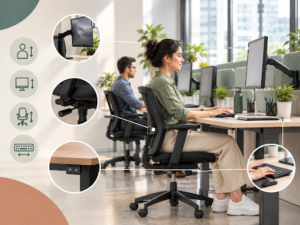
Tech integration: Navigate the realm of human-computer interaction. Utilize an adjustable desk, use a timer to indicate when to move around, use an adjustable task chair, and adjust monitors to optimal height/distance from eyes to enhance your workspace.
Biophilic design: Immerse your home in the psychology of biophilic design, supported by studies like “Biophilia: Does Visual Contact with Nature Impact on Health and Well-Being?” (International Journal of Environmental Research and Public Health, 2009). Integrate indoor plants and natural textures, drawing inspiration from “Urban natural environments as nature-based solutions for improved public health – A systematic review of reviews” (Environmental research, 2017), showcasing the positive impact of nature on mental well-being.
By meticulously incorporating these evidence-based ergonomic principles, your home renovation becomes a haven that harmonizes with both style and well-being. A proper home ergonomic assessment ensures that every element, from your chair to your ceiling light, is working in your favour.
Conclusion
Designing a home that supports your health is not just about aesthetics; it requires a thoughtful, evidence-based approach. A professional home ergonomic assessment takes the guesswork out of the process, helping you make targeted changes that reduce strain, improve comfort, and enhance your quality of life in every room.
Injury Prevention Plus specializes in ergonomic assessments for home offices, kitchens, and living spaces, tailored to your body, your habits, and your environment. Book your home ergonomic assessment with Injury Prevention Plus today and take the first step toward a home that truly works for you.
Frequently Asked Questions
What is an ergonomic risk assessment, and how does it support injury prevention?
An ergonomic risk assessment is a structured evaluation of workplace physical demands, posture, force, repetition, duration, and recovery conducted by a qualified ergonomist. It identifies conditions that exceed safe thresholds and generates specific recommendations to reduce them, addressing the root causes of musculoskeletal injury before they produce a claim.
Which industries benefit most from ergonomic risk assessment?
All industries with physical work demands benefit, but the impact is most significant in healthcare, warehousing, manufacturing, transportation, construction, and office-based settings with high-volume computer work. Each environment carries its own pattern of musculoskeletal risk, and ergonomic risk assessment is designed to identify and address the specific conditions present.
How is ergonomic risk assessment different from a general workplace safety audit?
A general safety audit covers a broad range of hazards such as chemical, electrical, and procedural. Ergonomic risk assessment focuses specifically on the physical demands of work and their relationship to musculoskeletal injury risk. It uses validated measurement tools to quantify exposure levels and produces findings specific enough to act on.
Can ergonomic risk assessment reduce workers' compensation costs?
Yes. Organizations with structured ergonomic programs consistently report reductions in musculoskeletal injury rates, lost-time claims, and modified duty requirements. The cost of an assessment is typically recovered through reductions in claims and absenteeism within the first year of implementation.
How long does an ergonomic risk assessment take?
Need help improving ergonomics in your workplace?
Our registered ergonomists are ready to help. Call us at (613) 730-1074 or book a consultation today.