

Our registered ergonomists are ready to help. Call us at (613) 730-1074 or book a consultation today.
The Hidden Cost of Frequent Reaching: How Ergonomic Risk Assessment Reveals the True Impact of Repetitive Movements on Workplace Health
Aug 21
Introduction
Reaching doesn’t feel like a risk. It feels like moving your arm.
That’s exactly why it stays off the radar for so long. Nobody reports a reaching injury in the moment it starts developing. They report a shoulder complaint six months later, after thousands of reaches across hundreds of shifts have finally exceeded what the rotator cuff can absorb. By that point the cost is already on the ledger. Lost productivity, modified duty, physiotherapy referrals, and eventually a formal claim. It just wasn’t visible while it was accumulating.
Frequent reaching is one of the most consistently underestimated physical demands in any workplace. It shows up in offices, warehouses, vehicle cabs, kitchens, and healthcare settings. It rarely triggers a hazard report. And without a structured ergonomic risk assessment, it drives a meaningful proportion of upper limb and shoulder injuries year after year across Ottawa, Toronto, Gatineau, and surrounding regions.
Why Does Reaching Create More Physical Strain Than It Appears To?
Because the shoulder is doing significantly more work than the task looks like it requires.
When the arm extends away from the body, the shoulder muscles activate to hold the joint stable against gravity and the weight of whatever is being handled. For a single reach, that activation is modest. For a task repeated fifty, a hundred, or several hundred times across a shift, the cumulative demand is substantial.
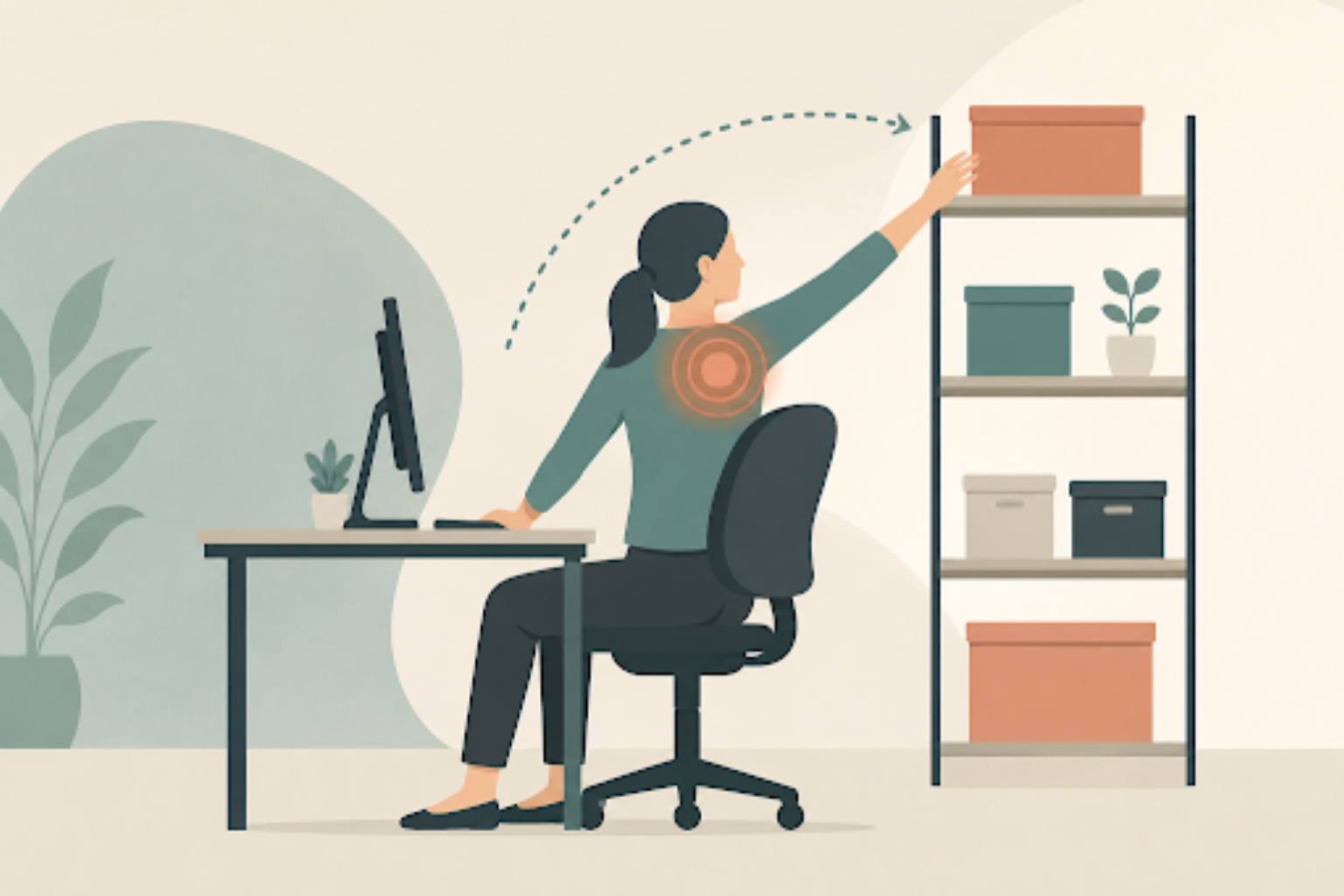
Distance matters considerably. Load on the shoulder joint increases disproportionately as the arm moves further from the body. A reach to the edge of comfortable arm extension generates roughly four times the shoulder joint load of the same task performed within the primary reach zone, the arc the forearm traces without the upper arm leaving the side of the body.
Most workplaces have no idea how far outside that zone their workers are reaching, how often, or for how long. That’s the awareness gap. And it’s where injury risk accumulates silently until it produces something that can no longer be ignored. An ergonomic risk assessment makes that exposure visible before it reaches that point.
Which Workplaces Are Most Affected by Frequent Reaching?
Reaching risk isn’t confined to physically demanding industries. It shows up wherever task layout places items, tools, screens, or controls outside comfortable arm reach on a repeated basis.
Warehouse and distribution environments across the Greater Toronto Area are among the highest-reaching work environments in any sector. Workers retrieving items from shelves above shoulder height or below knee level, reaching into racking toward the back of a bay, and extending across conveyor surfaces generate significant shoulder and lumbar load with every repetition. The reaching demand in these roles is rarely assessed as a standalone risk factor. It tends to disappear inside a broader manual handling review that focuses on lift weight without examining reach distance and shoulder posture in the same detail.
Office and desk-based workers accumulate reaching risk differently. A mouse positioned too high and slightly too far from the body keeps the shoulder marginally elevated and forward for the duration of the working day. A keyboard at the far edge of the desk requires a sustained reach every time the worker types. A monitor positioned to one side creates a lateral reach and rotation pattern that loads the neck and upper trapezius continuously. None of these look like reaching risks. Together, across a full working day, they add up to a consistent source of chronic upper limb strain that an office ergonomic assessment identifies directly.
For desk-based workers across Ottawa’s government sector, Toronto’s financial and tech environments, and Gatineau’s public service offices, these patterns are a consistent finding and a consistently addressable one.
Vehicle-based and field workers reach repeatedly across a shift in ways that rarely register as ergonomic demands. Extending into the cargo area from the driver’s position. Reaching across the cab to access a tablet or secondary control. Retrieving tools from floor-level storage multiple times per job. Each involves an extended reach, often combined with trunk rotation, repeated across dozens of vehicle stops per shift.
Home office workers face reaching risk from setups configured for casual use rather than sustained work. A laptop slightly too far away. A second monitor positioned to one side. A mouse on a surface a centimetre or two higher than the keyboard. Sustained across a full working day, these keep the shoulder out of its neutral position consistently enough to drive chronic upper limb discomfort that builds across weeks before it registers as worth mentioning.
How Do Employers Recognise That Reaching Is Becoming a Risk?
Reaching risk rarely announces itself. What it produces are signals that get attributed to other causes.
A cluster of shoulder complaints in a department where the physical work doesn’t look demanding. Upper limb discomfort that workers describe as coming on gradually without a specific incident. Physiotherapy referrals concentrated in roles involving sustained computer use or repetitive task work.
A few indicators worth paying attention to:
- Shoulder and upper limb complaints that follow a task pattern. When multiple workers in the same role report discomfort in the same body region, the role is generating the load. The individual workers are not the variable.
- Workers compensating during tasks. Leaning forward to reduce effective reach distance. Standing rather than sitting to get closer to a shelf. Rotating the trunk rather than repositioning the feet to face a reach target. These compensations are visible during observation if someone is looking for them, which is exactly what a formal ergonomic risk assessment does.
- Tasks where items are consistently placed outside comfortable reach. Shelves stocked to the back of a bay. Monitors positioned for available desk space rather than the worker’s arm length. Vehicle cargo organised by box size rather than retrieval frequency. These layout decisions drive reaching exposure across every worker performing those tasks, every shift.
- Reaching combined with load. Reaching risk is highest when the arm is extended, and something is being handled simultaneously. A light item retrieved from a shelf at full arm extension still generates four times the shoulder load of the same item retrieved within the primary zone. Weight amplifies this significantly.
What Practical Changes Reduce Reaching Exposure?
Most of the highest-impact interventions involve repositioning rather than replacement. They don’t require capital expenditure approval. They require someone to look at the task layout with the right questions in mind.
Bring frequently accessed items into the primary reach zone. In warehouses and distribution centres across Ottawa and Toronto, this means reviewing pick face positioning so the highest-frequency items sit between elbow and shoulder height within comfortable arm reach. In offices, it means moving the mouse to where the elbow naturally rests and bringing the keyboard close enough that the upper arms stay at the sides during typing.
Reorganise vehicle cargo storage by retrieval frequency. Tools and materials accessed multiple times per job should be at waist height and within easy reach from the cargo door. That reorganisation reduces the daily reaching and bending load for field workers across Gatineau, Toronto, and surrounding regions without changing the vehicle or the equipment.
Adjust shelf heights in fixed workstations. Positioning the most frequently accessed stock between knee and shoulder height eliminates the overhead and floor-level reaches that generate the highest shoulder and lumbar load.
Position screens and input devices for arm reach, not available desk space. Monitor at arm’s length. Mouse where the elbow rests. Keyboard close enough that the upper arms stay at the sides during typing. These three adjustments remove the chronic reaching demand driving most desk-based upper limb complaints.
Reduce reach-and-rotate combinations. Trunk rotation during a reach amplifies shoulder and lumbar demand considerably. Task layouts that require workers to reach across their body or rotate while extending the arm should be redesigned so the worker faces the reach target directly.
When Does Reaching Risk Warrant a Formal Ergonomic Risk Assessment?
When the practical changes above don’t resolve the pattern. When shoulder and upper limb complaints are recurring across a team. When a worker is returning from a reaching-related injury, and the role needs to be evaluated before they resume full duties. And proactively, when a role involves sustained reaching demands that have never been formally examined.
A structured ergonomic risk assessment makes reaching exposure visible in quantified terms. Validated tools including RULA, REBA, and the Arm Force Field method assess shoulder joint angles, force demands, and exposure duration, and produce risk ratings that identify where intervention is most urgent and what specific changes would reduce load most effectively.
For office workers across Ottawa and Toronto, an office ergonomic assessment evaluates actual working posture during real tasks, measures reach distances from the body to mouse, keyboard, and monitor, and identifies whether lateral reaching patterns are loading the neck and upper trapezius in ways the worker has stopped noticing.
For industrial and field roles, a physical demands analysis documents reach heights, distances, frequencies, and load weights in a format that supports risk quantification, job matching, and return-to-work planning under Ontario’s Workplace Safety and Insurance Act.
For home office and hybrid workers, a home office ergonomic assessment evaluates the actual setup in the environment where the work is happening, not a generic approximation of it.
Injury Prevention Plus conducts ergonomic risk assessments across office, industrial, vehicle, and home environments throughout Ottawa, Gatineau, Toronto, and surrounding regions. Every assessment is carried out by registered healthcare professionals with over 33 years of applied experience in occupational health ergonomics.
Book an assessment to find out what the reaching demands in your workplace are currently costing, and what a targeted intervention would look like.
Frequently Asked Questions
Why is frequent reaching considered a significant ergonomic risk?
Shoulder joint load increases disproportionately as the arm moves further from the body. A task performed at the edge of arm extension generates roughly four times the shoulder load of the same task within the primary reach zone. When repeated hundreds of times across a shift, the cumulative demand produces injury risk that develops slowly enough that it rarely gets identified before it becomes a formal complaint. An ergonomic risk assessment makes this exposure visible before it reaches that threshold.
Which workers are most affected by frequent reaching demands?
Warehouse and distribution workers performing picking tasks at shelf heights above shoulder or below knee level carry some of the highest reaching-related shoulder load of any occupation. Office workers with mice and keyboards positioned outside the primary reach zone accumulate chronic low-level shoulder demand across a full working day. Vehicle-based workers reaching into cargo areas and across vehicle cabs are also consistently identified in ergonomic risk assessment findings as carrying significant reaching-related upper limb risk.
How does an office ergonomic assessment identify reaching risks at a desk?
The assessment observes the worker’s actual posture during real tasks rather than an idealised demonstration. It measures the distance from the body to the mouse, keyboard, and monitor, evaluates whether the shoulder is consistently elevated or forward during common tasks, and identifies whether lateral reaching patterns are loading the neck and upper trapezius. Small repositioning changes identified through this process reduce chronic shoulder and neck load significantly without any equipment purchase.
Can a physical demands analysis document reaching risks for return-to-work planning in Ontario?
Yes. A physical demands analysis documents reach heights, distances, frequencies, and load weights for specific job tasks, giving treating practitioners and return-to-work coordinators an objective reference point for determining whether a worker recovering from a shoulder injury can safely resume full or modified duties. This documentation supports return-to-work processes under the Workplace Safety and Insurance Act and reduces friction between all parties during the planning process.
What is the most cost-effective way to reduce frequent reaching risks in a workplace?
Task and layout redesign before equipment purchase. The highest-impact changes almost always involve repositioning rather than replacement. Moving frequently accessed items into the primary reach zone, adjusting shelf heights, repositioning monitors and input devices within comfortable arm reach, and reorganising vehicle cargo storage to bring frequently used tools to waist height. A structured ergonomic risk assessment identifies which specific changes would produce the greatest reduction in reaching-related load for the particular environment being assessed.