Our registered ergonomists are ready to help. Call us at (613) 730-1074 or book a consultation today.

- Home
- About
- Services
- Office Ergonomic Assessment
- Virtual Ergonomic Assessment
- Webinars, Seminars and Training
- Physical Demands Analysis
- Vehicle Assessments
- Individual industrial Assessments
- Return to work-assessments
- Ergonomic risk assessments
- Corporate Opportunities
- Functional capacity evaluations
- Healthcare Ergonomics Assessments
- Manufacturing Ergonomic Assessment
- Warehouse Ergonomic Assessment
- Blog
- Contact
- FAQs

How Workplace Lighting Affects Ergonomics in the Workplace and Worker Health
Aug 29
Introduction
When workers start getting headaches or tired eyes, lighting usually isn’t the first thing they think of. They might think of too much screen time, a stressful week, or not sleeping well. The light above their desk rarely gets a second thought.
Ergonomics in the workplace helps connect the environment a person works in with the physical strain they experience. Lighting isn’t a comfort issue. It’s a physical demand. And like every other physical demand in a work environment, it accumulates.
Why Does Lighting Belong in an Ergonomics Conversation?
This is because the body responds to visual demand the same way it responds to any other kind of physical demand. Sustained effort produces fatigue. Fatigue produces compensation. Compensation, held long enough, produces strain.
A worker trying to read a document under insufficient light doesn’t consciously decide to lean forward. It just happens. The head moves toward the page. The cervical spine loads. The upper back muscles engage to hold the position. The shoulder girdle tightens slightly. Nothing about any of that registers as a physical event in the moment. By the end of the shift it’s accumulated into neck tension and a headache that the worker will take home, manage overnight, and bring back to the same desk and the same light tomorrow.
This is how lighting-related strain works. Not as a single incident but as a slow accumulation that’s genuinely difficult to trace back to its source without looking at the environment deliberately.
Ergonomics in the workplace looks at the environment deliberately. Lighting is part of that picture.
What Lighting Problems Actually Drive Physical Strain?
Not Enough Light for the Task
General overhead lighting adequate for walking through a space is not adequate for reading small print, reviewing documents, or inspecting detailed work across a full shift. Most workplaces treat lighting as a single decision made once for an entire floor. The tasks performed on that floor are not all the same, and the light required for them isn’t either.
Workers doing close detail work under insufficient illumination strain their visual system to compensate for what the environment isn’t providing. The ciliary muscles inside the eye work harder to maintain focus. The posture adjusts to bring the worker closer to the work. Both of those things are happening simultaneously, and neither of them is sustainable across an eight-hour day.
Glare Coming From the Wrong Direction
Glare is light landing in a place that creates problems rather than solving them. It comes in two forms and both matter.
Direct glare comes from a light source sitting within the worker’s field of vision. A window directly behind a monitor. A ceiling fixture positioned so it reflects on the screen. A desk lamp pointed at an angle that catches the eye during normal head movement. The visual system responds to a bright source in the field of view by constantly trying to adapt between the source and the task. That adaptation is effortful, and it’s continuous.
Reflected glare is subtler. Light bouncing off a glossy desk surface, a reflective keyboard, a shiny piece of equipment at the edge of the work area. The worker isn’t looking at a bright light source, but a version of it is present in their field of view in a form that creates contrast the visual system has to work around.
Both types of glare drive compensatory posture. Workers shift, tilt, lean, and reposition to move away from the source. Those adjustments feel like nothing. Sustained across a working day, they load the neck, shoulders, and upper back in ways that an ergonomic risk assessment traces back to the lighting condition rather than the workstation itself.
Bright and Cool-White Lighting
LED does not automatically mean comfortable. Plenty of offices have swapped fluorescents for LEDs and ended up with the same eye strain problem in a newer fitting. If the overheads feel harsh, some of them can just go off. A desk lamp on the actual work surface does the job better anyway. Keep the surrounding light low and warm and the difference is noticeable within a day.
High Contrast Between the Task and the Surroundings
The light around a desk is not something most people pay attention to until something starts to bother them. Usually by then it has been bothering them for weeks. When the work surface is dramatically brighter or darker than the surrounding space, the eyes are shuttling between two different luminance levels all day. That process has a cost. It does not announce itself as eye strain. It arrives as fatigue, a short fuse, difficulty concentrating past two in the afternoon.
A monitor set to maximum brightness in a dimly lit room. A brightly lit document review area surrounded by a much darker open plan floor. These contrasts create a demand on the visual system that compounds whatever the task itself requires.
How Does This Show Up Across Different Work Environments?
Office and Desk-Based Work
Screen-based work creates a specific lighting challenge. The monitor emits light. The surrounding environment reflects light. The document on the desk absorbs and reflects light differently from the screen. Managing all three within the same visual field across a full day is demanding, and most office lighting systems weren’t designed with that complexity in mind.
The most consistent findings in ergonomics in the workplace assessments across Ottawa, Toronto, and Gatineau office environments are overhead fixtures positioned directly above monitors creating screen reflections, windows behind workstations producing direct glare into the worker’s field of vision, and desk surfaces with enough reflectivity to create secondary glare during document work.
All of these are fixable. None of them are typically identified without someone looking for them specifically.
Industrial and Manufacturing Environments
In manufacturing, warehousing, and trades environments, lighting failures carry a different category of consequence. Insufficient illumination where precision work is performed, where machinery is operated, or where workers move through spaces with physical hazards increases both injury risk and error rate simultaneously.
Occupational health ergonomics in industrial settings treats lighting as a task performance factor. A worker inspecting components under inadequate light is both straining their visual system and increasing the probability of a quality or safety error. The physical and operational consequences compound each other and both trace back to the same environmental condition.
Common problems in these environments include shadow zones where overhead fixtures don’t adequately reach work surfaces, high contrast between brightly lit production areas and darker transit routes, reflective machinery surfaces creating glare during operation, and insufficient light in storage areas where workers need to identify items quickly and accurately.
Healthcare Settings
Healthcare settings have some of the most varied lighting needs. In hospitals, long-term care facilities, and clinics across Ottawa and Toronto, examination lighting, general room lighting, and task lighting often share the same space, with each serving a different purpose.
Night shift workers face a layer of challenge on top of that. Lighting levels change significantly between day and night operations, and workers moving between brightly lit clinical areas and dimly lit patient rooms are managing continuous luminance adjustment across a full shift. That adjustment is physiologically effortful in ways that compound the fatigue already produced by the physical demands of care work.
What Does Better Lighting Actually Look Like in Practice?
These are the changes that consistently reduce lighting-related strain across the environments where ergonomics in the workplace assessments identify lighting as a contributing factor.
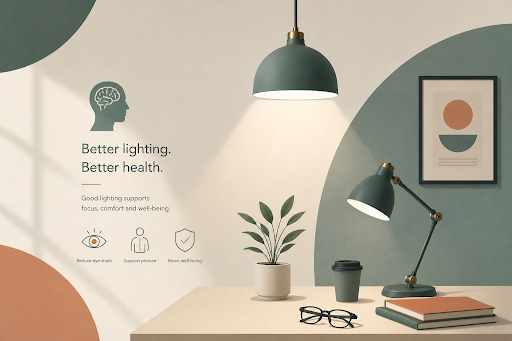
Match the light level to the task, not the room. Close detail work and document review need more illumination than general circulation areas. A single overhead level for an entire floor doesn’t serve all of the tasks performed within it. Task lighting at individual workstations fills the gap where general lighting falls short.
Position monitors perpendicular to windows. Not facing them, not with the window directly behind them. Perpendicular. This eliminates the two most common glare configurations in office environments without moving a single fixture.
Keep the area around the task lit to roughly a third of the task light level. A significant difference in luminance between the work surface and the surrounding environment forces continuous visual adaptation. Reducing that contrast reduces the adaptation demand.
There’s only so many times you can repair the same flickering light. If an old fluorescent fixture keeps having the same problem, replacing it with a quality LED fixture and the correct driver makes more sense in the long run.
Your monitor shouldn’t feel like a bright light shining in your face when the room around you is dark. At the same time, a screen that’s too dim in a bright room can make you strain to see it. Try to keep the screen brightness reasonably close to the lighting around you.
Audit the field of vision, not just the work surface. Glare from sources outside the immediate work area, a window across the room, a reflective surface on a neighbouring desk, still affects the worker if it falls within their normal field of view during the working day. An illumination measurement at the desk doesn’t capture this. Direct observation during actual tasks does.
When Should Lighting Be Part of a Formal Ergonomic Risk Assessment?
When workers in a specific area are reporting headaches, eye fatigue, or neck and shoulder tension that doesn’t track clearly to a workstation problem. When those reports cluster in particular locations rather than being distributed across the whole floor. When a new fit-out or lighting system change has coincided with an increase in visual complaints.
Sometimes the easiest way to spot a lighting problem is to look at where the complaints are coming from. If the workers sitting around one poorly positioned light are regularly dealing with headaches or eye strain, but people across the room aren’t, the location itself is giving you a useful clue.
An ergonomic risk assessment that includes lighting measures illumination at specific work surfaces, identifies glare sources within the actual field of vision during real tasks, evaluates luminance contrast between task areas and surroundings, and checks existing fixtures for flicker. The output is specific to the environment assessed, not generic guidance about lighting quality that could apply to any workplace.
Ergonomics in the workplace done properly doesn’t treat lighting as a footnote to the chair and desk assessment. It addresses the full physical and environmental demand placed on workers, because all of it lands in the same body at the end of the day.
Injury Prevention Plus conducts ergonomic risk assessments that include environmental factors such as lighting across office, industrial, healthcare, and field environments throughout Ottawa, Gatineau, Toronto, and surrounding regions. Every assessment is carried out by registered healthcare professionals with over 33 years of experience in occupational health ergonomics.
Book an assessment to identify what your work environment is producing that hasn’t been formally looked at yet.
Frequently Asked Questions
Is workplace lighting considered part of ergonomics in the workplace?
Yes. Ergonomics in the workplace covers the full range of physical and environmental conditions affecting how people function during work. Lighting directly affects visual demand, posture, fatigue, and injury risk. Poor lighting produces measurable physical consequences including neck strain, headaches, and eye fatigue that develop through the same cumulative mechanism as other ergonomic injuries. It belongs in the assessment, not in a separate facilities review.
What are the most common lighting problems that affect worker health?
Insufficient task illumination, direct and reflected glare, flickering light sources, and high contrast between the work area and surrounding environment are the most consistent findings in workplaces where workers report visual strain and related physical symptoms. These problems frequently coexist and compound each other, which is why addressing one in isolation often doesn’t resolve what’s being reported.
How does glare from a window or ceiling light cause neck and shoulder strain?
Glare in the visual field drives compensatory posture. A worker leaning away from a window glare source, tilting their head to avoid a ceiling reflection, or shifting position to reduce screen glare is sustaining a postural deviation that loads the cervical spine, upper trapezius, and shoulder girdle. The deviation is small in the moment. Held across an eight-hour shift it produces cumulative musculoskeletal strain that an ergonomic risk assessment traces back to the lighting condition rather than the chair or desk.
Can ergonomics in the workplace address lighting for shift workers and night workers?
Yes. Shift workers face lighting challenges that standard daytime assessments don’t account for. Transitions between high-luminance clinical or industrial environments and lower-light areas, working under artificial light across a full night shift, and adapting between bright and dark spaces repeatedly across a rotation all affect visual fatigue in ways specific to shift work patterns. Occupational health ergonomics assessment for shift workers addresses lighting within the broader physical demand profile of the role rather than applying daytime office standards to a fundamentally different situation.
How is lighting evaluated during an ergonomic risk assessment?
A lighting evaluation within an ergonomic risk assessment measures illumination levels at specific work surfaces, identifies glare sources by observing the worker’s actual field of vision during typical tasks, evaluates the luminance contrast between task areas and surrounding surfaces, and checks existing fixtures for flicker. The findings are specific to the workstations and environments being assessed, which allows interventions to target the actual sources of visual strain rather than applying uniform recommendations across a space where the problem is concentrated in one area.