Our registered ergonomists are ready to help. Call us at (613) 730-1074 or book a consultation today.
The Most Dangerous Task on Your Production Floor: How a Manufacturing Ergonomic Assessment Finds It
Nov 07
Introduction
How to assess workplace ergonomic risks and prevent injuries is a question employers often ask only after a pattern of complaints has formed. Many work-related musculoskeletal disorders develop over time due to repeated physical demands, awkward postures and insufficient recovery. Identifying these risks early can help employers take preventive action before discomfort develops into a more serious workplace injury. This post outlines the main ergonomic risk factors, a practical process for assessing them internally, and the point at which a professional ergonomic risk assessment is warranted.
Understanding Workplace Ergonomic Risks
A task rarely causes harm on a single occasion. The concern is accumulation. When the same muscles, tendons and joints are loaded repeatedly with limited recovery time, small amounts of tissue strain can add up faster than the body is able to repair them.
The main risk factors are well established, and each affects the body in a slightly different way:
- Repetition: The same movement performed many times in a shift, such as scanning, packing, or typing, loads the same tissues without variation.
- Awkward posture: When a joint moves away from a neutral position, muscles generally work harder to produce the same force. A neck bent toward a low screen is a common example.
- Force: Lifting, pushing, pulling, and gripping all increase tissue loading, and gripping a tool harder than the task requires adds to it.
- Sustained posture: Holding one position for long periods keeps muscles contracted and may reduce circulation to the working tissue.
- Contact stress and vibration: A forearm resting on a hard edge, or a hand on a vibrating tool, places pressure on nerves and soft tissue.
- Limited recovery: When nothing changes in what the body is doing from one hour to the next, the tissue has little opportunity to recover.
Early symptoms are often mild. Stiffness, tingling, headaches, and fatigue late in the shift are frequently attributed to age, sleep, or stress, which can delay recognition of a workplace cause.

Assessing Ergonomic Risk Step by Step
Established guidance, including the MSD Prevention Guideline for Ontario and, for office settings, CSA Z412, treats the identification and assessment of risk factors as the foundation of prevention. A structured internal review can follow a similar sequence:
- Review existing records. Injury, WSIB, first aid, and absence records, sorted by role or work area, can show whether the same body region appears repeatedly in the same job.
- Speak with employees. Workers are often aware of difficult tasks before the records reflect them, and may describe adjustments they have made to cope.
- Observe the work at its normal pace. A full work cycle should be observed, and also different points in the shift, because posture often changes as fatigue increases.
- Compare each task against the risk factors. Frequency, duration, posture, force, and recovery time can each be noted for every task reviewed.
- Rank the findings. Tasks that affect more people, for longer periods, or with greater physical demand are generally addressed first.
- Make changes and review the results. Employee feedback and the records over the following months indicate whether a change has reduced the exposure.
An internal review of this kind provides a useful first pass. It identifies where to look, although it does not measure force, load, or cumulative exposure with the precision of a formal evaluation.
Identifying the Causes Behind Workplace Injuries
An ergonomic analysis asks what the job is requiring of the worker’s body, rather than what the worker did incorrectly. This shifts attention to task design, equipment, layout, and work organization, which are usually where the changes can be made.
Several patterns are common in practice:
- Neck and shoulder discomfort in offices is often associated with a screen that sits too low or too far away, a laptop used without an external monitor, or a shared desk configured for a previous user.
- Low back discomfort in warehouses is frequently linked to storage at floor level, long carry distances, and limited access to lifting aids.
- Wrist and forearm complaints on production lines may relate to bench height, tool grip design and cycle speed.
- Back and hip discomfort among drivers can reflect seat fit, extended seated time and whole-body vibration.
The response should follow the cause. A new chair may provide limited benefit if the screen position is the underlying problem, and training may add little if the shelf height is what forces the awkward posture.
When an Internal Review Is Not Enough
An internal review has limits, and a formal evaluation is generally worth considering in the following situations:
- The same complaint continues to appear in the same role
- Modified duty or WSIB claims keep originating from one work area
- A change was made, and the complaints did not improve
- The work involves heavy lifting, pushing, repetitive machine loading, or prolonged driving
- An employee is returning from injury to a task that has not been measured
- New equipment, layout changes, or higher output targets are planned
How Professional Ergonomic Risk Assessments Support Injury Prevention
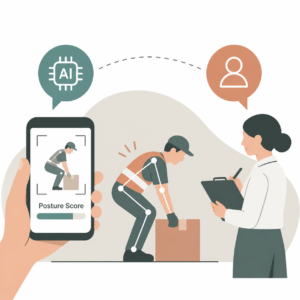
A professional ergonomic risk assessment adds measurement and interpretation to what an employer already knows about the site. During an ergonomics assessment, the assessor observes the work, speaks with the employees performing it, and records reach distances, heights, forces, and cycle counts. Recognized tools are then used to score the findings:
- REBA (Rapid Entire Body Assessment): scores whole-body posture and the load being handled.
- RULA (Rapid Upper Limb Assessment): scores neck, shoulder, arm and wrist posture during repetitive work.
- LiFFT (Lifting Fatigue Failure Tool): estimates cumulative low back loading from repeated lifting across a shift.
The report ranks the findings by risk and sets out recommendations specific to the site, so that the order of priorities is clear.
The type of ergonomic risk assessment needed depends on the work. An office ergonomic assessment reviews desks, screens, and shared workstations, and a virtual ergonomic assessment covers remote and hybrid employees by video. An industrial ergonomic assessment addresses lifting, tools, and task design, and a vehicle ergonomic assessment addresses fleet and field roles.
A physical demands analysis serves a different purpose. It documents what a role physically requires, including lifting, reaching, standing, and repetition, which supports hiring, job matching, and return-to-work planning in Ontario. The ergonomic risk assessment identifies which of those demands carry the most risk, and the two are often used together.
Some organizations engage an ergonomic consultant for a single project, while others use ergonomic consulting on an ongoing basis so that earlier changes can be reviewed and new risks identified as equipment, layouts, and targets change. IPP provides ergonomic assessments in Ottawa, Gatineau, Toronto, and surrounding regions.
Book an assessment to discuss which type of ergonomic risk assessment best suits the work in question.
Frequently Asked Questions
What is an ergonomic risk assessment?
An ergonomic risk assessment is a structured look at how a job loads the body. A trained assessor watches the work, measures things like posture, force, repetition, and recovery, scores the risk with recognised tools, and recommends changes. The aim is to find strain early, before it becomes an injury.
How often should workplace ergonomic risks be assessed?
When someone new starts a physically demanding role, when equipment, layout or targets change, when complaints start to pile up, and when someone returns from an injury. Many workplaces also review a few roles each year so every area gets a look over time. Waiting for a formal injury to trigger an ergonomic risk assessment is the slowest route.
Can I assess ergonomic risks myself?
You can do a first pass: check records, talk to workers, watch the tasks, and note the obvious problems. That helps you decide where to look. What’s hard to do yourself is measure force, load, and cumulative exposure. When problems keep returning, a professional ergonomic risk assessment is the next step.
What is the difference between an ergonomic risk assessment and a physical demands analysis?
An ergonomic risk assessment looks at how a task loads the body and which risks matter most. A physical demands analysis records what a job physically requires, such as lifting, reaching, standing, and repetition. One tells you what to change. The other documents what the role needs, which helps with hiring, job matching, and return to work.
Can I book an ergonomic assessment in Toronto, and does it have to be on site?
Yes. For an ergonomic assessment in Toronto, businesses can book on-site. Injury Prevention Plus serves Toronto, Ottawa, Gatineau, and surrounding regions. Industrial and warehouse work is usually assessed on site, while an ergonomics assessment for an office or remote setup can often be done over video. An ergonomic consultant can talk through the best option for your team, and ergonomic consulting can continue after the first visit if you want ongoing support.