Our registered ergonomists are ready to help. Call us at (613) 730-1074 or book a consultation today.
Construction Ergonomic Assessment: Reduce Injury Risks
Sep 26
Introduction
A construction worker can often tell you exactly when an injury happened. It may have been during a lift, while using a power tool, or after spending hours working in the same position.
But the injury may have been building for much longer.
Construction work puts the body under stress every day. Workers lift, carry, bend, kneel, reach, climb and use tools for hours at a time. A single task may seem harmless, but doing it repeatedly for weeks, months or years can take a toll.
A construction ergonomic assessment looks at those repeated demands. It helps identify which tasks are putting too much stress on the body and where practical changes can reduce that strain.
What causes physical strain in construction work?
Construction workers undergo a lot of physical demands during a normal shift. Some are easy to spot, while others only become a problem after repeated exposure.
For example, a worker may spend several hours bending forward while installing flooring or working below floor level. A plumber may spend much of the day kneeling or crouching. An electrician may work with their arms raised for long periods. A drywall worker may repeatedly lift and hold heavy sheets.
Each task adds to the physical load on the body.
The problem becomes greater when workers move from one demanding task to another without enough time to recover. The muscles, joints and soft tissues may not get enough rest before the next round of work begins.
That is why Ergonomics for Construction Workers needs to look at the whole shift rather than one movement in isolation.
Which construction tasks carry the most ergonomic risk?
An Ergonomic Risk Assessment for Construction usually looks at several common sources of physical strain.
Bending and working at low levels
Flooring, plumbing, tiling and other trades often require workers to bend forward for long periods. Repeated bending places stress on the lower back, especially when it is combined with lifting or reaching particularly with a poor posture. .
A worker may be able to hold a bent position for a few minutes without any problem. Doing the same thing for several hours is a different matter.
Working overhead
Electricians, drywall workers and HVAC technicians often work with their arms above shoulder height.
Holding tools overhead for long periods puts extra demand on the shoulders and upper arms. The longer the task continues, the harder it becomes to maintain the position comfortably.
Ergonomic Risks in Construction can also increase when the worker has to use force while reaching, work in a cramped space or hold a heavy tool away from the body.
Carrying materials across a site
Construction sites rarely have smooth, level floors throughout the day. Workers may carry materials across stairs, ramps, mud, uneven ground or scaffolding.
These conditions make carrying harder because the worker has to keep their balance while handling the load. The lower back and legs may have to work harder than they would on a flat surface.
Kneeling and crouching
Trades such as flooring and plumbing often involve working close to the ground. Spending long periods kneeling or crouching can place repeated stress on the knees and other parts of the lower body.
Hard concrete and unfinished floors can make these tasks even more uncomfortable.
Power tools and vibration
Drills, saws and other hand-held tools place repeated demands on the hands, wrists and arms. Workers also need to grip and control the tool, sometimes while working in an awkward position.
When tool use continues for much of the shift, vibration, grip force and repetition can become important parts of the overall risk.
Why can a normal lift still lead to a back injury?
Preventing Back Injuries in Construction requires looking beyond the weight of one lift.
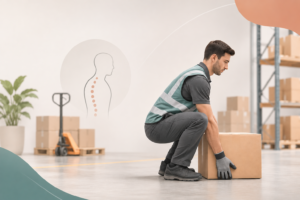
Consider a worker who lifts a material several dozen times during a shift. The load may be manageable each time. However, the worker may also be bending, carrying the material across an uneven surface and reaching to place it at different heights.
The height of the lift matters too. Lifting a load from the floor generally places more demand on the lower back than lifting the same load from a comfortable working height.
Frequency matters as well. A lift that feels fine once may become a problem when it is repeated 50 or 100 times during a shift.
Recovery also matters. If a worker spends the morning carrying materials, follows that with repeated bending and then finishes the day with more lifting, the body has had little chance to recover.
A proper Manual Material Handling in Construction review therefore considers more than weight. It looks at the height of the lift, frequency, distance, surface, working position and the way tasks are spread across the shift.
Does the worker's trade change the risk?
Yes. Construction workers do not all face the same physical demands.
A construction ergonomic assessment should take the actual trade and its daily tasks into account.
Roofers may spend long periods working on sloped surfaces while bending, lifting and carrying. This can place considerable demand on the lower body and back.
Electricians may face more overhead work and awkward positions when working in ceiling spaces or around electrical equipment.
Drywall workers deal with heavy sheets as well as repeated overhead finishing work. Both activities can put stress on the shoulders and upper body.
Plumbers and HVAC technicians may spend long periods kneeling, crouching or reaching in tight spaces.
Because these jobs are so different, an Ergonomic Risk Assessment for Construction should focus on the specific tasks performed by each trade rather than treating every construction role in the same way.
When should a construction site consider an ergonomic assessment?
There are several signs that a site may benefit from a formal assessment.
- Workers in the same trade keep reporting similar problems: If back complaints keep appearing among flooring workers or shoulder complaints are common among ceiling workers, the task itself may need to be reviewed.
- Modified duties are becoming common: Regular modified-duty arrangements can be a sign that the physical demands of a role are causing repeated problems.
- A task has never been assessed: Construction sites often have safety checks and manual handling training in place, but some physically demanding tasks may never have had a detailed ergonomic review.
- A worker is returning after an injury: Understanding the actual physical demands of the job can help employers and healthcare professionals make safer return-to-work decisions.
- The work setup is changing: New equipment, changes to material storage or a different site layout can change how workers perform a task. An ergonomic review can help spot problems before they become regular complaints.
What does a construction ergonomic assessment look at?
A construction ergonomic assessment looks at how work is actually done during a shift.
It may review:
- Overhead work, including tool weight, arm position and how long the worker stays overhead
- Bending, kneeling and crouching during floor-level tasks
- Lifting and carrying, including weight, height, distance and frequency
- Grip force and repeated use of hand tools
- Vibration from power tools
- The order in which demanding tasks are performed
- How much recovery time workers get between physically demanding activities
Ergonomic risks in construction also need to be considered where workers spend a large part of the day with their arms raised.
For back-related concerns, assessment methods such as the LiFFT method and Liberty Mutual equations can help measure the demands created by lifting and carrying across a shift.
The goal is to understand where the physical load is coming from and which parts of the job can realistically be changed.
What can be changed after an assessment?
The recommendations will depend on what the assessment finds.
In some cases, materials can be moved closer to the point where they are needed. This reduces unnecessary carrying.
Material storage can sometimes be raised so workers do not have to lift everything from floor level. Tools may be changed if their weight, grip or vibration is adding to the problem.
Work can also be arranged differently. For example, rotating tasks can prevent one body area from carrying most of the physical load throughout the day.
For floor-level work, better knee protection or changes to the work surface may help. For overhead work, changing the work height, equipment or task setup may reduce the time workers spend reaching above shoulder level.
These changes are also useful when Preventing Back Injuries in Construction because they address the demands built into the job rather than relying only on workers to change how they lift.
Conclusion
Construction sites are busy and every trade has its own physical demands. A useful assessment should reflect what workers actually do, how often they do it and what the site conditions are like.
A detailed review can show where the biggest problems are and which changes are worth making first.
Injury Prevention Plus conducts construction ergonomic assessments for construction, trade, industrial and field environments across Ottawa, Gatineau, Toronto and surrounding areas. The assessments are carried out by registered healthcare professionals with more than 33 years of experience in occupational health ergonomics.
If your site has repeated musculoskeletal complaints, physically demanding tasks or workers returning after an injury, an assessment can help you understand where the strain is coming from and what can be changed.
Frequently Asked Questions
What is a construction ergonomic assessment?
A construction ergonomic assessment reviews the physical demands of construction work, including lifting, bending, carrying, overhead work and repetitive tasks. It helps identify areas that may increase the risk of injury.
ow can an Ergonomic Risk Assessment for Construction help prevent injuries?
An Ergonomic Risk Assessment for Construction looks at factors such as task frequency, working posture, lifting height, carrying distance and recovery time. The findings can help employers make practical changes to reduce physical strain.
How can ergonomics for construction workers help prevent back injuries?
Ergonomics for construction workers can help reduce back strain by improving material placement, reducing unnecessary lifting and carrying, changing difficult working positions and spreading demanding tasks more effectively across a shift.
What are the main Ergonomic Risks in Construction?
Ergonomic Risks in Construction can include prolonged arm elevation, awkward shoulder positions, heavy tools and repeated overhead movements. These demands can increase strain on the shoulders and upper body.
What does Manual Material Handling in Construction involve?
Manual Material Handling in Construction includes lifting, carrying, pushing, pulling and moving materials around a worksite. An assessment considers factors such as load weight, lifting height, frequency, carrying distance and the surface workers move across.