Our registered ergonomists are ready to help. Call us at (613) 730-1074 or book a consultation today.
Public Safety Ergonomic Assessment: Understanding the Physical Strain of Task Switching
Oct 24
Introduction
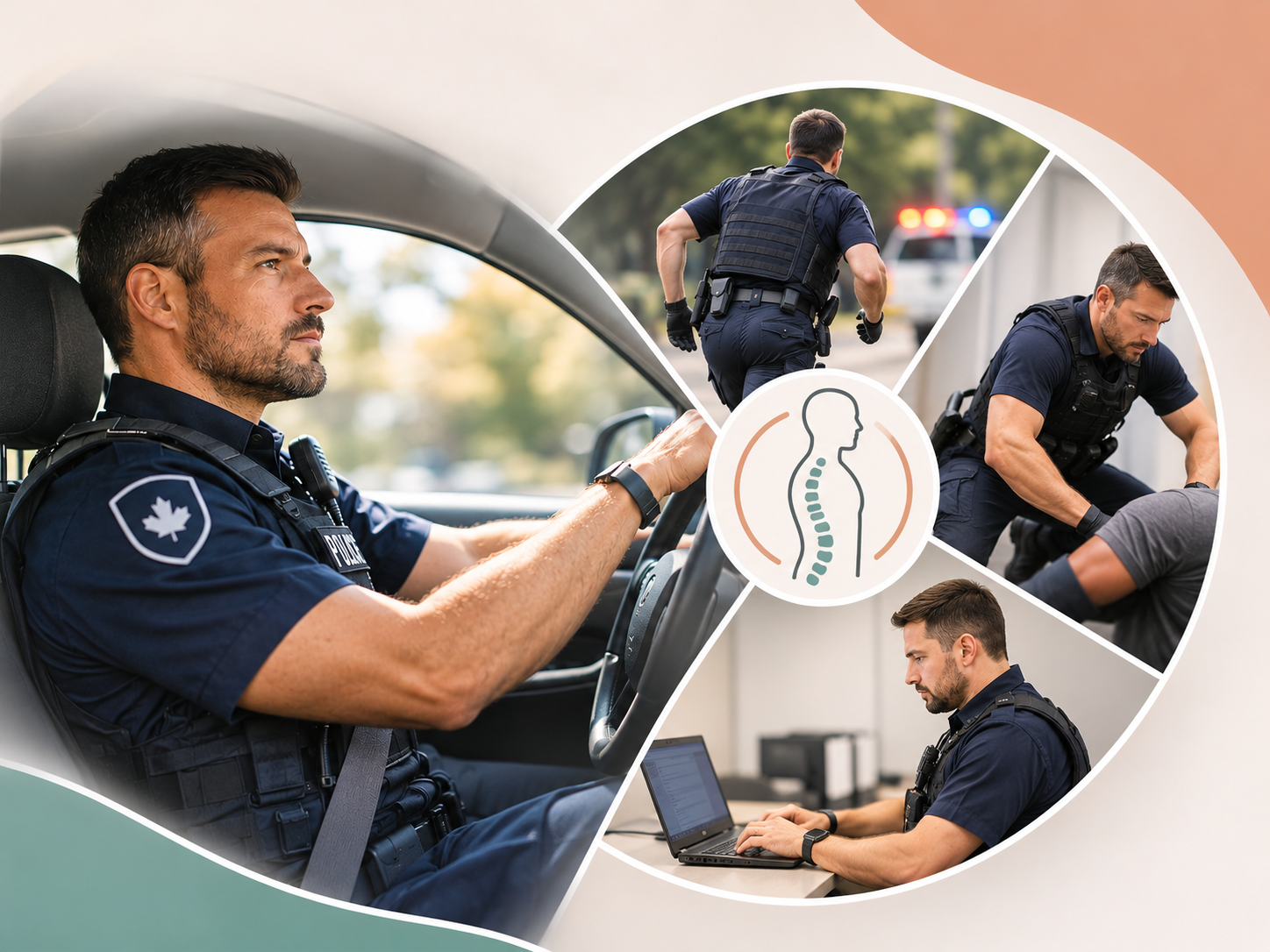
A police officer can sit in a patrol car for two hours, step out to a physical incident, get back in and drive another ninety minutes, then walk into a complex scene that means lifting, restraining and moving on foot. All of that can happen in one shift. Sometimes twice.
The body gets no memo between those changes. It goes from long static loading in a vehicle seat to sudden, high-effort output with no warm-up, no recovery and nothing in between to cushion the switch.
That gap is where a good share of police and public safety musculoskeletal injuries come from. No single demanding task causes them. The damage comes from switching, over and over, between tasks that load the body in completely different ways, without the conditions that would let it handle those transitions safely.
A public safety ergonomic assessment is built to look at that whole picture, and not at tasks one at a time.
How do different job tasks add to physical strain in police and public safety work?
Every task in a public safety shift loads the body differently, and they rarely come with any recovery in between.
- Long stretches of driving
An officer sitting in a car for two hours isn’t resting. The lumbar spine is under steady compression, whole-body vibration from the road keeps loading the discs, and the hip flexors shorten in a fixed seated position. Getting in and out of the vehicle all shift loads the hip, knee and lower back in a posture most workers would never hold for more than a few seconds. Over ten hours and dozens of entries and exits, it adds up. - Duty belt and body armour
This weight sits unevenly across the torso, hips and lower back for the entire shift. It never pauses between tasks. It sits on top of everything else the officer does. Restraining a subject, chasing on foot or lifting a patient in an emergency all happen with equipment that shifts the centre of gravity and loads the spine differently than the same task without it. - Sudden jumps to high-demand activity
Going from a vehicle seat to a physical confrontation, a foot pursuit or an emergency lift is a transition the body isn’t ready for. Muscles that spent ninety minutes in static loading don’t snap back to full capacity. In many cases the risk of injury is higher during the transition than during the demanding task itself, because nothing has warmed up and the demand arrives at once. - Standing and walking on hard surfaces
Community policing, event work, court attendance and station duties all mean long periods on hard flooring. Tired legs and lumbar loading from standing without postural variation turn up consistently whenever a public safety workplace assessment looks at roles with a lot of standing time. Duty footwear matters too, and it almost never gets evaluated as an ergonomic factor. - Paperwork and desk-based work
In-vehicle reporting on a laptop mounted at an angle never meant for long use. Station paperwork at a desk nobody has set up for the person sitting at it. Admin tasks that land after a physically heavy shift, when the body is already carrying a lot. Findings from a police ergonomic assessment regularly single this part of the job out as a major source of neck, upper back and wrist complaints, which officers rarely connect to the desk work.
What makes task switching itself a physical risk?
Most workplace health programs miss this one completely.
They assess tasks individually. Driving gets evaluated, so does manual restraint, so does patient handling. What nobody looks at is what happens to the body as it moves between those states across a shift, especially when the changes are abrupt and the demands on either side are nothing alike.
A body that has sat in sustained flexion in a vehicle isn’t in the same state as one that has been moving and changing posture. When a sudden high-demand task follows a long static spell, the stabilising muscles haven’t had the activation and blood flow that usually come before heavy effort. The strain risk during the switch is higher than at any point in the long task before it.
Sports science and rehabilitation have understood this for years. Workplace safety programs for public safety roles mostly haven’t caught up. They keep assessing tasks on their own and miss the cumulative and transitional load that really drives the injury pattern.
A public safety ergonomic assessment that takes in shift structure, task sequence and transition demands, alongside the individual tasks, produces findings specific enough to act on.
How can strain be reduced when switching between patrol, vehicle use and emergency response?
Does vehicle setup really change what the body handles across a shift?
Yes, and by a lot.
A patrol seat that isn’t adjusted to the officer adds to every hour of driving. The lumbar support is in the wrong place, set for somebody else’s back. The seat height keeps the hips at an angle that raises flexor tension. The seat distance bends the knees in a way that loads the hip joint differently than it should over long periods.
For patrol vehicles, a public safety ergonomic assessment checks:
- Seat height and distance to the pedals, against the officer’s body dimensions
- Lumbar support position, and whether it actually meets the lumbar curve when the officer sits
- Steering wheel distance, and whether the officer has to keep reaching to use the controls
- In-vehicle equipment layout, including laptop mounts and radio position, and whether normal use forces repeated side reaching or trunk rotation
- Entry and exit mechanics, and whether door height and step design load the hip and lower back on every exit
None of that is minor. An officer who gets in and out twenty times a shift through a badly designed vehicle opening takes a very different hip and lower back load than one whose access suits their body.
Can duty belt and equipment load be managed ergonomically?
The load itself can’t be removed. How it’s spread and positioned is something you can control.
Belt weight and distribution is a particular focus of any public safety ergonomic assessment, because the way equipment sits on the belt decides how load travels through the lower back, hips and knees during every task. Put the heavy gear on one side and the officer is managing lopsided loading through every hour, every transition and every physical activity of the shift.
The fixes are fairly simple:
- Spread equipment weight as evenly as operational needs allow
- Keep the heaviest items close to the body’s midline, which shortens the lever arm acting on the lower back
- Check body armour fit against the individual officer’s torso, since armour that doesn’t fit changes load distribution and compounds the problem across a full shift
- Look at whether the combined belt and armour weight is sustainable for that officer’s physical capacity
What helps the body cope with sudden jumps from static to high-demand tasks?
Brief movement before and between demanding tasks makes a measurable difference.
This isn’t about warm-up routines nobody has time for. It’s the gap between stepping out of the vehicle straight into a high-demand situation and taking thirty seconds to move naturally first. A bit of walking, some joint movement through a comfortable range, a change of posture before the demand hits.
Firefighters leaving an apparatus ahead of an active scene, paramedics climbing out of an ambulance for a call, military personnel moving from vehicle operation to field activity: preparing the body for sudden output is a recognised part of risk management in military ergonomic assessment and tactical health programs.
Police operations rarely give it the same attention, even though the transition demand is comparable. Building brief movement into the routine around vehicle exit, when a physical demand is expected, is a cheap intervention with real physiological backing. A public safety ergonomic assessment can show where in a given operation those moments fall.
Does workstation setup matter for a role that isn’t desk-based?
More than most police organisations give it credit for.
Documentation takes up a big part of an officer’s shift. Reporting in the car on a laptop mounted at an angle not meant for long use puts load on the neck and upper limbs that builds with each reporting period. At a station workstation that hasn’t been adjusted to the individual officer, the pattern carries on.
Desk work may seem less demanding than field duties, but hours of typing and working on a poorly positioned laptop can add strain to the neck, shoulders and wrists. A public safety workplace assessment looks at documentation workstations as well as operational tasks, ensuring these risks aren’t missed.
How does a public safety ergonomic assessment deal with these specific risks?
A public safety ergonomic assessment doesn’t look at police, fire or paramedic work through an office or industrial lens. The task demands, the equipment load, the vehicle environment and the shift from static to high-demand activity are specific to this setting, and the method has to reflect that.
A thorough public safety ergonomic assessment covers:
- Patrol vehicle seat configuration, equipment layout, and entry and exit mechanics, relative to the officer’s body dimensions
- Duty belt and body armour load, distribution and fit
- Documentation workstation setup, in the vehicle and at the station
- The physical demand profile of operational tasks, including restraint, patient handling, prolonged standing and foot pursuit
- Shift structure and task sequence, in particular whether switches between static and high-demand tasks happen under conditions that raise injury risk
- Recovery time, and whether the shift lets people recover between high-demand events
Military work has its own ergonomic challenges, from carrying heavy loads and wearing body armour to operating military vehicles and working across varied terrain. A military ergonomic assessment uses the same basic framework as a public safety assessment, with a focus on military equipment, vehicles and field conditions rather than civilian policing tasks.
Apart from a public safety ergonomic assessment, a physical demands analysis outlines the physical tasks and requirements of the job. This information helps WSIB return-to-work coordinators and treating practitioners assess an officer’s or first responder’s readiness to return after a musculoskeletal injury.
For vehicle-based roles, the work ties directly to the vehicle ergonomic assessment methodology IPP uses for fleet and transport workers, adapted to the configuration and demands of public safety vehicles.
Injury Prevention Plus conducts public safety ergonomic assessments for police services, military units, fire departments and emergency medical services throughout Ottawa, Gatineau, Toronto and surrounding regions. Every assessment is carried out by registered healthcare professionals with OPS security clearance and over 33 years of applied experience. Bilingual assessment is available for francophone public safety personnel across the Outaouais region and Eastern Ontario.
Book a public safety ergonomic assessment to find out what task switching in your operation is asking of your people, and which targeted changes would reduce the physical cost.
Frequently Asked Questions
Why are task transitions a specific injury risk in public safety work?
When the body moves from a sustained static posture, such as prolonged vehicle operation, directly into high-demand physical activity, the stabilising muscles haven’t had the activation and circulation that would normally precede that demand. The risk of strain during the transition is higher than during either task alone. Public safety work involves these transitions repeatedly across a shift, which makes them a significant and consistently underexamined source of musculoskeletal injury risk.
How does a police ergonomic assessment differ from a standard workplace assessment?
A police ergonomic assessment evaluates the specific physical demands of law enforcement work including patrol vehicle configuration, duty belt and body armour load, documentation workstation setup, operational task demands, and the transitions between static and high-demand activity across a shift. Standard workplace assessment methodology is designed for fixed workstations or production environments and doesn’t account for the task variability, equipment load, or sudden demand transitions that characterise police work.
What does a military ergonomic assessment cover that a standard industrial assessment doesn’t?
A military ergonomic assessment addresses load carriage systems, body armour and protective equipment fit, military vehicle ergonomics, and the physical demands of field operations across variable terrain and deployment conditions. It also examines the cumulative physical load of sustained operations, the ergonomic consequences of load weight distribution in pack and vest systems, and the transition demands between different operational states. These are not variables that standard industrial assessment frameworks are designed to evaluate.
How does duty belt and body armour configuration affect musculoskeletal injury risk?
The weight of a duty belt and body armour is carried across the lower back, hips, and torso for the full shift. Asymmetrical distribution of that weight, armour that doesn’t fit the individual officer’s torso dimensions, and belt configurations that concentrate heavy items at positions that increase the lever arm through which that weight acts on the spine all contribute to cumulative musculoskeletal loading across every hour of the shift and every task performed within it. A public safety ergonomic assessment evaluates configuration and fit specifically to identify where load distribution can be improved within the operational requirements of the role.
Can a public safety ergonomic assessment support return-to-work planning for injured officers in Ontario?
Yes. A public safety ergonomic assessment combined with a physical demands analysis of the specific role provides the objective documentation that WSIB return-to-work coordinators and treating practitioners need to determine whether an officer can safely resume full or modified duties. The physical demands analysis documents the specific task requirements, load demands, and transition demands of the role, giving the treating team a factual basis for return-to-work decisions rather than general assumptions about what police or public safety work physically requires.