
Our registered ergonomists are ready to help. Call us at (613) 730-1074 or book a consultation today.
Reducing Manual Handling Injuries: What an Ergonomic Risk Assessment Reveals
Oct 23
Introduction
Most manual handling injuries get blamed on a moment. A bad lift. An awkward carry. The morning someone’s back finally gave out.
That moment is real. It’s just not where the problem started.
What gets reported is usually the end of a much longer story. The same lift at the wrong height, repeated across hundreds of shifts. A carry just heavy enough to be manageable once and damaging at forty repetitions a day. A push or pull task that looked fine in a safety audit and generates forces well above what the body can handle when you actually measure it.
A structured ergonomic risk assessment makes that accumulation visible before it produces a formal injury. Here’s what’s actually driving manual handling injuries, what practical changes reduce the risk, and what a formal assessment finds that observation alone never catches.
What Actually Causes Manual Handling Injuries in the Workplace?
Rarely one thing. Almost always a combination of factors that are each manageable on their own and damaging together.
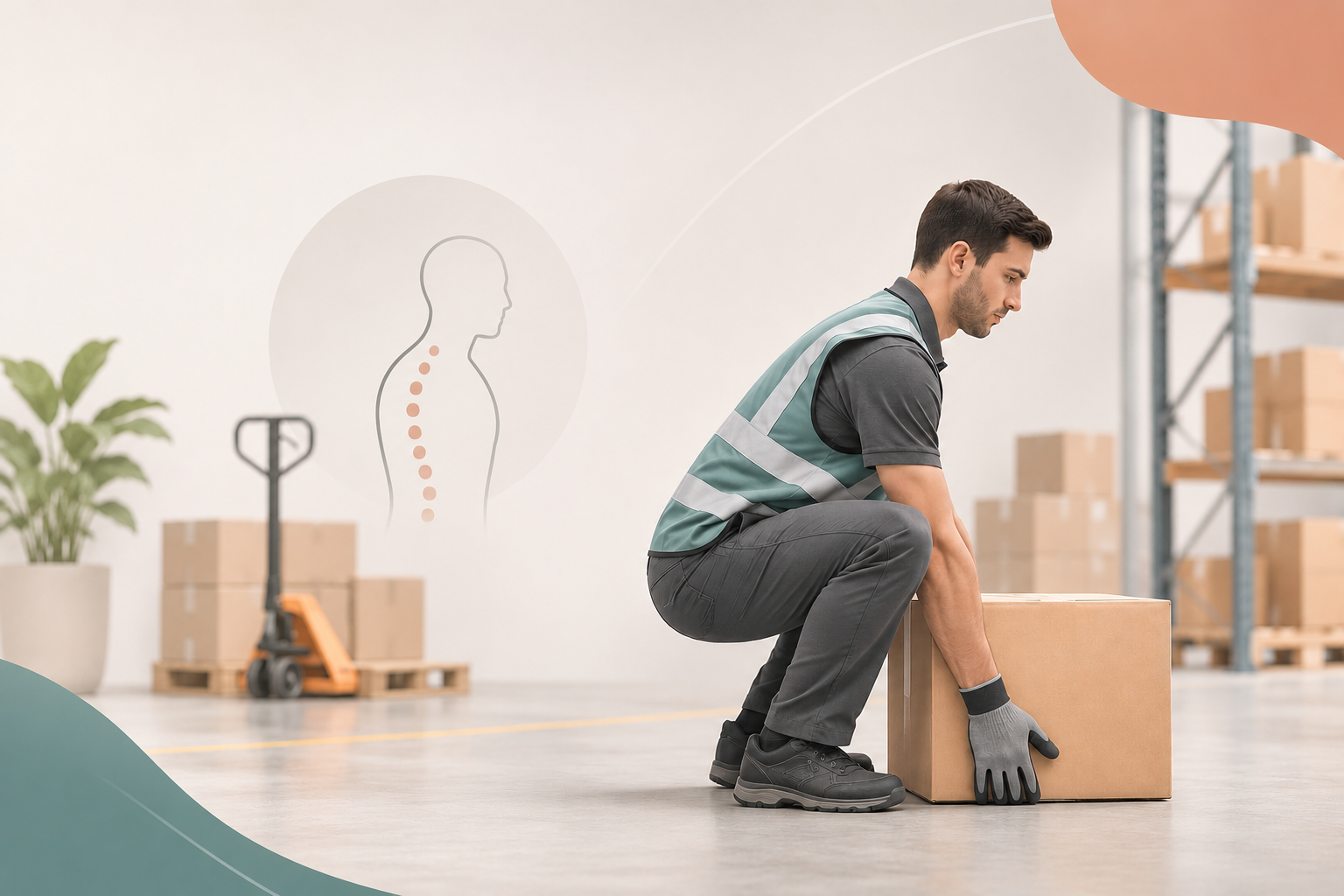
Load weight without accounting for lift height. The standard question in most workplaces is whether the load is too heavy. The more useful question is where the lift is happening. A twenty-kilogram lift from floor level loads the spine significantly more than the same lift from mid-height. On a warehouse floor where materials land at ground level and need to move to a working surface, floor-level lifting is the default. Ergonomic principles for manual handling look at height alongside weight because the two interact in ways that weight alone doesn’t capture.
Repetition without enough recovery between cycles. A single lift within acceptable weight limits is fine. The same lift fifty or a hundred times across a shift without meaningful rest between repetitions is a different physical demand entirely. The tissue accumulates load. The deficit carries into the next day. Eventually the body runs out of capacity to absorb another ordinary task.
Awkward postures during the lift or carry. Forward bending under load, twisting while carrying, reaching across the body to manage something with an awkward shape. Each of these changes the body’s mechanical position in ways that amplify spinal and shoulder loading far beyond what the weight alone would generate.
Task design and storage layout that nobody has reviewed. Most manual handling risk isn’t created by workers making poor choices. It’s built into the task before the first person performs it. Heavy items stored at floor level because that’s where they fit. A packing station at the wrong height for the people using it. A staging area that forces a longer carry than the task needs. These are design decisions made once, with physical consequences that repeat every shift until someone formally examines them.
Mechanical assists that exist but don’t actually get used. A pallet jack at the other end of the building from where it’s needed. A hoist that requires two people to operate when only one is available. Equipment that looks fine on a site plan but doesn’t fit the real workflow produces the same physical demand as no equipment at all.
Why Do Manual Handling Injuries Often Go Unnoticed Until They Become Serious?
Because the early signals are easy to dismiss, and the gap between early signal and serious injury is long enough that nobody connects the two.
A worker whose lower back is slightly stiff by the end of Monday doesn’t report an injury. They go home, sleep, come back Tuesday, and manage. By Thursday the stiffness arrives earlier. By the following month it’s there from the start. By the time it becomes something that gets formally reported, weeks or months of loading are already behind it.
Ways to avoid injury at this stage are far simpler and less expensive than at the formal injury stage. The workstation adjustment that would have resolved the problem in week two becomes a modified duty arrangement in month four. The task redesign that would have prevented the pattern costs less than a single WSIB claim.
That’s the core argument for a proactive ergonomic risk assessment over a reactive one. Identifying and addressing manual handling risk before injury is a fraction of the cost of managing that injury after it’s happened.
What Practical Strategies Actually Reduce Manual Handling Injuries?
Do Workstation and Storage Layout Changes Make a Real Difference?
Yes, and often more than any other single intervention.
The highest-impact changes in most workplaces don’t require new equipment. They require looking at where things are stored and how that forces the body into positions it doesn’t need to be in.
- Move high-frequency items to between knee and shoulder height. This removes the floor-level and overhead lifts that generate the highest spinal and shoulder loads without requiring any change to the items or the workflow around them.
- Position staging areas so workers face the direction of travel rather than twisting under load. Trunk rotation combined with a carry amplifies lumbar loading in ways a straight carry at the same weight wouldn’t produce.
- Reduce carrying distances wherever possible. The farther the workers carry something, the more their lower back muscles have to work. Placing staging areas closer to workstations can help limit the physical strain that builds up during the day.
- Adjust packing and workstation heights to the people using them. A surface at the wrong height produces sustained forward bending or shoulder elevation for the full duration of the task. At the pace and shift duration common in distribution environments, the total exposure across a day adds up to something significant.
Does Task Rotation Help or Just Move the Problem Around?
It helps when it’s done right. It moves the problem when it isn’t.
The difference is whether the rotation pairs tasks with genuinely different physical demands. Rotating a worker between two picking stations that both require frequent floor-level lifts provides movement without any ergonomic benefit. The same tissue accumulates the same load in the same direction, just with a walk between locations.
Effective rotation puts different body regions to work at different times:
- A high shoulder-demand overhead picking task paired with a lower-demand quality inspection role
- A repetitive floor-level lifting task alternating with a seated packing or labelling task
- A heavy manual carry followed by a period of equipment operation or documentation work
The region getting the highest load in the first task recovers while a different region handles the second. That’s the point of rotation. Without deliberate pairing of genuinely different demands, it’s just a schedule change.
How Do Micro-Recovery Intervals Work and Why Do They Matter?
Regular breaks are important, but short recovery periods throughout the shift can help even more. They give the body a chance to recover before physical strain builds up over several hours.
Frequent changes in posture can help reduce the strain caused by repetitive tasks. For example, switching tasks for two minutes every 20–30 minutes can help limit the build-up of physical stress. A longer lunch break may not be enough to make up for hours of continuous work.
The key is to build these changes into the workday rather than expecting employees to find time for them on their own.
- A standing task after every sustained seated packing period
- A brief walk between intensive picking sequences
- A postural change at predictable intervals, built into the workflow rather than left to discretion
For managers planning shift schedules, the question is not just whether breaks are on the timetable. It’s whether the work itself creates the variation that protects against cumulative strain between those breaks.
Does Equipment Maintenance Affect Manual Handling Risk?
More than most operations account for.
A pallet jack with worn wheels requires significantly more push and pull force to initiate movement than a well-maintained one. That extra force is absorbed by the worker’s shoulders, lower back, and lower limbs on every push. Across dozens of pushes per shift, the difference between maintained and neglected equipment accumulates into real physical demand.
The same applies to conveyor systems, hand trucks, trolleys, and any mechanical assist. Equipment that exists to reduce manual handling demand only delivers that reduction when it’s working properly. A proper warehouse risk assessment looks at equipment condition, work tasks, and workstation layout to spot potential risks before they cause problems.
How Do Manual Handling Risks Vary Between Offices and Warehouses?
The principles are the same. But due to the differences in the specifics, they need to be evaluated separately.
In warehouse and industrial environments, the risk sits mainly in lifting, carrying, and push and pull tasks at production volumes. The loads are heavier, the repetition rates are higher, and the results of poor task design show up faster.
In office environments, manual handling risk is lower in intensity but still present. Moving boxes of files, shifting furniture, carrying equipment between floors, restocking supply rooms. These tasks happen infrequently enough that nobody assesses them formally, yet occasionally enough that workers approach them without the physical preparation they’d bring to tasks they perform daily.
An office ergonomic assessment that includes the non-desk physical tasks alongside the workstation evaluation produces a more complete picture of what that role actually asks of the body. The manual handling component of an office role is rarely the highest-risk element, but it’s consistently the least examined.
How Does an Ergonomic Risk Assessment Find Manual Handling Risks That Observation Misses?
A visual observation of a worker performing a manual handling task identifies obvious problems. A structured ergonomic risk assessment measures what the task is actually asking of the body.
The difference is in the tools and the scope.
Force measurement for push and pull tasks accounts for the force required to initiate movement, the handle height relative to the worker’s body, the floor surface, equipment condition, and the frequency and distance across a shift. Visual observation of a worker pushing a loaded cart tells you the task exists. Force measurement tells you whether the initiation force exceeds what the body can sustain at the frequency it’s being performed.
Cumulative spinal loading calculation using the LiFFT method and Liberty Mutual equations quantifies how much lumbar compression builds across the full shift from all the lifting, carrying, and bending combined. A single lift assessed against the NIOSH lifting equation tells you whether that individual lift is within acceptable limits. The LiFFT calculation tells you whether the full shift pattern of lifts, at the heights and frequencies they actually occur, exceeds what the lumbar spine can absorb and repair overnight.
Postural analysis using RULA and REBA quantifies the risk of the postures workers adopt during manual handling tasks, accounting for trunk angle, shoulder position, and the load being managed at the point of maximum demand. These produce specific risk ratings for specific tasks rather than general observations about whether something looks physically demanding.
Shift structure evaluation looks at whether task variation and recovery time across the shift allow adequate tissue recovery between high-demand exposures. A task within acceptable limits in isolation may generate real injury risk when performed continuously for four hours without variation, which is what this part of the assessment examines.
A physical demands analysis breaks down the physical requirements of a job to help employers plan an employee’s return after an injury. Healthcare providers and WSIB coordinators can use the report to decide whether an employee can return to their usual duties or needs some changes to their role.
Injury Prevention Plus offers ergonomic risk assessments across Ottawa, Gatineau, Toronto, and nearby areas, backed by registered healthcare professionals with over 33 years of experience.
Book an assessment to understand your workers’ physical demands and find practical ways to reduce injury risks.
Frequently Asked Questions
What are the most common causes of manual handling injuries in the workplace?
The most consistent causes are load weight combined with poor lift height, high repetition without adequate recovery between repetitions, awkward postures during lifts and carries including forward bending and twisting under load, task and storage layout that forces workers into high-risk positions, and mechanical assists that exist but don’t get used because they don’t fit the real workflow. Most manual handling injuries develop from a combination of these factors rather than any single cause.
How does an ergonomic risk assessment identify manual handling risks that standard safety checks miss?
A standard safety check identifies obvious hazards. An ergonomic risk assessment measures the cumulative physical demand of the full shift, not just the individual task. It uses validated tools including the LiFFT method, Liberty Mutual equations, and RULA to quantify spinal loading, force demands, and postural risk across all manual handling tasks combined. This produces a picture of what the shift is actually asking of the body, which is what determines injury risk rather than the assessment of any single lift or carry in isolation.
Does task rotation actually reduce manual handling injury risk?
Yes, when the rotation is between tasks with genuinely different physical demand profiles. Rotation between two tasks that load the same body region in the same direction provides movement without ergonomic benefit. Effective rotation pairs a high-demand task for one body region with a lower-demand task for that region, allowing partial tissue recovery within the shift. The pairing is what makes rotation ergonomically effective rather than simply a schedule change.
What is a warehouse risk assessment and how does it differ from a general ergonomic risk assessment?
A warehouse risk assessment applies ergonomic risk assessment methodology specifically to the physical demands common in warehouse and distribution environments, including high-volume lifting and carrying, push and pull tasks with loaded equipment, picking route design, storage layout, and mechanical assist availability and condition. The tools and thresholds used are calibrated to the physical demands and repetition rates of warehouse work rather than applied from a general framework that may not account for the volume and intensity of warehouse manual handling.
How does a physical demands analysis support return-to-work planning after a manual handling injury in Ontario?
A physical demands analysis documents the full physical requirements of a manual handling role, including lift heights, load weights, carry distances, push and pull force demands, repetition rates, and recovery structure across a typical shift. This documentation gives treating practitioners and WSIB return-to-work coordinators an objective reference point for determining whether a worker recovering from a manual handling injury can safely resume full or modified duties. It reduces reliance on estimates and supports appropriate accommodation planning under Ontario’s Workplace Safety and Insurance Act.