Our registered ergonomists are ready to help. Call us at (613) 730-1074 or book a consultation today.
Managing Heat and Comfort in the Workplace
Jul 20
Introduction
Nobody files a complaint about the temperature until someone collapses.
Before that, it’s just uncomfortable. Workers adapt, drink water, open a window, and get on with it. What’s actually happening in that window is worth looking at. Errors increase. Physical tasks cost more effort than they should. Fatigue arrives two hours earlier than usual. And none of it gets connected to the heat because heat doesn’t look like a workplace risk. It looks like a warm day.
Ergonomics covers this. Not just chairs and screen height, the full range of physical and environmental conditions that determine how a person functions at work. Thermal comfort sits in that category, and leaving it unmanaged means leaving a real source of physical risk completely unaddressed.
Does Heat Actually Affect Physical Performance or Just Comfort?
Both, and the physical performance piece is more serious than most workplaces treat it.
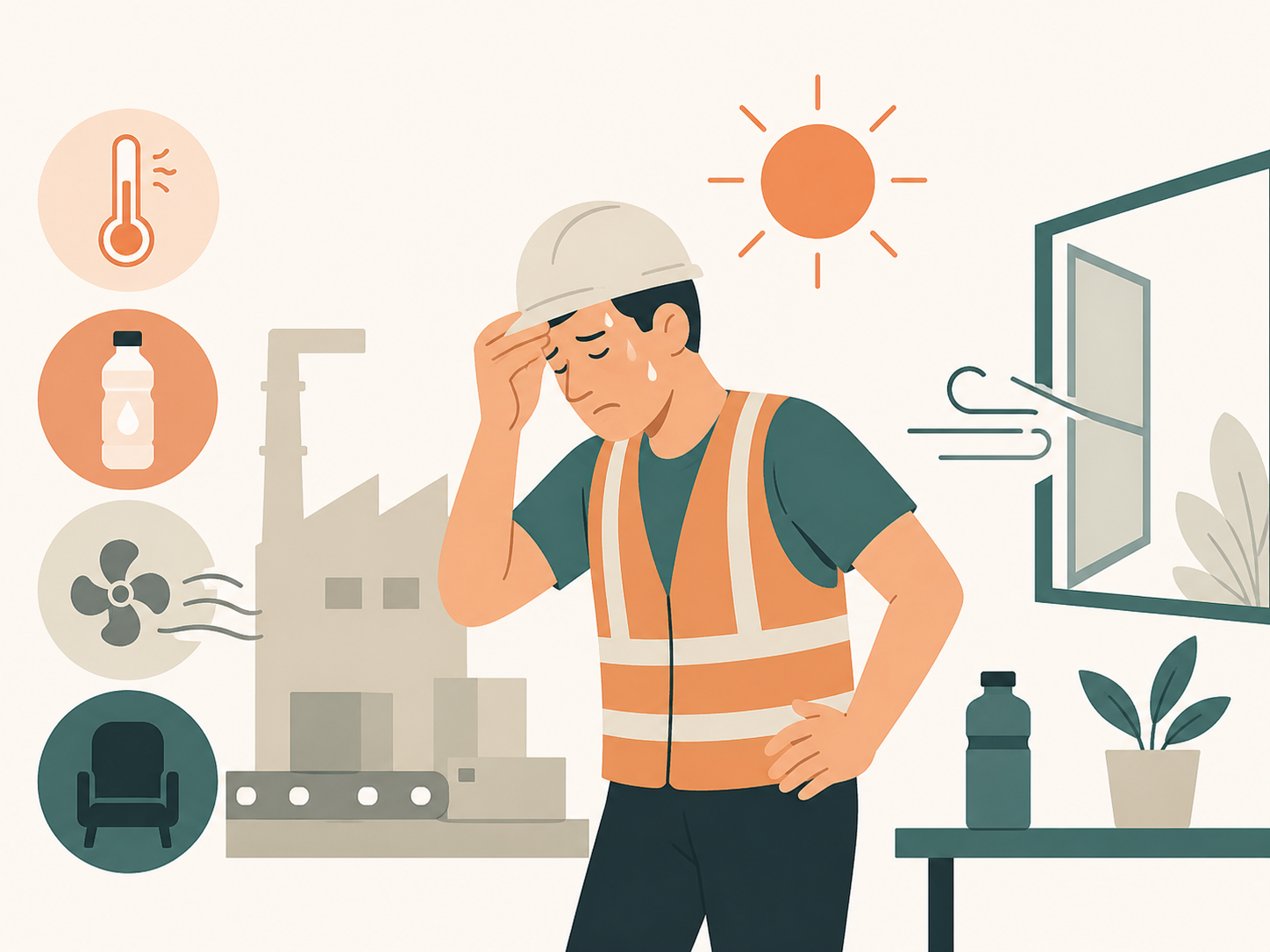
When core body temperature rises, blood flow redirects toward the skin to assist cooling. Less reaches the muscles doing the work. Sweating increases. Without enough fluids, blood volume drops. Fine motor control deteriorates. Reaction time slows. Concentration narrows before the worker notices it happening.
The ergonomics angle here is specific. Heat raises the physical cost of tasks that would otherwise be manageable. A lift sitting just under an acceptable threshold in normal conditions can exceed it when the worker is thermally stressed and their muscles are running short. The task hasn’t changed. The worker’s capacity to perform it safely has.
That gap is where injuries happen.
Which Environments Carry the Highest Heat-Related Risk?
The effects of heat are not the same in every workplace. A person’s level of exposure depends on the environment they are working in, the tasks they are performing, and the physical effort those tasks require.
Industrial and manufacturing settings
Machinery generates radiant heat that air conditioning rarely fully offsets. Workers near high-temperature equipment across a full shift are managing external heat load on top of physically demanding tasks. The combination accumulates faster than either would alone.
Outdoor construction and trades work
Solar radiation adds a heat load that indoor environments don’t replicate. An exposed site in summer means managing direct sun, ambient temperature, and heavy physical demand simultaneously, often without meaningful access to shade or cool space.
Warehouses and distribution centres
Large spaces with poor natural ventilation and workers in continuous movement. Picking and packing roles in particular involve repetitive physical demand through environments that trap heat effectively, shift after shift.
Commercial kitchens
High sustained temperatures, physically demanding postures, repetitive movement, and time pressure. The ergonomic risk assessment picture in a busy kitchen is considerably more serious than the setting suggests.
Healthcare settings with PPE requirements
Protective equipment significantly limits the body’s ability to shed heat. Workers in full PPE are managing thermal stress while simultaneously handling cognitively and physically demanding patient care. That combination doesn’t get enough attention.
What Do Ergonomic Principles Say About Managing Thermal Comfort?
Match the environment to what workers are actually doing. Not a fixed building temperature, not a single policy for all roles. The task determines what the environment needs to provide.
A few things that make a real difference in practice:
Physical demand and ambient temperature need to be matched. Sedentary desk work and heavy manual handling generate very different amounts of body heat. A shared space where some workers are seated and others are doing continuous physical work cannot be managed with one temperature setting. The active group will always be at risk.
Radiant heat is separate from air temperature. The average temperature of a room does not always reflect what individual workers experience. Someone working beside a heat-generating machine may be exposed to considerably warmer conditions. Practical measures such as barriers or workstation relocation can often solve the issue without additional cooling.
Air movement plays an important role in thermal comfort. Even without lowering the temperature, a steady flow of air can help workers feel cooler and recover more effectively from heat. In many environments, directional fans offer a simple and highly effective solution.
Recovery has to be real, not theoretical. A cool rest area that workers can access during breaks, practically not just technically, allows core temperature to drop between high-demand periods. An ergonomic risk assessment that includes thermal exposure evaluates whether current work-rest patterns give adequate recovery relative to the heat load workers are managing.
PPE material is an ergonomic decision. Where protective equipment is required in warm environments, what it’s made of directly affects the body’s ability to shed heat. An ergonomic consultant should be involved in this decision when PPE requirements intersect with high-temperature work conditions.
What Are the Early Signs That Heat Has Become a Risk Rather Than an Inconvenience?
Workers don’t report heat-related strain as heat-related strain. They report what it produces.
Fatigue earlier in the shift. Difficulty concentrating on tasks that aren’t complex. More errors in routine work. Headaches appearing mid-morning. Increased tension across the team. At the individual level, each of these is easy to attribute to something else. When multiple workers in the same environment report the same pattern on the same days, the environment is the common factor.
The value of thermal awareness training lies in recognising problems before they become serious. Early signs of heat stress are usually easy to manage, but once they are missed, the consequences can become far more significant.
How Does Poor Thermal Comfort Make Existing Ergonomic Risk Worse?
Heat doesn’t create ergonomic risk independently. It amplifies what’s already there.
A worker managing lower back load from a poorly adjusted workstation is more vulnerable when thermally stressed. Fatigue degrades movement quality. Degraded movement quality under physical demand is where a significant share of musculoskeletal injuries actually occur, late in a hot shift, when accumulated fatigue has removed the physical margin the worker started with.
Occupational health ergonomics treats thermal comfort as part of the physical work environment for exactly this reason. It isn’t a facilities concern sitting alongside ergonomics. It feeds directly into the risk profile of every task being performed in that space.
An ergonomic risk assessment that evaluates heat alongside postural demand, force, and repetition gives an accurate picture of what workers are actually managing across a shift. For workplaces across Ottawa, Toronto, and Gatineau where summer temperatures push indoor conditions well beyond comfortable, this isn’t a minor consideration. It’s a real one.
Injury Prevention Plus applies ergonomics expertise across office, industrial, vehicle, and field environments throughout Ottawa, Gatineau, Toronto, and surrounding regions. Every assessment is carried out by registered healthcare professionals with over 33 years of experience.
Book an assessment to get a complete picture of what your work environment is asking of your team.
Frequently Asked Questions
Is thermal comfort part of workplace ergonomics?
Yes. Ergonomics covers the full range of physical and environmental conditions affecting how people function at work. Temperature directly impacts physical performance, fatigue, concentration, and injury risk. It’s an ergonomic concern, not just a comfort preference.
What temperature works for most work environments?
It depends on what workers are doing. Sedentary office work sits comfortably between 20 and 26 degrees Celsius. Physically demanding roles generate body heat, so lower ambient temperatures are appropriate. Radiant heat sources and outdoor conditions require separate assessment because they add to total thermal load independently of air temperature.
How does heat increase musculoskeletal injury risk?
Heat raises fatigue and reduces movement quality by diverting blood flow away from working muscles toward the skin. Tasks within safe limits under normal conditions can exceed them when the worker is thermally stressed. The demand hasn’t changed. The capacity to handle it safely has dropped.
What immediate steps reduce heat-related ergonomic risk?
Improve airflow, provide accessible cool rest areas, schedule the heaviest physical tasks during cooler parts of the day, ensure hydration is consistently available, and review whether PPE materials are unnecessarily trapping heat. An ergonomic risk assessment that includes thermal conditions identifies which intervention would have the greatest impact in a specific environment.
When should an ergonomic consultant be brought in for heat-related concerns?
When heat-related fatigue or complaints are recurring, when error rates or injury frequency increases during warmer months, when PPE requirements intersect with high-temperature work, or when a new facility is being designed, thermal comfort can be built in from the start rather than fixed later.