Our registered ergonomists are ready to help. Call us at (613) 730-1074 or book a consultation today.

- Home
- About
- Services
- Office Ergonomic Assessment
- Virtual Ergonomic Assessment
- Webinars, Seminars and Training
- Physical Demands Analysis
- Vehicle Assessments
- Individual industrial Assessments
- Return to work-assessments
- Ergonomic risk assessments
- Corporate Opportunities
- Functional capacity evaluations
- Healthcare Ergonomics Assessments
- Manufacturing Ergonomic Assessment
- Warehouse Ergonomic Assessment
- Blog
- Contact
- FAQs

Ergonomic Principles: Why Neutral Posture Is a Range, Not a Fixed Position
Aug 29
Introduction
Sit up straight. Keep your wrists flat. Don’t hunch. The posture advice most people have heard reduces neutral posture to a single correct position you’re either in or failing to maintain. That framing isn’t just unhelpful. It’s inaccurate, and it sets workers up to feel like they’re doing something wrong when the reality is more nuanced than any single posture instruction cancapture.
Ergonomic principles view neutral posture as a range of positions in which the body can perform a task without placing excessive load on any particular structure. That range varies from person to person and depends on the task and work environment. A seated office worker reviewing a document will have a different neutral position from a warehouse picker retrieving an item from floor level, while an electrician working overhead will have different postural demands again.
This distinction changes how posture should be viewed at work. The question is not simply, “Am I sitting correctly?” but rather, “Is this position sustainable for the demands of the task, and can my body handle what comes next?”
What Do Ergonomic Principles Actually Mean by Neutral Posture?
Neutral posture refers to the range of joint positions in which the body’s muscles, tendons, and passive structures are working within their sustainable capacity. Not at their minimum effort. Not at their maximum. Somewhere in a middle range where load is distributed appropriately, fatigue accumulates slowly, and the risk of cumulative tissue damage stays low.
The key word in that definition is range. A wrist positioned at zero degrees of extension, perfectly flat, is not the only acceptable wrist position. A wrist at five or ten degrees of extension or flexion is also fine for most tasks at most durations. The same wrist held at thirty or forty degrees of extension is not neutral, regardless of how natural it feels to the worker who has been doing it that way for three years.
Ergonomic principles applied to posture assess three things simultaneously. The joint position itself. The duration for which that position is sustained. And the force or load being applied while in that position. A joint angle that is acceptable at low force for a short duration may be unacceptable at moderate force for a full shift. Neutral is not a static snapshot. It’s a relationship between position, load, and time.
The Neck: Where Neutral Is Most Commonly Lost and Least Often Noticed
A typical adult head weighs about four to five kilograms when positioned neutrally, with the cervical spine supporting it. Moving the head forward from that position substantially increases the effective load on the cervical spine. Research consistently shows that at thirty degrees of forward flexion the effective load on the cervical spine is approximately eighteen kilograms. At forty-five degrees it approaches twenty-two.
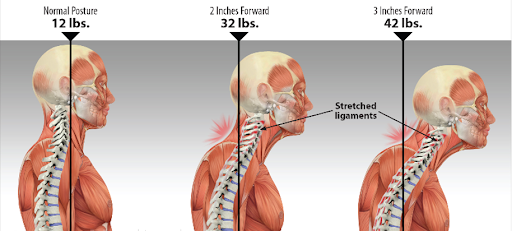
Most workers have no idea their head is in thirty degrees of forward flexion. The lean happens gradually and below the threshold of conscious awareness. A screen slightly too far away. A document positioned below comfortable viewing angle. Messaging on a cellphone positioned below chest level. Each of these drives head position forward without the worker recognising it as a postural deviation because it doesn’t feel like a dramatic movement.
The neutral range for the neck includes small amounts of forward and lateral movement. The body is not designed to hold the head in one fixed position any more than it’s designed to hold any other joint completely still. What it isn’t designed for is sustained forward flexion at meaningful angles, repeated across a full working day, without recovery time between periods of demand.
Ergonomics in the workplace assessment consistently identifies cervical posture as one of the primary drivers of neck and upper back complaints in both office and industrial settings. The fix is a combination of environmental and behavioural habits. However, correcting the environmental factors that can promote these movements helps to improve the behavioural habits. Moving the screen closer. Raising a document on a document holder. Addressing the task layout that requires sustained downward gaze. Telling the worker to hold their head up doesn’t address what’s pulling it forward.
The Shoulders: Neutral Includes More Range Than Most People Realise, and Less Than Most Workstations Allow
The shoulder is the most mobile joint in the body. That mobility is useful in daily life and a significant source of cumulative injury risk at work, because the range of motion the shoulder has access to is considerably larger than the range within which it can sustain prolonged load without consequence.
Neutral shoulder posture in a working context means the upper arm hanging close to the side of the body with the elbow near the trunk. From that position, moderate elevation, reaching, and rotation are all within the range the shoulder can manage without generating unsustainable load. The problem most workplaces create is sustained elevation above that baseline, not dramatic overhead reaching but the chronic slight elevation that happens when a mouse is too far away, a work surface is too high, or a tool requires the arm to be held away from the body to operate effectively.
A shoulder held at fifteen or twenty degrees of abduction, slightly away from the body, for six hours a day across a working week is in a position that generates rotator cuff load far beyond what the same shoulder would carry with the arm hanging at rest. The elevation is too small to register as a problem. The accumulation across weeks and months is what produces the shoulder complaint that eventually requires clinical attention.
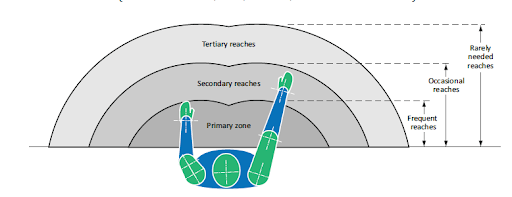
Ergonomic principles for shoulder posture focus on keeping the upper arm close to the body during sustained tasks. For office workers this means mouse and keyboard positioned within the primary reach zone. For industrial workers it means reviewing the height of work surfaces and the positioning of tools and components relative to where the worker is standing. For overhead trades work it means evaluating duration of elevation and building recovery into the task sequence.
The Wrists and Forearms: Small Deviations With Large Cumulative Consequences
Wrist neutral is the position in which the bones and tendons of the forearm are aligned without compression or stretch. Roughly straight, with a small allowance for natural variation. The ergonomic concern with wrist posture isn’t usually dramatic deviation. It’s sustained moderate deviation during high-repetition tasks.
Typing with the wrists extended upward because the keyboard is too high, or in a positive angle with tabs at the back extended. Mousing with the forearm pronated because the mouse is on a surface elevated above elbow height or positioned too far to the right of the keyboard. Using a hand tool that requires the wrist to flex or extend to operate effectively. Each of these produces tendon and nerve loading that is modest in a single instance and significant across hundreds or thousands of repetitions per shift.
The forearms are equally important and less frequently discussed. Sustained pronation, the forearm rotated so the palm faces downward, is the default position for most keyboard and mouse work. The forearm muscles managing sustained pronation fatigue across a working day in ways that show up as the diffuse forearm tension that most office workers describe as “normal” by mid-afternoon. It’s common. It isn’t normal. It’s a load management problem that ergonomic principles address through workstation configuration along with than stretching recommendations.
How Task Demands, Reach Distance, and Duration Shape What Neutral Actually Means
Wrist neutral is the position in which the bones and tendons of the forearm are aligned without compression or stretch. Roughly straight, with a small allowance for natural variation. The ergonomic concern with wrist posture isn’t usually dramatic deviation. It’s sustained moderate deviation during high-repetition tasks.
Typing with the wrists extended upward because the keyboard is too high, or in a positive angle with tabs at the back extended. Mousing with the forearm pronated because the mouse is on a surface elevated above elbow height or positioned too far to the right of the keyboard. Using a hand tool that requires the wrist to flex or extend to operate effectively. Each of these produces tendon and nerve loading that is modest in a single instance and significant across hundreds or thousands of repetitions per shift.
The forearms are equally important and less frequently discussed. Sustained pronation, the forearm rotated so the palm faces downward, is the default position for most keyboard and mouse work. The forearm muscles managing sustained pronation fatigue across a working day in ways that show up as the diffuse forearm tension that most office workers describe as “normal” by mid-afternoon. It’s common. It isn’t normal. It’s a load management problem that ergonomic principles address through workstation configuration along with than stretching recommendations.
A Practical Self-Check for Workers in Any Environment
This isn’t a formal assessment. It’s a way to identify when the body is signalling that something about the current position or task deserves attention.
Are you bracing?
Bracing means holding muscle groups in sustained activation to stabilise a position rather than allowing the body to rest in it. Shoulders held up slightly. Forearms tense or resting on the desk edge during keyboard use. Jaw clenched during concentrated work. Bracing is the body compensating for a position it can’t comfortably sustain. If you notice you’re holding tension in a muscle group that has nothing to do with the task, the position is outside its sustainable range for the current conditions.
Are you reaching rather than moving?
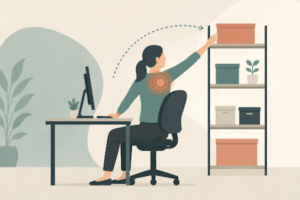
If you’re extending your arm to access something rather than repositioning your body to bring it within easy reach, the task layout is creating unnecessary shoulder and spinal load. The reach itself may be small. If it’s happening dozens or hundreds of times per shift, the cumulative load isn’t.
Has your head moved toward the work?
Lean toward the screen. Look down at the document. Drop the chin to see the component being assembled. These forward movements of the head and neck happen below conscious awareness and are almost always driven by the task layout rather than a postural choice. If you catch yourself closer to the work than you were at the start of the task, the work has come to you rather than you going to it, and the environment is pulling your posture rather than supporting it.
Have you changed position recently?
The body manages sustained posture through a process of continuous small adjustments. When those adjustments stop happening, usually because the task is demanding enough to absorb full attention, static loading builds in the structures holding the position. If you haven’t shifted, repositioned, or changed weight distribution in the last twenty to thirty minutes, the tissues sustaining your current posture have been under static load for longer than ergonomic principles would consider appropriate for most working positions.
Does one side feel different from the other?
Differences in fatigue or discomfort between the two sides, such as greater shoulder tension on one side or more fatigue in the dominant forearm, may point to uneven loading created by the task layout. It is useful to note where the difference appears, when it begins, and which task precedes it.
When a Self-Check Isn't Enough
Awareness of posture is useful, but it does not address the workstation or task behind the problem. When the work environment repeatedly places the body outside its sustainable range, no amount of attention to posture can prevent the resulting load from accumulating over time.
This is where a formal ergonomic risk assessment produces outcomes that self-monitoring cannot. An assessor observing a worker performing their actual tasks identifies the environmental conditions producing postural deviation, quantifies the exposure level against validated thresholds, and produces specific recommendations that address the source rather than the symptom.
For workers across Ottawa, Toronto, Gatineau, and surrounding regions whose posture self-checks consistently produce the same findings, and whose environment hasn’t changed to address them, that’s the signal that the environment needs a formal evaluation.
Injury Prevention Plus conducts ergonomic assessments across office, industrial, healthcare, vehicle, and field environments throughout Ottawa, Gatineau, Toronto, and surrounding regions. Every assessment is carried out by registered healthcare professionals with over 33 years of applied experience.
Book an assessment to identify what your working environment is asking of your body and what it would take to bring that within a sustainable range.
Frequently Asked Questions
What do ergonomic principles mean by neutral posture?
Ergonomic principles define neutral posture as a range of joint positions in which the body can work without generating excessive load on muscles, tendons, or passive structures. It’s not one fixed position. It’s a range that varies depending on the task being performed, the force applied, and the duration of exposure. A joint position that is neutral for a brief low-force task may fall outside the acceptable range for a sustained high-repetition task performing the same motion.
Why does reach distance affect whether a posture is neutral?
Reach distance changes joint angles and the mechanical advantage through which load acts on the shoulder and spine. A position that is comfortable and sustainable at close reach becomes progressively more demanding as the reach extends, because the extended arm creates a longer moment arm through which gravity and task load act on the shoulder joint. Ergonomic assessment of reach distance is often the highest-impact single variable in evaluating whether a sustained working posture falls within an acceptable range.
How do ergonomic principles apply differently in industrial settings compared to office environments?
In office environments, ergonomic principles focus primarily on static posture, sustained seated positions, reach distance to input devices, and screen height and distance. In industrial settings the same principles apply to dynamic tasks involving lifting, carrying, overhead work, and tool use, where the range of acceptable posture is shaped by load weight, movement frequency, and the physical conditions of the work environment. The underlying framework is the same. The specific applications and the validated tools used to assess them are different.
What does bracing indicate about posture and working position?
Bracing, the sustained activation of muscle groups not directly involved in the task, indicates that the body is compensating for a position it cannot comfortably sustain passively. It is one of the earliest physical signals that a working posture has moved outside its sustainable range for the current task conditions. Shoulders held up slightly, forearms tense during low-force tasks, and jaw clenching during concentrated work are all common bracing patterns that appear before discomfort becomes obvious enough to register consciously.
When should a worker seek a formal ergonomic risk assessment rather than relying on self-monitoring?
When self-monitoring consistently identifies the same postural problems and the working environment hasn’t changed to address them. When discomfort follows a consistent workday pattern that correlates with specific tasks or positions. When multiple colleagues in the same role report similar patterns. And when returning from a musculoskeletal injury to a role whose physical demands haven’t been formally evaluated. Self-monitoring identifies that something is wrong. An ergonomic risk assessment identifies what in the environment is producing it and what specific changes would reduce the load.