Our registered ergonomists are ready to help. Call us at (613) 730-1074 or book a consultation today.
The Most Dangerous Task on Your Production Floor: How a Manufacturing Ergonomic Assessment Finds It
Nov 07
Introduction
Ask a crew which job is the worst and they’ll point to the lifting station without a second thought. Big parts, loud machine, everybody’s got a story about it.
Ask a different way. Who’s rubbing their wrists at break and never saying so? Usually it’s someone on a bench nobody gives a second look. Light parts, steady pace, looks like an easy shift from the walkway.
That quiet bench is often where people get hurt. Below is why it goes unnoticed, how you can spot it yourself, and where a manufacturing ergonomic assessment comes in.
Why does nobody speak up?
Mostly because it doesn’t feel like an injury. It feels like Tuesday.
Every repetition is light, so there’s no moment you could point to. A sore forearm gets put down to age, a bad night or a weekend of yard work. Some people don’t want to be shifted onto a worse job. Others raised it once, saw nothing change, and decided it wasn’t worth another go.
Then there are the experienced operators. They’ve worked out little tricks that make a hard task look smooth, so a supervisor walking by sees nothing wrong. The body is still carrying the load. It’s just carrying it quietly.
Often it’s been going on for months before anyone hears about it.
Where does the hidden strain sit?
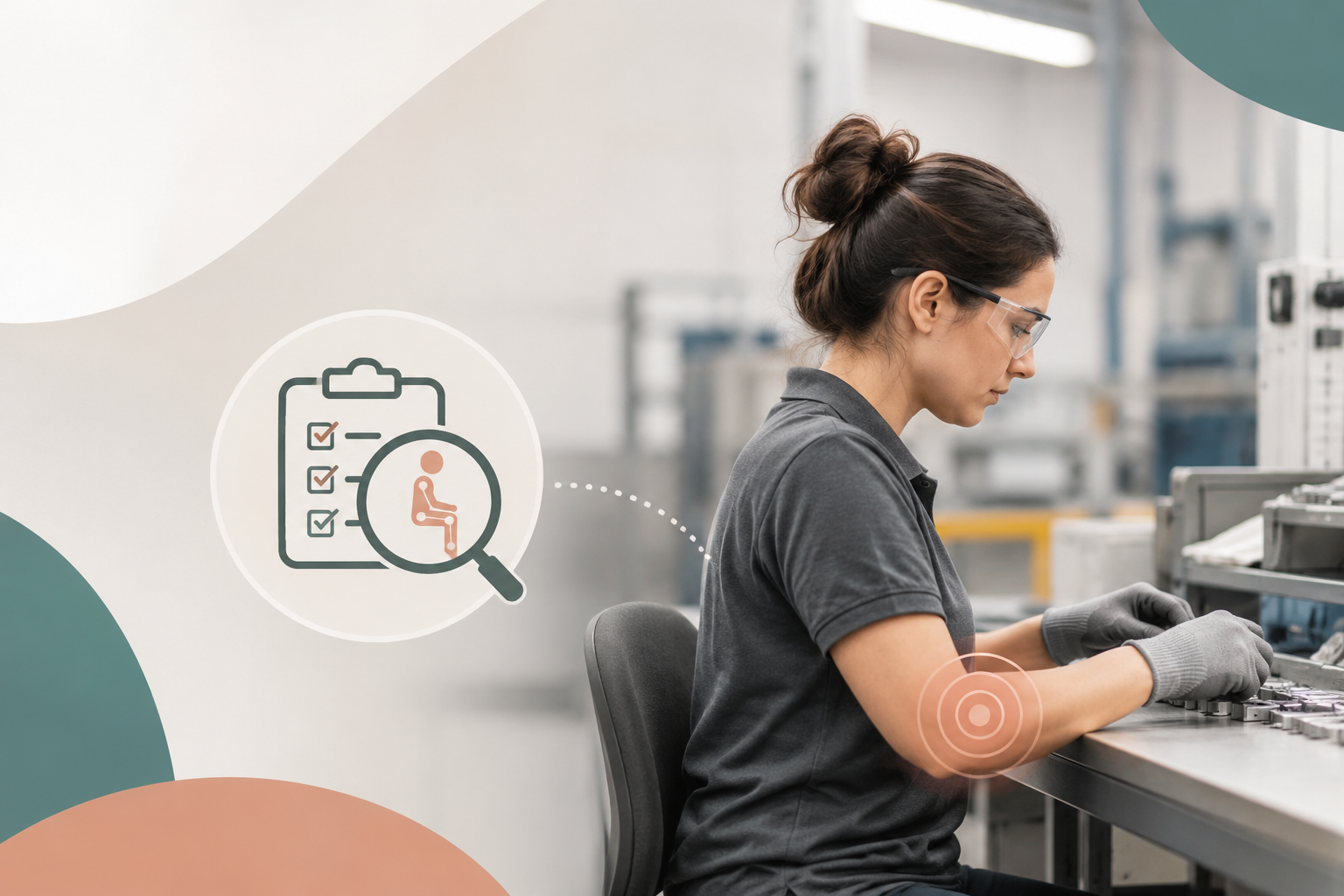
In the light, steady, repetitive work. It never feels heavy, so it never gets flagged. But do the same small movement thousands of times and it adds up fast.
A few usual suspects:
- Loading and unloading small parts. A short reach and a slight wrist bend, every cycle, all shift.
- Inspection and sorting at a fixed bench. Neck bent and shoulders slightly raised for hours.
- Packing and labelling. One hand and arm movement, repeated at line speed.
- Hand tools and fastening. Grip force and vibration building up without anyone noticing.
- Pushing carts. Worn wheels or a rough floor can double the effort.
Nobody’s handing out a toughest-job trophy to any of these. They still wear people down.
Why does a quiet task end up risky?
Because small things stack. Some repetition, awkward posture, physical effort, limited task variety and insufficient rest between cycles. Each factor may seem minor on its own. Together, they load the same tissue for a whole shift.
Here’s an example. An operator loads a machine with one part every three minutes. Sounds relaxed. Over eight hours, that’s more than 150 placements, each with the same short reach, the same wrist angle, the same forearm resting on the same guard edge. A walk-through sees a calm person doing a simple job. A manufacturing ergonomic assessment sees 150 identical loads landing on one shoulder and one wrist.
Contact stress and vibration make it worse. So does sameness. If every cycle is a copy of the last one, nothing ever gets a break.
Can you spot it before somebody gets hurt?
Yes, if you watch the work and not just the complaint log. Next time you’re on the floor, look for:
- People shaking out their hands or rubbing a shoulder at break
- Anyone leaning, twisting or propping an arm just to reach
- Home-made fixes, such as a folded towel on a bench edge or a stool dragged over to stand on
- Jobs that people ask to move off, or that only a few can stand for long
- Pace dropping or mistakes creeping in late in the shift
Your records help too. A string of small first-aid visits from one station, or the same body part appearing in several reports, usually means that task needs a proper look.
What does a proper assessment find that watching can’t?
It puts numbers on it. The task gets measured against known limits for posture, force, repetition and recovery across the whole shift. Some jobs turn out riskier than they look. Others turn out safer than people feared.
During a manufacturing ergonomic assessment, the assessor observes workers performing their usual tasks and discusses their work with them. They measure reach distances, work heights, physical forces and repetition. They use RULA, REBA, the LiFFT method and Liberty Mutual equations to evaluate risks. Work schedules, breaks and task rotation are also considered.
The ergonomic analysis behind the findings shows what is really driving the load. That’s why the recommendations come out specific and not generic. It’s also how you discover that the loud, heavy station is fine, and the quiet bench is the problem.
For a detailed review of one role, an industrial ergonomic assessment can focus on the worker and their daily tasks. A physical demands analysis outlines the physical requirements of a job and helps employers with hiring, job matching and return-to-work planning. Our manufacturing ergonomics services help production sites understand these requirements.
What usually changes afterwards?
Mostly small, practical things:
- Parts and staging moved closer, so the reach is shorter
- A loading point raised or lowered
- A fixture or jig so the hand isn’t held at an awkward angle
- A guard edge padded or reshaped where it presses on the forearm
- Tasks paired in a rotation, so different body parts get a rest
- Worn carts, wheels and tools replaced
These changes may not affect production speed, although this depends on the task. A detailed report ranks the recommendations so you can identify which improvements need attention first.
When is the right time to book an ergonomic assessment?
Whenever a job is highly repetitive. When injury or absence records keep pointing to the same area. When new equipment or higher output targets are on the way. Or when someone is coming back from an injury to a task that’s never been measured.
Waiting for complaints is the slow route, because the people at the quietest stations may never make one. An ergonomic risk assessment before the pattern appears in your records costs less than sorting it out afterwards. A round of ergonomic risk assessments across a few key stations will usually tell you more than another lap of safety walk-throughs.
Injury Prevention Plus offers ergonomic assessment services across manufacturing, warehouse, industrial, office, healthcare and field settings in Ottawa, Gatineau, Toronto and surrounding areas. Our assessments are carried out by registered healthcare professionals with more than 33 years of experience.
Book an assessment to find out which task on your floor deserves a closer look.
Frequently Asked Questions
Why do workers not report pain from repetitive tasks?
Each movement feels light, so the discomfort seems minor and easy to explain away. Some worry about being moved to a harder job or looking unable to cope. Others have complained before and seen no change. The result is that strain can build for months before anyone says a word.
What is a manufacturing ergonomic assessment?
It is an on-site review of how production tasks load the body. A registered assessor observes the work at normal pace, measures posture, force and repetition, and scores the risk using recognised tools. The report ranks what needs attention and recommends specific changes.
How is an industrial ergonomic assessment different from a safety walk-through?
A safety walk-through looks for visible hazards such as spills, guarding and blocked exits. An industrial ergonomic assessment measures how a task loads muscles and joints over a whole shift. It can find risks in jobs that look calm and well run.
What does a physical demands analysis add to an ergonomic risk assessment?
A physical demands analysis records exactly what a job requires, such as lifting, reaching, standing and repetition. It gives a clear picture of the role for hiring, job matching and return-to-work decisions. An ergonomic risk assessment then shows which of those demands carry the most risk.
Will an assessment slow down production?
Usually not. The assessor observes people working at their normal pace and speaks with them briefly. There is no need to stop the line, though some short measurements may be taken at the workstation. Your site contact and the assessor can agree the timing beforehand.